


Shakers and mixers: thermo shakers, orbital shakers and vortex mixers for sample preparation
A shaker or mixer sits at the start of almost every protocol — from gentle rocking of blots and gels to high-speed vortexing of microtubes, with or without temperature control. COLO.Science covers the full range: dry-block thermo shakers for microtubes, microplate thermostatic shakers, models with heating and cooling, shaker incubators, orbital and rocking shakers, vortex mixers, rotators and roller mixers. This category helps you select by sample format, required temperature, speed range and capacity.
- Lab equipment — general laboratory instruments and systems
- Sample preparation — mixing, homogenisation, concentration
- Microtube and dry-block thermo shakers — 0.2–2.0 ml tubes, 15/50 ml tubes
- Microplate thermostatic shakers — 96- and 384-well, deep-well
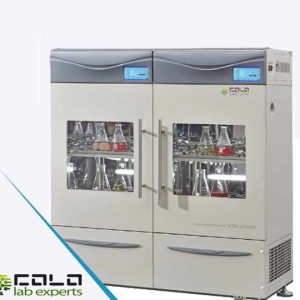
- Shaker incubators — microbiology, cell culture, fermentation
- Orbital shakers — flasks, bottles, platforms
- Rocker shakers — blots, gels, staining
- Vortex mixers and rotators — single tubes, roller mixers
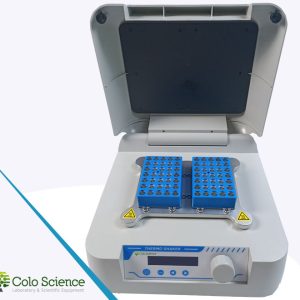
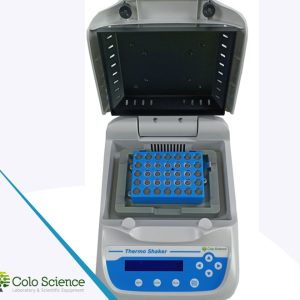
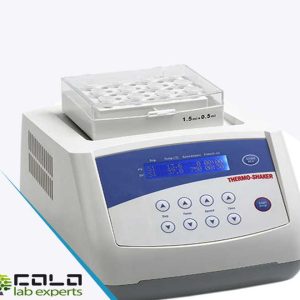
- Thermo shaker for microtubes — an interchangeable dry block heats, cools and mixes in one instrument; blocks for 0.2 ml PCR strips, 0.5/1.5/2.0 ml microtubes and 15 or 50 ml tubes, RT+5 °C to 100 °C, up to 1500 rpm.
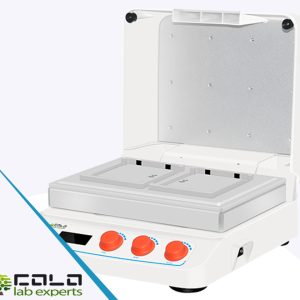
- Microplate thermostatic shaker — the plate is held at a set temperature and mixed with a small orbit — the condition for reproducible ELISA protocols, enzymatic reactions and screening.
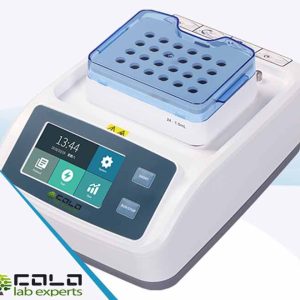
- Shakers with heating and cooling — Peltier cooling below room temperature, so one instrument covers both incubation at 37 °C and holding at 4 °C.
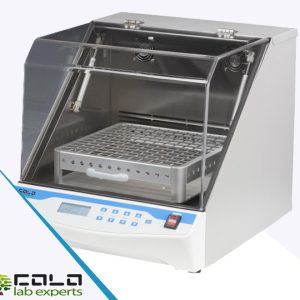
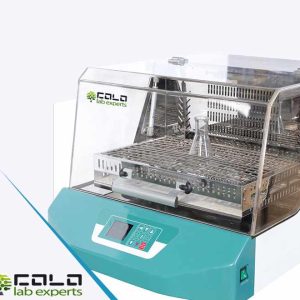
- Shaker incubators — precise temperature control with orbital shaking; benchtop and floor-standing models with clamps for Erlenmeyer flasks.
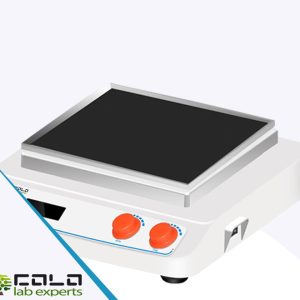
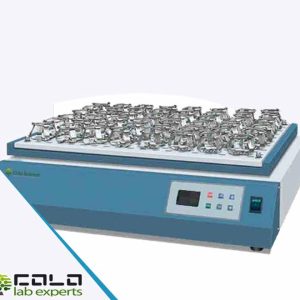
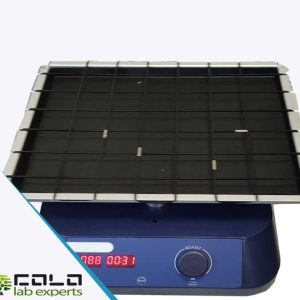
- Orbital and linear shakers — ambient operation, selected by speed range, orbit in millimetres and platform load capacity.
- Rocker shakers, rotators and roller mixers — shallow-angle rocking for blots and gels, end-over-end rotation for extraction, roller mixers for blood tubes.
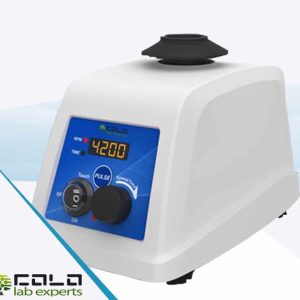
- Vortex mixers — the fastest way to bring a single tube, microtube or vial to full homogeneity; touch or continuous mode, with adapters for several tubes or a microplate.
The thermo shaker is the most requested instrument in this group because it replaces three things on the bench: a dry block, a water bath and a shaker. The block is chosen by sample format, temperature and speed are set independently, so the same unit runs incubation, lysis, denaturation and pellet resuspension.
If the protocol calls for sub-ambient temperature — enzymes, unstable samples, reactions held at 4 °C — choose a model with heating and cooling. For ELISA and screening, the block is replaced by a carrier for microplates with 96 or 384 wells.
Shakers & Mixers Categories

Shakers & Mixers
Showing 1–24 of 30 results
-
-
-
Microplate thermostatic shakers
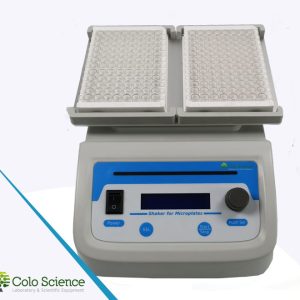
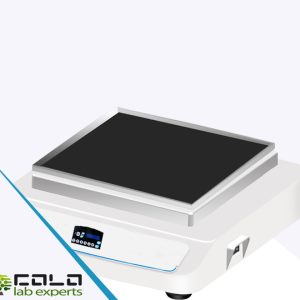
MTP200 Thermo Shaker for Microplates
MTP200 thermo shaker for microplates — RT+5 °C to 80 °C, ≤ ±0.5 °C, 200–1600 rpm, 3 mm orbit. Two plate positions shaken together, timer to 99 h 59 min, for 96-well and 384-well ELISA microplates and 96-well tissue culture plates.
SKU: PRO4503 -
-
-
-
-
Shakers & Mixers, Vortex mixers and rotators
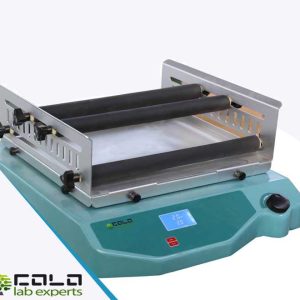
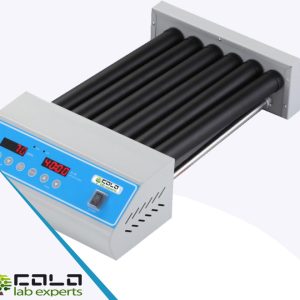
ROMIX70 Blood Roller Mixer
ROMIX70 blood roller mixer, 6 rollers of 280 mm, 20–99 rpm, combined rolling and swinging action with 25 mm amplitude. Programmable forward/reverse, timer 1 min – 99 h 59 min or continuous, maximum load 4 kg. Independent LED displays for speed and time, maintenance-free brushless DC motor, AC 100–240 V.
SKU: PRO4582