

'/%3E%3C/svg%3E)


Sample Separation Equipment
Sample separation is an essential part of laboratory sample preparation, especially when complex materials must be divided into clearer, measurable fractions before analysis. In routine QC, R&D, clinical, microbiology, food, environmental and industrial laboratories, sample separation equipment helps prepare liquids, suspensions, emulsions, biological materials and mixed matrices for reliable downstream testing.
Sample separation is commonly used before analytical measurement, microscopy, spectroscopy, chromatography, microbiological evaluation or general laboratory processing. Depending on the sample type and workflow, separation may be based on centrifugal force, density difference, sedimentation, filtration, phase separation or selective removal of interfering components.
At COLO.Science, this category is structured as a practical navigation hub for instruments used in physical and mechanical separation workflows. The first active instrument group is laboratory centrifuges, including mini centrifuges, microcentrifuges, clinical centrifuges, high-speed centrifuges and refrigerated centrifuges. Additional sample separation equipment groups can be added later as the sample preparation programme expands.
Selecting the right sample separation equipment requires evaluation of sample volume, tube format, rotor type, maximum speed, relative centrifugal force, temperature control, safety features and compatibility with routine laboratory protocols. For centrifugation workflows, the relationship between RPM, RCF, rotor geometry and tube capacity is especially important for obtaining reproducible separation results.
CATEGORY STRUCTURE (NAVIGATION HUB)
- Lab Equipment
– general laboratory instruments and equipment for routine, QC and R&D workflows.- Sample Preparation
– equipment used before measurement, testing or analytical evaluation.- Sample Separation
- Laboratory Centrifuges
- Filtration and solid-liquid separation equipment (future group)
- Phase separation and sample clean-up systems (future group)
- Density-based separation instruments (future group)
- Sample Separation
- Sample Preparation
SAMPLE SEPARATION INSTRUMENT GROUPS
- Laboratory centrifuges – instruments for separating liquid samples, suspensions, blood components, cells, precipitates and other materials by centrifugal force.
- Mini centrifuges and microcentrifuges – compact systems for small tubes, microtubes and routine preparation steps in molecular biology, microbiology and clinical workflows.
- Clinical and benchtop centrifuges – general-purpose systems for blood, serum, plasma, urine, culture tubes and routine sample processing in laboratories with moderate throughput.
- Refrigerated centrifuges – centrifugation systems with temperature control for heat-sensitive samples, biological materials, enzymes, proteins and temperature-critical preparation steps.
- Future separation groups – filtration, solid-liquid separation, phase separation and other preparation technologies can be added later under the same sample separation structure.
FEATURED: LABORATORY CENTRIFUGES
Laboratory centrifuges are the core instrument group within the current sample separation category. They support reproducible separation of components in tubes, microtubes, bottles and other laboratory vessels. Important selection parameters include maximum RPM, RCF, rotor type, sample capacity, tube compatibility, lid safety, timer control, noise level and temperature regulation for refrigerated models.
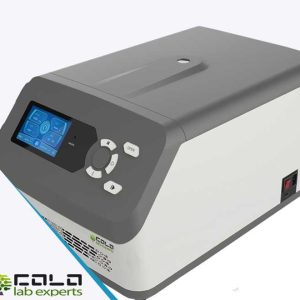
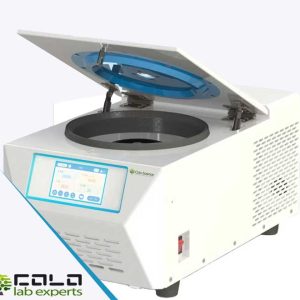
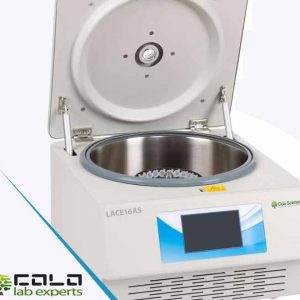
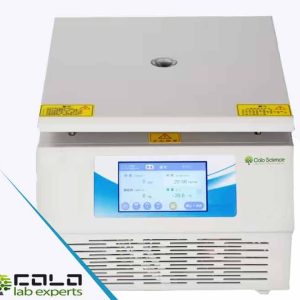
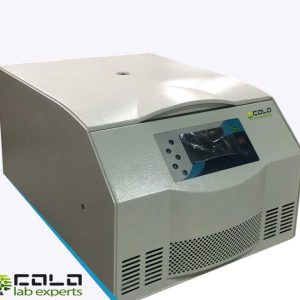
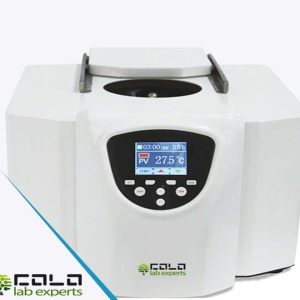
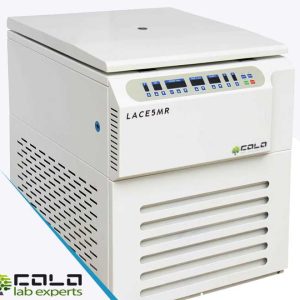
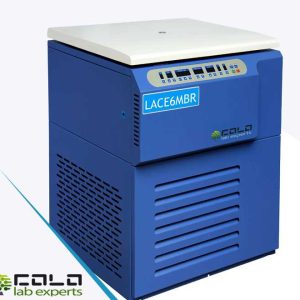
The COLO laboratory centrifuge range includes compact mini centrifuges, microcentrifuges, clinical centrifuges, high-speed centrifuges, large-capacity benchtop systems and refrigerated centrifuges for temperature-sensitive applications.
Sample Separation Categories
Sample Separation
Showing 1–24 of 36 results
-
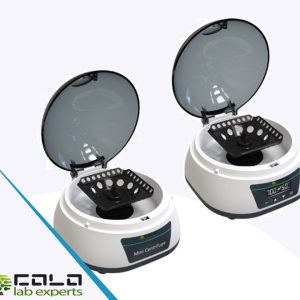
Mini centrifuges
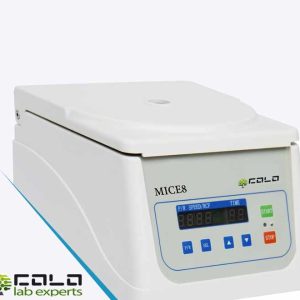
MICE8 Mini Table Top Centrifuge 4000 rpm with Rotor 8X15 ml
COLO.Science · Mini Laboratory Centrifuge
MICE8 is a compact mini centrifuge for blood, urine and routine sample prep with 4000 rpm, 2800 ×g and 8 × 15 mL rotor.
Key specs: 4000 rpm · 2800 ×g · 8 × 15 mL · 0–99 min timer · LED display · brushless motor · <45 dBA · SKU PRO5044
SKU: PRO6856 -
Clinical / blood centrifuges, Mini centrifuges
MICE12 Portable Mini Centrifuge 4000 rpm 12 x 10ml
-20%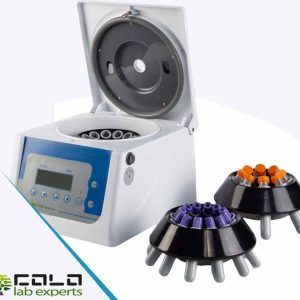 Clinical / blood centrifuges, Mini centrifuges
MICE12 Portable Mini Centrifuge 4000 rpm 12 x 10ml
MICE12 portable mini centrifuge — 4000 rpm, standard 12 × 10 ml fixed-angle rotor, optional 8 × 15 ml rotor, backlit LCD display, DC brushless motor, electromagnetic lid lock and compact 7.5 kg benchtop design.
SKU: PRO6855 -
Clinical / blood centrifuges
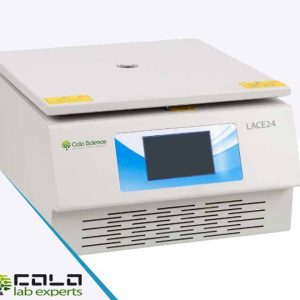
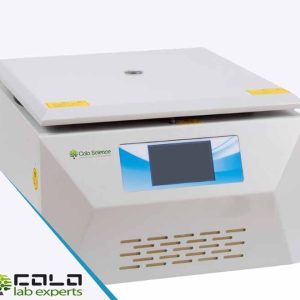
LACE24 Benchtop Laboratory Centrifuge — 4000 rpm
LACE24 benchtop laboratory centrifuge — 4000 rpm, up to 2250 × g, LCD touch-screen control, 99 stored programs and 10 acceleration / deceleration levels. Centrifuge unit supplied with rotor selected separately: PRO6994 24 × 10 ml or PRO6993 6 × 50 ml.
SKU: PRO6857 -
Clinical / blood centrifuges
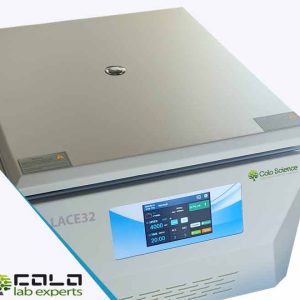
LACE32 6000rpm Table Top Centrifuge
LACE32 universal laboratory centrifuge for routine sample preparation — up to 6000 rpm, 6321 × g, maximum capacity 4 × 250 ml, 9 swing-out, fixed-angle and microplate rotor configurations, 10 acceleration/deceleration levels and a 5-inch touch screen.
SKU: PRO6925 -
Clinical / blood centrifuges
LACE56N High Capacity High Speed Centrifuge 6000 rpm, 6321 × g
LACE56N high capacity high speed centrifuge for large-volume laboratory separation — 6000 rpm, 6321 × g, capacity up to 4 × 750 ml, 5-inch touch screen, automatic rotor identification and 11 configurable rotor families.
SKU: PRO6932 -
Clinical / blood centrifuges, Refrigerated Centrifuges
LACE56R High Capacity Refrigerated Centrifuge 6000 rpm, 6321 × g
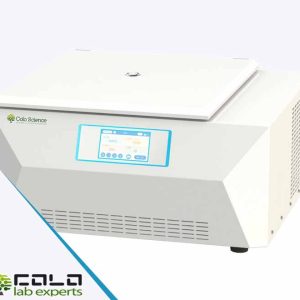 Clinical / blood centrifuges, Refrigerated Centrifuges
LACE56R High Capacity Refrigerated Centrifuge 6000 rpm, 6321 × g
LACE56R high capacity refrigerated centrifuge — 6000 rpm, 6321 × g, capacity up to 4 × 750 ml, -20 °C to +40 °C temperature range, ±1 °C precision, cooling to 4 °C in 8 minutes and 11 configurable rotor families.
SKU: PRO6992 -
Microcentrifuges, Refrigerated Centrifuges
LACE-LION Refrigerated Microcentrifuge 15000rpm/21400xg
LACE-LION refrigerated microcentrifuge for clinical, medical, biochemistry and molecular laboratory workflows.
15,100 rpm / 21,400 × g · -20 °C to 40 °C · 24 × 1.5 / 2 ml included rotor · LCD soft touch · rotor ID · IVD compliant.
SKU: PRO3905 -
Microcentrifuges, Refrigerated Centrifuges
RITACUBA16R High-Speed Refrigerated Centrifuge
RITACUBA16R high-speed refrigerated centrifuge for PCR, molecular biology and routine sample preparation.
16,500 rpm / 24,148 × g · max. 6 × 50 ml · 8 fixed-angle rotors · 5-inch touch screen · 99 programs · rotor auto-ID.
SKU: PRO6933 -
Microcentrifuges, Refrigerated Centrifuges
LACE16AR refrigerated high-speed centrifuge with NCP composite rotors 16,500 rpm, 24,148 × g
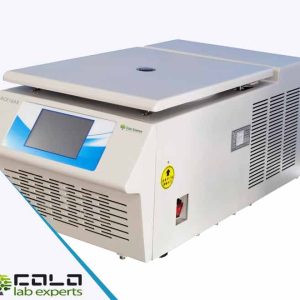 Microcentrifuges, Refrigerated Centrifuges
LACE16AR refrigerated high-speed centrifuge with NCP composite rotors 16,500 rpm, 24,148 × g
LACE16AR refrigerated high-speed centrifuge for molecular biology and temperature-sensitive samples — 16,500 rpm, 24,148 × g, -20 °C to +40 °C, capacity up to 18 × 5 ml, 4 NCP rotors, nano-ceramic chamber and 5-inch touch screen.
SKU: PRO7067 -
Microcentrifuges, Refrigerated Centrifuges
RITACUBA18R – High Speed Laboratory Refrigerated Centrifuge 18500rpm
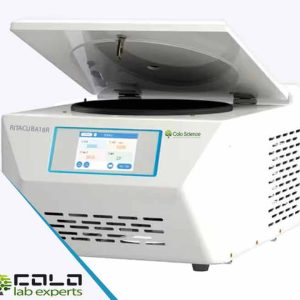 Microcentrifuges, Refrigerated Centrifuges
RITACUBA18R – High Speed Laboratory Refrigerated Centrifuge 18500rpm
RITACUBA18R high-speed refrigerated centrifuge — up to 18,500 rpm, 27,100 × g and 6 × 100 ml, with a −20 to +40 °C temperature range, rapid cooling to 4 °C, 5-inch HD touchscreen, automatic rotor recognition and a broad multi-rotor configuration range.
SKU: PRO7071 -
Microcentrifuges, Refrigerated Centrifuges
RITACUBA20R refrigerated centrifuge for high- and low-speed laboratory workflows
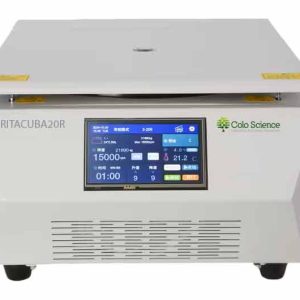 Microcentrifuges, Refrigerated Centrifuges
RITACUBA20R refrigerated centrifuge for high- and low-speed laboratory workflows
RITACUBA20R refrigerated centrifuge — up to 20,000 rpm, 29,060 × g and 4 × 250 ml, with −20 to +40 °C temperature control, 99 custom programs and flexible angle and swing-out rotor configurations.
SKU: PRO7073 -
-
-
Microcentrifuges
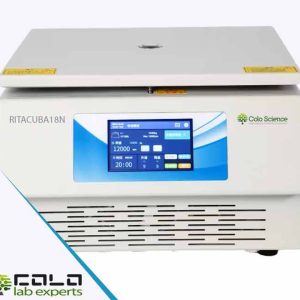
RITACUBA18N high-speed laboratory centrifuge 18,500 rpm
RITACUBA18N high-speed laboratory centrifuge — up to 18,500 rpm, 27,100 × g and 6 × 100 ml; ambient operation, 5-inch HD touchscreen, automatic rotor recognition, 99 programs and a broad rotor range for microtubes, plates and larger vessels.
SKU: PRO7070 -
Microcentrifuges, Refrigerated Centrifuges
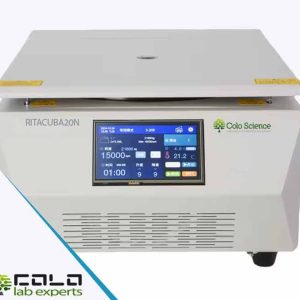
RITACUBA20N high-speed centrifuge 20,000 rpm
RITACUBA20N high-speed centrifuge — up to 20,000 rpm, 29,060 × g and 4 × 250 ml; non-refrigerated operation, 5-inch HD touchscreen, automatic rotor recognition, up to 999 custom programs and a broad rotor range for high-speed microtube and higher-capacity workflows.
SKU: PRO7072