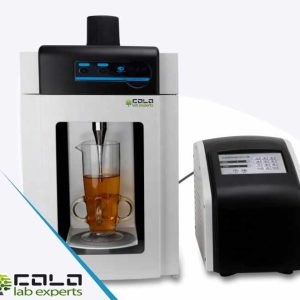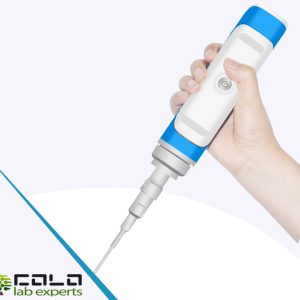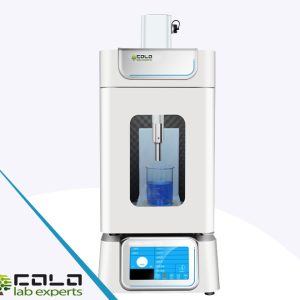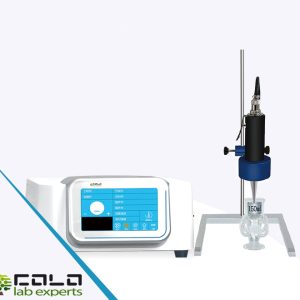
Ultrasonic homogenizers are high-intensity instruments used across biological, chemical and industrial laboratories for rapid cavitation-based sample processing. These devices can be configured as handheld units for maximum flexibility, mounted on a stand/holder for repeatability, or operated inside an acoustic protection enclosure (sound-proof box) to shield operators from ultrasonic noise, maintain temperature stability and improve lab comfort.
From micro-volume probe sonication to larger batch workflows, ultrasonic homogenizers enable fast dispersion, emulsification, deagglomeration and cell lysis. Correct configuration—matching instrument power, probe diameter, immersion depth and operation mode (continuous vs. pulsed mode)—ensures reproducible energy delivery while protecting sensitive, heat-labile samples.
ULTRASONIC HOMOGENIZER CONFIGURATIONS
- All homogenizers – mechanical, rotor-stator and ultrasonic solutions for sample preparation.
- Handheld sonicators – direct manual processing, ideal for flexible vessels and quick cavitation tasks.
- Stand-mounted sonicators – stable probe positioning for routine, validated and reproducible lab protocols.
- Acoustic enclosures – protective box for noise reduction, temperature and workflow stability.
SELECTION & TECHNICAL GUIDANCE
- Handheld – choose when flexibility is more important than strict repeatability.
- With stand / holder – recommended for routine work and reproducibility: stable probe position and consistent immersion depth.
- Acoustic enclosure (sound-proof box) – reduces ultrasonic noise exposure and improves operator comfort, especially in open and teaching laboratories.
- Temperature control – cavitation generates heat; for sensitive samples use pulsed mode, an ice bath, or a jacketed vessel/recirculating chiller.
- Power vs. amplitude – Amplitude sets cavitation intensity at the probe tip. Match probe diameter and power range to sample volume for efficient processing.
- Foaming and shear effects – Oversized probes or long continuous режим can cause foaming; mitigate using pulse режим and appropriate immersion depth.
Typical laboratory and industrial applications include nanoparticle dispersions, stable emulsions, protein extraction, homogenization of suspensions, and microbiological sample lysis. For heat-sensitive matrices, pair pulsed sonication with cooling and select probe size to avoid over-processing.
Ultrasonic Homogenizer
Showing all 5 results