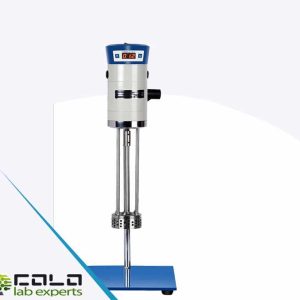


Dispersing homogenizers | COLO.Science are high-speed rotor–stator instruments designed for fast, controlled dispersion, emulsification and homogenization of liquids and semi-liquids. They are widely used in chemistry, cosmetics, food R&D, microbiology and industrial QC when you need reproducible particle size reduction, stable emulsions and consistent mixing energy across batches.
Dispersing homogenizers work by a rotating rotor inside a stator head that generates intense shear, turbulence and pumping action. By selecting the right speed range (RPM), dispersing tool and head diameter, you can optimize processing for low-viscosity solutions, viscous creams, suspensions, or pre-dispersed powders—without over-heating or introducing excess air.
TYPICAL DISPERSING HOMOGENIZER TYPES
- Handheld dispersing homogenizers – flexible, quick processing for beakers and variable vessels.
- Stand-mounted dispersing homogenizers – stable positioning for repeatable, validated lab protocols.
- High-speed rotor–stator units – broader RPM ranges for fast emulsification and fine dispersions.
- Industrial-style lab homogenizers – stronger drive systems for viscous matrices and longer runs.
SELECTION & TECHNICAL GUIDANCE
- Speed range (RPM) – higher RPM increases shear and dispersion fineness; choose according to viscosity and target droplet/particle size.
- Rotor–stator tools – fine, medium and coarse heads control pumping, shear and flow; match tool geometry to your sample and batch size.
- Tool diameter – smaller heads suit micro-volumes; larger heads improve throughput for larger batches.
- Viscosity and load – viscous samples require stronger drive torque; consider stand-mounted units for stability and safety.
- Temperature management – high shear can heat samples; use short cycles, pulse processing and external cooling for heat-sensitive formulations.
- Air entrainment – reduce foaming by correct immersion depth, gradual powder addition and appropriate tool choice.
Typical applications include emulsions (oil/water), dispersions of powders and pigments, suspension homogenization, cosmetic creams, food formulations and general laboratory mixing where repeatability matters. For scale-up, prioritize stable positioning, consistent tool geometry and documented RPM/time parameters to ensure comparable results between batches.
Dispersing Homogenizer
Showing all 3 results