COLO.SCIENCE / FREEZE DRYERS
Laboratory freeze dryers for heat-sensitive product
Vacuum freeze drying removes water from a frozen sample by sublimation: the ice passes straight to vapour without melting, so the product never sees a liquid phase and never sees process heat. Protein structure, enzyme activity and cell viability survive the drying step. Select a laboratory freeze dryer around what the product sits in during the run, and around how much water the batch has to give up.
FEATURED SERIES / LYOPHIL800
Four models on one platform
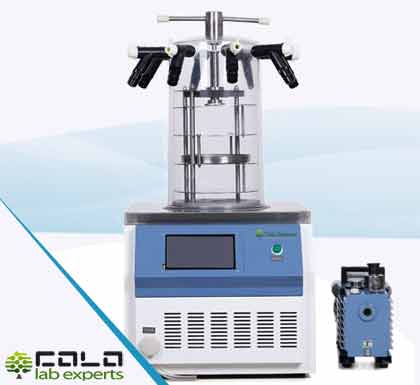
Cold trap to −56 °C, ultimate vacuum 5 Pa and 3 kg of water captured per batch — identical across all four models of this laboratory freeze dryer platform. What separates them is the sample interface: plain shelves, a top press for vial stoppering, an eight-port manifold, or both. The external rotary vane vacuum pump ships with every unit, together with its oil, oil filter and hose.
What actually decides the model
The vessel, not the trap temperature. Every laboratory freeze dryer in this category reaches the same cold trap temperature and the same ultimate vacuum. Decide first whether the product dries in open trays, in vials that must be closed before air returns, or in flasks on a manifold — the rest of the specification follows from that.
Batch size and water load. Water capture is stated per batch, not per hour. A 3 kg batch covers most research and pilot work; a laboratory that regularly exceeds it belongs in a larger capacity class rather than in a longer cycle.
Bench space and the pump. A benchtop unit needs roughly 60 × 50 cm of bench plus floor or shelf space for the vacuum pump beside it. Because the pump and its consumables ship with the instrument, there is no separate procurement before the first run.
Let us match a freeze dryer to your batch
Send the product to be dried, the batch size and water content, the vessel you work in and whether stoppering under vacuum is required. We will confirm which laboratory freeze dryer suits the batch, the drying area needed and the approved configuration.