


'/%3E%3C/svg%3E)


COLO.SCIENCE | FREEZE DRYERS
LYOPHIL800 Series — Four Models on One Platform
A benchtop freeze dryer series for laboratories that dry heat-sensitive product: cold trap down to −56 °C, ultimate vacuum 5 Pa and 3 kg of water captured per batch, with tray drying, vial stoppering under vacuum and manifold flask drying available as configurations.
Concentration & Evaporation Catalogue
Technical Specification (PDF)
Request a Quote
How the LYOPHIL800 benchtop freeze dryer works
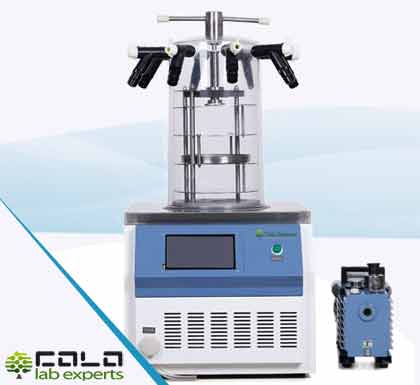
Vacuum freeze drying, or lyophilisation, removes water from a frozen sample by sublimation: the ice passes straight to vapour without melting. Because the product never passes through a liquid phase and never sees process heat, protein structure, enzyme activity and cell viability survive the drying step. That is why serum, vaccines and tissue samples are dried this way rather than in an oven, and why a benchtop freeze dryer is standard equipment wherever biological material is preserved.
The frozen sample is held under vacuum while the cold trap beside it is driven down to −56 °C. Water vapour leaving the sample condenses as ice on the trap wall, which keeps the vapour pressure low enough for sublimation to continue. The LYOPHIL800 trap is a wide-mouth cylinder with no coil inside it, so the ice can be seen, reached and wiped out instead of being chipped from between windings.
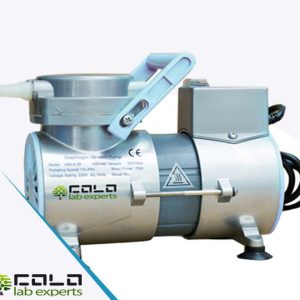
An external rotary vane vacuum pump pulls the system down to 5 Pa and is supplied with every benchtop freeze dryer in the series, together with its oil, oil filter and connecting hose. Nothing else has to be sourced to put the instrument into service.
Key characteristics
- Cold trap ≤ −56 °C and ultimate vacuum ≤ 5 Pa, both stated without load
- Water capture 3 kg per batch; ice chamber Ø250 × 150 mm
- Drying area 0.125 m² on four Ø200 mm shelves, or 0.08 m² on three Ø180 mm shelves
- Shelf spacing 70 mm and adjustable; shelf load 1.5 L or 1 L
- External vacuum pump, oil, oil filter and hose included
Suitable for
- Vials of product that must be stoppered before air re-enters the chamber
- Liquids dried directly in round-bottom flasks on a manifold
- Bulk product spread on trays — extracts, media, reagents
- Research and pilot batches rather than production-scale runs
- Laboratories with bench space of roughly 60 × 50 cm plus room for the pump
Choosing a benchtop freeze dryer is mostly a question of what the product sits in during drying, not of how cold the trap goes. All four LYOPHIL800 models share one refrigeration system, one vacuum performance figure and the same 3 kg per batch water capture; what separates them is whether the chamber carries plain shelves, a pressing plate for closing vial stoppers, a manifold for flasks, or both. Deciding that first makes the rest of the specification fall into place.
Models, configurations and SKU
Four SKUs cover the series. Every benchtop freeze dryer below shares the same cold trap, vacuum system and batch capacity; the model number records which sample interface it was built with.
LYOPHIL800
SKU PRO3394
Tray drying. Four Ø200 mm shelves, 0.125 m², 1.5 L shelf load. The largest drying area and the highest vial count in the series.
LYOPHIL801
SKU PRO3393
Top press. Three Ø180 mm shelves, 0.08 m², 1 L shelf load. A manual gland closes vial stoppers while the chamber is still under vacuum.
LYOPHIL802
SKU PRO3400
Tray drying plus an eight-port manifold. Keeps all four full shelves and adds flask drying for liquids.
LYOPHIL803
SKU PRO3395
Top press plus an eight-port manifold. Both options on one instrument, three Ø180 mm shelves.
Technical specifications
Figures below apply to the benchtop freeze dryer itself. Values marked without load are measured with an empty chamber, as declared by the manufacturer.
| Parameter | LYOPHIL800 | LYOPHIL801 | LYOPHIL802 | LYOPHIL803 |
|---|---|---|---|---|
| SKU | PRO3394 | PRO3393 | PRO3400 | PRO3395 |
| Configuration | Tray drying | Top press | Tray + manifold | Top press + manifold |
| Drying area | 0.125 m² | 0.08 m² | 0.125 m² | 0.08 m² |
| Shelves | 4 × Ø200 mm | 3 × Ø180 mm | 4 × Ø200 mm | 3 × Ø180 mm |
| Shelf load | 1.5 L | 1 L | 1.5 L | 1 L |
| Manifold ports | — | — | 8 | 8 |
| Schering vials Ø12 / 16 / 22 mm | 920 / 480 / 260 | 560 / 285 / 165 | 920 / 480 / 260 | 560 / 285 / 165 |
| Net weight | 55 kg | 61 kg | 57 kg | 63 kg |
| Cold trap temperature | ≤ −56 °C (no load) | |||
| Ultimate vacuum | ≤ 5 Pa (no load) | |||
| Water capture | 3 kg per batch | |||
| Ice chamber | Ø250 × 150 mm, large opening, no internal coil | |||
| Shelf spacing | 70 mm, adjustable | |||
| Manifold joint | Ø29/32 ground glass joint (LYOPHIL802 and LYOPHIL803) | |||
| Power | 0.95 kW, 220 V / 50 Hz | |||
| Ambient temperature | ≤ 25 °C | |||
| Overall dimensions | 590 (L) × 460 (W) × 400 (H) mm + 440 mm chamber height | |||
Dimensions and net weights are for the instrument alone and exclude the external vacuum pump. On LYOPHIL801 and LYOPHIL803 the stated height excludes the manual gland handle, which adds 70 mm.
Sample handling and chamber design
What the product sits in during the run is the one thing that genuinely differs between the models, and it is the part of a benchtop freeze dryer that decides how a laboratory actually works with it day to day.
Trays
The stainless steel sample holder carries either four Ø200 mm shelves or three Ø180 mm shelves, depending on whether the pressing plate is fitted. Shelf spacing is 70 mm and adjustable, so a tall vial and a shallow tray of bulk product can both be accommodated. Spread the product thinly: a thin layer sublimates faster and far more evenly than a deep one.
Top press
On LYOPHIL801 and LYOPHIL803 a manual gland presses the stoppers home while the chamber is still evacuated. The dried product is sealed before it can pick up moisture from room air, which matters for hygroscopic material and for anything that will be stored for a long time. The cost is one shelf level and 0.045 m² of drying area.
Manifold
LYOPHIL802 and LYOPHIL803 add eight ports, each taking a round-bottom flask with a Ø29/32 ground glass joint. Liquid is frozen in the flask as a shell against the wall and dried without ever being transferred to a tray. Ports are independent, so a finished flask can come off while the others stay under vacuum.
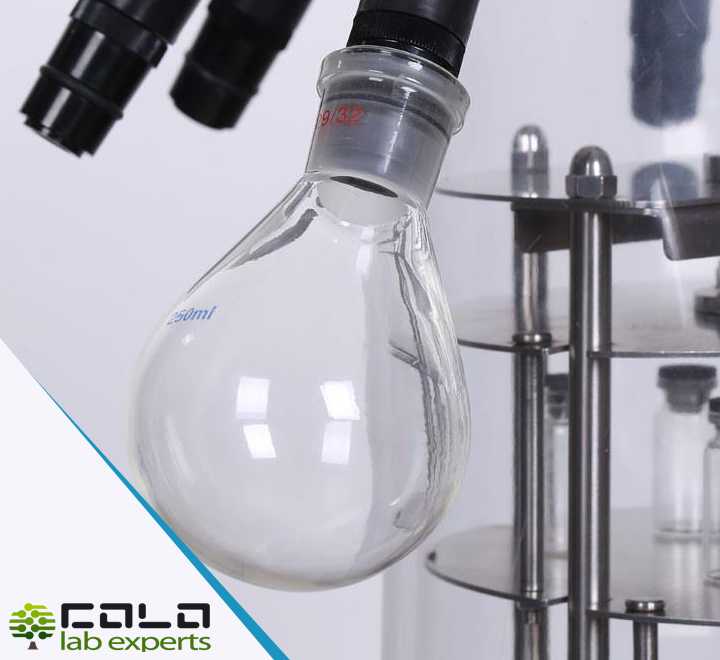
Drying flask on a manifold port, Ø29/32 ground joint
Chamber design and safe operation
- The drying chamber is a transparent bell on a seal ring, so the whole batch stays visible through the run and a collapsing cake is noticed immediately.
- Freeze the sample completely before the vacuum starts. Residual liquid boils under vacuum and sprays out of the vessel.
- Keep acids, bases and volatile organic solvents out of the sample. They attack the seals and the pump oil and shorten the life of the vacuum system.
- Before starting the pump, check that the drain valve is tight, the inflation valve closed, and the bell and seal ring clean — otherwise the vacuum will not be reached.
- Use insulated gloves near the cold trap. In operation it is far below freezing and unprotected contact causes cold burns.
Standard delivery and accessories
Each benchtop freeze dryer arrives ready to run, with the vacuum pump and its consumables in the same delivery.
Included with every model
- Freeze dryer in the ordered configuration
- External vacuum pump, with oil, oil filter and connection hose
- Stainless steel trays — four Ø200 mm or three Ø180 mm
- Transparent bell vacuum cover with seal ring
- Round-bottom drying bottle, Ø29/32 joint
- Operating guide
Available separately
- Additional round-bottom drying flasks — state the volume required
- Wide-neck filter flasks for powders that are loaded and recovered dry
- Port valves and adapters, so one flask can be removed under vacuum
- Spare vacuum pump oil and oil filter
- Spare seal ring for the bell chamber
Documentation and range. The full technical specification, including vial capacities and installation data for all four models, is available as a five-page PDF. Related concentration and evaporation equipment, including every benchtop freeze dryer we supply, is listed in the category overview and catalogue.
Our international range of sample preparation equipment is presented on COLO.Science, our international site.
Where a benchtop freeze dryer is used
Freeze drying is chosen when the value of a sample lies in something that heat would destroy. In biopharmaceutical production that means serum, plasma, vaccines, enzymes, antibiotics and hormones, where activity per milligram is the whole point of the product. In pharmaceutical analysis, biochemical drug examination, immunology and bacteriology rely on stable dried reference material that behaves the same in January as it did in June.
Tissue and sample banking is the other large use: blood, bacterial cultures, arteries, bone, skin, cornea, nerve tissue and organs are preserved for years in a form that can be stored at room temperature and rehydrated when needed. In chemistry and materials work, heat-sensitive reagents, plant extracts and reaction intermediates are dried without the thermal load an oven would impose.
The operational argument for a benchtop freeze dryer is straightforward. A 3 kg batch covers most research and pilot work, the instrument sits on a bench rather than needing floor space and services, and because the vacuum pump ships with it there is no separate procurement exercise before the first run. Where a laboratory outgrows 3 kg per batch, the same platform continues into larger capacity classes.
Selection guide
| If your work is… | Choose | Because |
|---|---|---|
| Bulk product or open vials on trays | LYOPHIL800 | Largest drying area, 0.125 m² and up to 920 vials per batch |
| Vials that must be sealed before air re-enters | LYOPHIL801 | Top press closes stoppers under vacuum |
| Liquids dried in their own flasks | LYOPHIL802 | Eight manifold ports and all four shelves retained |
| Mixed — vials one week, flasks the next | LYOPHIL803 | Both options on one instrument |
Neither option can be retrofitted later, so the benchtop freeze dryer is specified once, at the order. If the choice is not obvious, send us the sample type, the batch volume or vial count, the vessel you work in and whether stoppering under vacuum is required, and we will confirm the model against your batch.
SALES AND SUPPORT FOR BENCHTOP FREEZE DRYERS
COLO Lab Experts
Polje ob Sotli 4, SI-3255, Slovenia
+386 70 713 437 ·
sales@colo.si ·
colo.si
We supply and support laboratories across Europe, with delivery, installation and service arranged per order. All B2B prices are net, excluding VAT and shipping.
Trays, vials or manifold flasks — which model fits your batch?
Send the product to be dried, the batch size and water content, the vessel you work in and whether stoppering under vacuum is required. We will confirm which benchtop freeze dryer suits the batch, the drying area needed and the approved configuration.