


COLO.Science · Spectroscopy & Color · UV/Vis spectrophotometers
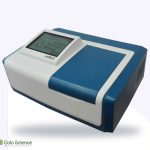
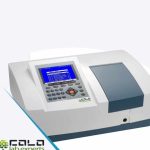
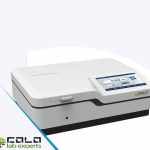
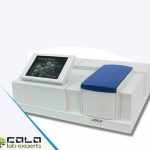
MAVRICA-V visible spectrophotometer series — four basic Vis models, 325–1000 nm
The MAVRICA-V visible spectrophotometer series brings together four basic Vis instruments for teaching laboratories, water testing and routine colorimetric methods. All models share the same optics, simple manual operation, direct concentration reading and RS232 output — and every instrument is delivered with PC software and 4 glass cuvettes. The models differ in wavelength range, spectral bandwidth and the cell holder.
Which UV/Vis spectrophotometer?
Basic Vis — teaching and routine
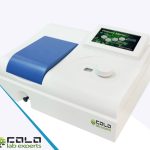
Single and split beam — routine Vis and UV/Vis
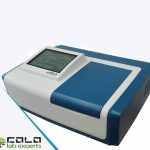
Double beam, variable bandwidth and PMT
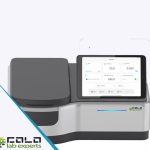
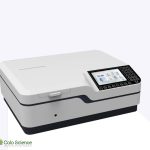
One platform, four models — choose by range, bandwidth and path length
Many colorimetric methods need only one fixed wavelength in the visible range: phosphate, nitrite, iron or ammonium in water, glucose and protein tests, colour reactions in student practicals. A basic instrument with manual wavelength setting does this reliably and at low cost. In the MAVRICA-V visible spectrophotometer series the G models (VEG, STG) take cuvettes up to 50 mm for low concentrations, while the N models (VED, STU) offer a 4 nm bandwidth and lower stray light.

Key characteristics
- Czerny-Turner monochromator with holographic grating 1200 lines/mm, 160 mm focal length, silicon photocell detector.
- Tungsten-halogen lamp for the visible range; the lamp can be replaced by the user.
- Manual wavelength setting with a knob; automatic 0 A and 100 %T adjustment.
- Transmittance, absorbance and concentration — switching with one key, direct concentration reading and concentration factor.
- RS232 output and PC software for data processing in standard delivery; thermal printer as an option.
- Compact benchtop design for teaching, water testing and routine colorimetric methods.
Suitable for
- Teaching laboratories in schools, colleges and universities
- Water, wastewater and environmental testing with photometric test methods
- Clinical colorimetric tests and small medical laboratories
- Food, beverage and agricultural laboratories
- Routine quality control and colour reactions in industry
Models in the series
All four models are delivered with PC software for data processing and 4 glass cuvettes, 10 mm.


MAVRICA-V visible spectrophotometer series — model comparison
| Parameter | MAVRICA-VEG | MAVRICA-STG | MAVRICA-VED | MAVRICA-STU |
|---|---|---|---|---|
| Best for | Teaching and routine work with long cuvettes (up to 50 mm), from 340 nm | Like VEG, with the range extended down to 325 nm | Routine methods needing a narrower bandwidth and low stray light, from 360 nm | Widest range in the series (from 325 nm), 4 nm bandwidth and absorbance up to 4 A |
| Differences between models | ||||
| Wavelength range | 340–1000 nm | 325–1000 nm | 360–1000 nm | 325–1000 nm |
| Spectral bandwidth | 5 nm | 5 nm | 4 nm | 4 nm |
| Cell holder (standard) | 50 mm | 50 mm | 10 mm | 10 mm |
| Stray light at 360 nm (NaNO₂) | ≤0.5 %T | ≤0.5 %T | ≤0.1 %T | ≤0.1 %T |
| Photometric range | 0–100 %T · 0–1.999 A · 0–1999 C | 0–100 %T · 0–1.999 A · 0–1999 C | 0–100 %T · 0–1.999 A · 0–1999 C | 0–200 %T · −0.097–4.000 A · 0–9999 C |
| Power | 130 W | 130 W | 80 W | 120 W |
| Packing size / gross weight | 560 × 480 × 290 mm / 14 kg | 560 × 480 × 290 mm / 14 kg | 590 × 460 × 340 mm / 16 kg | 590 × 460 × 340 mm / 16 kg |
| Common to all models | ||||
| Included in standard delivery | PC software for data processing · 4 × glass cuvette, 10 mm | |||
| Optical system | Czerny-Turner, grating 1200 lines/mm, focal length 160 mm, silicon photocell | |||
| Wavelength setting · accuracy · repeatability | Manual · ±2 nm · ≤1 nm | |||
| Photometric accuracy | ±0.5 %T · ±0.004 A (0–0.5 A) · ±0.008 A (0.5–1 A) | |||
| Photometric repeatability | ≤0.2 %T · 0.002 A (0–0.5 A) · 0.004 A (0.5–1 A) | |||
| Noise | ≤0.3 %T at 100 %T · ≤0.2 %T at 0 %T | |||
| Display · output | LCD · RS232 | |||
Power supply AC 220 V ±22 V, 50 Hz ±1 Hz for all models. Conformity: CE.
Why a basic visible spectrophotometer
For a fixed-wavelength method the essential parameters are a stable lamp, good photometric repeatability and the right path length — not automatic scanning. The MAVRICA-V visible spectrophotometer series concentrates on exactly this: simple operation with a wavelength knob, automatic 0 A / 100 %T and direct concentration reading, so students and routine staff learn and use it quickly.
When you need automatic wavelength setting, spectrum scanning or the UV range, choose NOVEL3S for the visible range or a UV/Vis model such as NOVEL-100S.
Standard delivery
- Instrument: MAVRICA-V spectrophotometer (VEG, STG, VED or STU)
- Cell holder: 50 mm (VEG, STG) · 10 mm (VED, STU)
- Cuvettes: 4 × glass cuvette, 10 mm path length
- Software: PC software for data processing
- Cables and spares: Power cable · 2 fuses
- Documents: Operation manual
Options: 50 mm cell holder for VED and STU, additional glass or plastic cuvettes, thermal printer — confirmed in the COLO.Science quotation.
Knowledge base
Detailed data for all four models are in the MAVRICA-V technical specification (PDF). Spectral bandwidth, stray light, the Beer–Lambert law and cuvette selection are explained on COLO.Science, our knowledge platform.
Selection guide
- Lowest wavelength needed: from 325 nm — STG or STU; from 340 nm — VEG; from 360 nm — VED.
- Low concentrations: G models take cuvettes up to 50 mm path length in standard delivery.
- Narrower bandwidth, lower stray light: N models (VED, STU) — 4 nm and ≤0.1 %T.
- Automatic wavelength, scanning or UV: choose NOVEL2, NOVEL3S or a UV/Vis model.
Configuration notice
This page is provided for orientation and product selection. Cell holders, cuvettes, printer and other options are confirmed with the official COLO.Science quotation.
Sales and support for international customers
COLO Lab ExpertsPolje ob Sotli 4, SI-3255 Buče, Slovenia
Phone: +386 70 713 437 · Email: sales@colo.si · Web: colo.si
We supply laboratories across Europe directly and through partners. B2B prices are quoted net, excluding VAT.