


A vacuum drying oven dries heat-sensitive, oxidisable and solvent-wet samples at low temperature: reduced pressure lowers the boiling point, so moisture and solvents evaporate gently from RT+10 to 250 °C. COLO.Science vacuum ovens have four-side heating, a sealed stainless chamber and digital or touch-screen control.
Vacuum drying ovens
Showing all 3 results

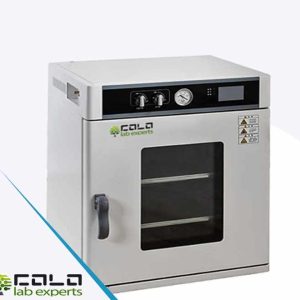
Vacuum drying ovens: how to compare and choose
The products above differ in temperature range, capacity and control. The guide below explains those differences step by step, so you can compare the models and ask for the right configuration.
1Vacuum drying oven models
| DRYVA – 25 L vacuum drying oven | DRYVA with four-side heating and digital control for routine vacuum drying in small batches. |
|---|---|
| DRYVH – 52 L high precision | DRYVH gives tighter temperature uniformity for pharmaceutical and materials work. |
| DRYVE55 – touch-screen programming | DRYVE55 adds programmable ramps and a touch screen for documented, repeatable drying cycles. |
| Vacuum pump and accessories | Choose an oil-free diaphragm pump for solvent vapours or a rotary vane pump for deeper vacuum; add a cold trap to protect the pump. |
2How to choose a vacuum drying oven
- Temperature and vacuum. Most vacuum drying runs at 40–80 °C. Check the lowest pressure the pump reaches and the leak tightness of the door seal.
- Heating design. Four-side heating transfers heat to the shelves and samples faster than heating from the bottom only — important in vacuum, where air does not carry heat.
- Chamber volume. 25 L suits small batches and method development; 52–55 L covers routine production samples.
- Solvents and safety. For flammable solvents use a suitable pump, a cold trap and exhaust; tell us the solvent and we check the configuration.
3Vacuum drying oven applications

- Drying of pharmaceutical powders and APIs at low temperature
- Removing residual solvents from extracts and polymers
- Drying electronic components, batteries and moisture-sensitive materials
- Degassing of resins and potting compounds
- Drying of samples that oxidise in air
Vacuum drying oven – frequently asked questions
Why dry samples in a vacuum oven?
Lower pressure lowers the boiling point, so water and solvents evaporate at low temperature without damaging heat-sensitive samples, and the absence of air prevents oxidation.
Which vacuum pump do I need?
For solvent vapours an oil-free diaphragm pump with a cold trap; for deeper vacuum a rotary vane pump. We size the pump to the chamber volume.
What is the temperature range?
COLO.Science vacuum drying ovens work from RT+10 °C to 250 °C.
Is a vacuum oven slower than a forced-air oven?
Heat transfer is slower without air, which is why four-side heating and shelf contact matter; drying at low temperature still often finishes faster for wet samples.
Need a vacuum drying oven?
Send us the sample, solvent and batch size — we configure the oven, pump and cold trap.