



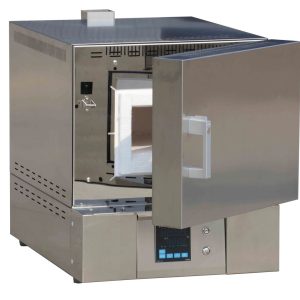
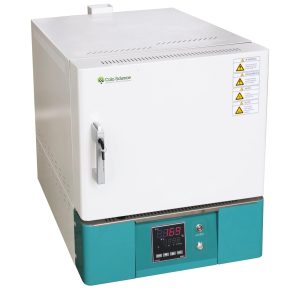
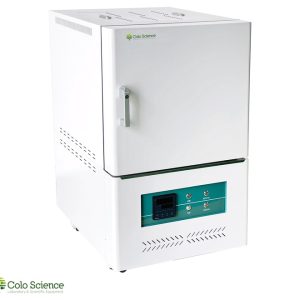
A muffle furnace heats samples in an insulated ceramic chamber up to 1200, 1400, 1600 or 1700 °C for ashing, loss on ignition, annealing and sintering. COLO.Science laboratory muffle furnaces have ±1 °C PID control with programmable segments, 2 to 36 L chambers and heating elements matched to the temperature: wire, silicon carbide or MoSi₂.
Muffle Furnace
Showing all 6 results
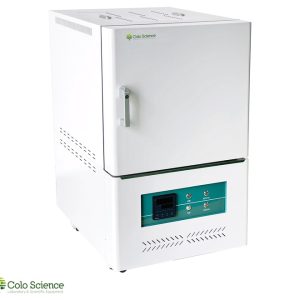

Muffle furnaces: how to compare and choose
The products above differ in temperature range, capacity and control. The guide below explains those differences step by step, so you can compare the models and ask for the right configuration.
1Muffle furnace models by maximum temperature
| 1200 °C – routine ashing furnace | MUFUS (2–36 L) and MUFU-CA cover ashing of food, feed, coal and soil, LOI and gravimetric methods. MUFU-A·S has a stainless steel housing for demanding environments. |
|---|---|
| 1400 °C – silicon carbide elements | MUFUH (4, 13, 18 L) uses SiC heating rods for faster heating and long life at high temperature — heat treatment, glass and ceramic tests. |
| 1600 °C – MoSi₂ high-temperature furnace | MUFU-T16 reaches 1600 °C with molybdenum disilicide elements for ceramics, refractories and materials research. |
| 1700 °C – maximum temperature | MUFU-T17 adds headroom for sintering of advanced ceramics, zirconia and metallurgical samples, with 30-segment programming. |
2How to choose a laboratory muffle furnace
- Working temperature. Choose a furnace with 100–200 °C above your highest working temperature — elements last longer when they do not run at the limit every day.
- Chamber volume and crucibles. Count crucibles per batch: 2–7 L for a few crucibles, 12–18 L for routine ash series, 36 L for larger parts.
- Programming and atmosphere. Multi-segment ramp/soak programs reproduce standard methods; for ashing of organic samples add an exhaust or chimney so fumes leave the chamber.
- Standards and documentation. Ash and LOI methods (ISO, ASTM, AOAC, EN) define temperature and time; we supply calibration certificates on request.
3Muffle furnace applications

- Ash content of food, feed, flour, coal, biomass and soil
- Loss on ignition (LOI) of cement, clay and minerals
- Annealing, hardening and tempering of metal parts
- Sintering of ceramics, glass melting and enamel firing
- Sample preparation for XRF and elemental analysis
Muffle furnace – frequently asked questions
What is a muffle furnace used for?
For heating samples to 1000–1700 °C in an insulated chamber: ashing, loss on ignition, heat treatment, sintering and preparation of samples for elemental analysis.
What temperature do I need for ashing?
Most food and feed ashing methods use 525–600 °C; coal and coke ash up to 815 °C; LOI of cement and minerals 950–1000 °C. A 1200 °C furnace covers all of them.
Which heating element is best?
Resistance wire up to 1200 °C, silicon carbide (SiC) for 1400 °C, and molybdenum disilicide (MoSi₂) for 1600–1700 °C.
Do I need ventilation?
Yes, when ashing organic samples. Use a furnace with exhaust opening or chimney and place it under an extraction hood.
Choosing a muffle furnace?
Tell us the maximum temperature, chamber volume and method — we recommend the model and send a quotation.