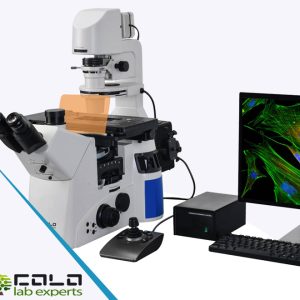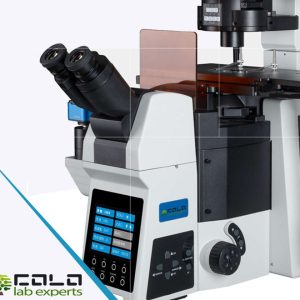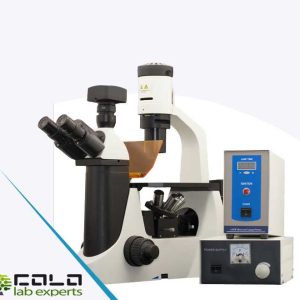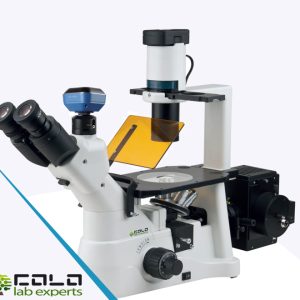


Inverted fluorescence microscopy is the default configuration for live-cell and culture workflows where samples are in dishes, multiwell plates or flasks.
Buyers rarely search only “fluorescence microscope” — they search by method and components: “inverted LED fluorescence microscope”, “fluorescence filter cube/set”,
“FITC TRITC DAPI channels”, “high NA objectives for fluorescence”, and “CMOS fluorescence microscope camera”.
This category groups inverted systems configured for epi-fluorescence in cell biology and routine screening, with emphasis on
excitation/emission bands, dichroic mirrors, multi-band filter sets, long working distance (LWD) objectives, and stable LED illumination.
If you are selecting an inverted LED fluorescence microscope for plates or live samples, you can navigate here from general requirements down to specific models and configurations.
TECHNICAL SEARCH TERMS & CORE OPTIONS
- Epi-fluorescence (inverted) – incident-light fluorescence optimized for culture vessels and multiwell plates.
- Filter cubes / fluorescence filter sets – excitation filter, emission filter, and dichroic beamsplitter matched to fluorophores.
- Common channels – DAPI (UV), FITC (Blue), TRITC (Green), Cy/Red; plus multi-band configurations.
- LED fluorescence illumination – wavelength-selectable modules (UV/blue/green/red) with stable output and low maintenance.
- LWD objectives – long working distance optics for dishes/plates, often used for cell culture imaging.
- High NA objectives – key for low-light fluorescence signal collection, resolution and contrast.
- Phase contrast compatibility – frequent requirement for live-cell workflows (brightfield + fluorescence).
- CMOS camera & documentation – exposure control, low-noise acquisition and repeatable imaging protocols.
SELECTION QUICK GUIDE: PLATES, OBJECTIVES, FILTERS
Start with your sample format (Petri dish, flask, multiwell plate) and fluorophores (DAPI, FITC, TRITC), then select compatible
fluorescence filter cubes/sets or a multi-band filter set.
For cell culture, prioritize LWD objectives and the right NA for signal brightness and resolution; many workflows require phase contrast alongside fluorescence.
For documentation, a stable inverted LED fluorescence microscope paired with a low-noise CMOS camera and repeatable exposure settings is typically the deciding factor.
Inverted Fluorescence Microscopy
Showing all 4 results