


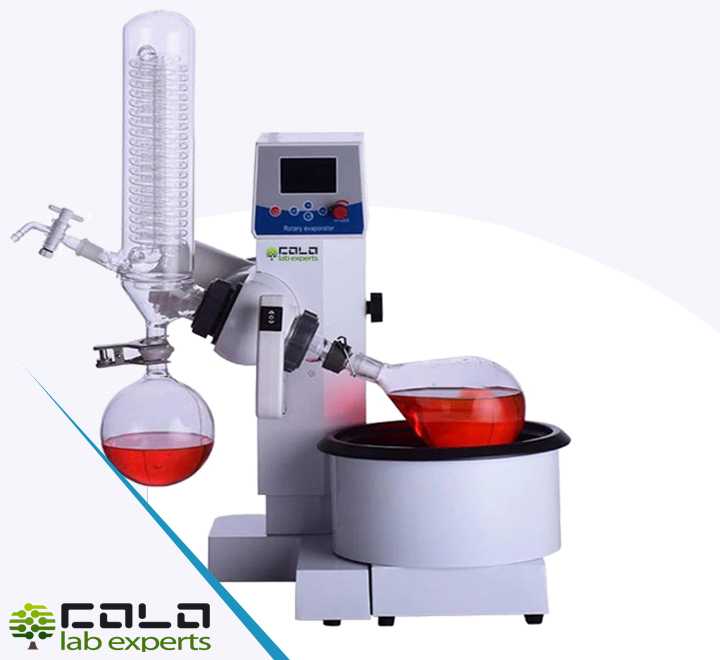
ROVA901 rotary evaporator: operating principle
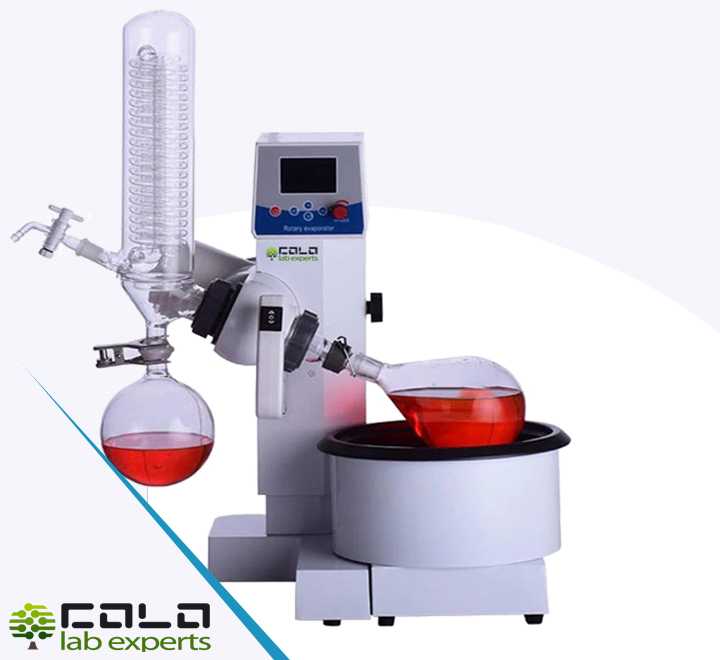
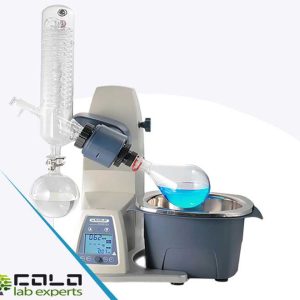
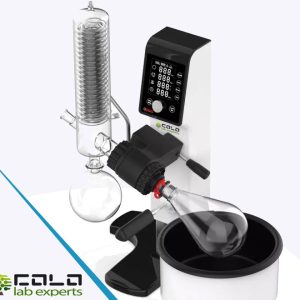
Rotation spreads the liquid over the inner surface of the evaporation flask. Heat from the bath supplies the energy for evaporation, while reduced pressure allows the solvent to boil at a lower temperature than at atmospheric pressure. Vapour moves to the cooled condenser and is collected as liquid in the receiving flask.
The ROVA901 rotary evaporator brings these functions together in a laboratory system with automatic lifting and menu-based operation. The operator selects rotation, thermal conditions and vacuum as a coordinated process. A chiller removes heat from the condenser; a vacuum pump reduces pressure. Each device has a separate role, so its selection affects the performance of the complete installation.
QUICK SELECTION NOTE
Choose the evaporator, glassware, condenser cooling and vacuum source as one configuration. CIBAC45 cooling circulating bath, VACUU-COT30 vacuum pump and vacuum controller are optional equipment; the quotation defines the supplied setup.
Key characteristics and application fit
Key characteristics
- DC drive with a 5–300 rpm speed range and steady start.
- Automatic lift operated by touch control or a push button; 120 mm stroke.
- Vertical condenser with 1600 cm² cooling surface and drip-point design.
- PTFE sealing and a PTFE-coated water/oil heating bath.
- Large LCD, menu interface, rotary control and timer functions.
- Intermittent forward/reverse rotation for drying sequences.
Suitable for
- Concentration of extracts and reaction mixtures.
- Solvent removal before subsequent analytical work.
- Recovery of condensed solvents in laboratory workflows.
- Chemistry and pharmaceutical development laboratories.
- Teaching, research and routine sample preparation.
Coordinate heating, rotation, vacuum and cooling
Selecting a ROVA901 rotary evaporator starts with the sample and solvent rather than a single maximum temperature. A suitable combination of pressure, bath temperature, rotation and condenser cooling supports a controlled evaporation rate. Heat-sensitive samples, mixtures with changing composition and liquids that foam may require different operating conditions, even when the initial volumes are similar.
The 210 °C bath limit describes the equipment range; it is not a routine setpoint for every solvent. Likewise, the maximum rotation speed does not define an evaporation throughput. The working point depends on the flask, sample behaviour and available condensation capacity. Matching these variables helps the laboratory plan a repeatable procedure without assuming a guaranteed distillation rate.
Model and configuration
ROVA901
ROVA901 is the model covered by this specification: automatic lift, vertical condenser, variable DC drive and a water/oil heating bath. CIBAC45 and VACUU-COT30 are separately specified supporting devices. They do not represent alternative versions of the evaporator itself.
Technical specifications
| Parameter | Specification |
|---|---|
| Model | ROVA901 |
| Condenser type | Vertical |
| Condenser cooling surface | 1600 cm² |
| Drive | DC motor, 70 W |
| Rotation speed | 5-300 rpm |
| Speed tolerance above 100 rpm | ±1% |
| Speed tolerance below 100 rpm | ±1 rpm |
| Lift | Automatic |
| Lift operation | Touch control and push-button operation |
| Lift stroke | 120 mm |
| Heating bath temperature | Ambient to 210 °C |
| Temperature setting resolution | 1 K |
| Maximum filling volume* | 4 L |
| Heating power | 1400 W |
| Total input power | 1500 W |
| Dimensions (W × D × H) | 510 × 490 × 345 mm |
| Weight | 25.76 kg |
| Operating ambient temperature | 5-40 °C |
| Permissible relative humidity | 80% |
| Protection rating | IP20, DIN EN 60529 |
| Supply voltage | 100-240 V |
| Supply frequency | 50 / 60 Hz |
| DC voltage | 24 V DC |
| Vacuum controller | Optional |
Volume designation: the stated 4 L maximum filling volume is reproduced under the source parameter name. It must not be treated as the evaporation-flask capacity. The quotation identifies the supplied evaporation and receiving flasks separately.
Operating functions and handling
The ROVA901 rotary evaporator uses a large LCD with a menu interface and rotary control for routine settings. Automatic lifting is available through touch control and push-button operation, allowing the evaporation assembly to be positioned relative to the bath without a manual lift mechanism.
Intermittent positive and negative rotation, together with the timer, supports drying sequences. The stated unattended mode switches the equipment to standby after the experiment. This function belongs to the instrument control; laboratories still establish appropriate operating procedures for their samples and installation.
A dedicated flask-release mechanism assists removal of the evaporation flask. The vertical condenser includes a drip-point arrangement to limit condensate backflow. These handling features support routine use, cleaning and preparation for the next batch without changing the need to choose suitable glassware and seals.
Construction and installation
PTFE sealing and the coated bath are specified construction features of the ROVA901 rotary evaporator. The bath coating supports cleaning, while heat-insulated handling features reduce direct contact with hot surfaces. Select water or an appropriate heat-transfer fluid within the fluid’s permitted operating range; a bath capable of 210 °C does not mean water can be used throughout that range.
Installation data include a 5–40 °C ambient operating range, 80% permissible relative humidity and IP20 protection. Position the instrument and its supporting devices according to their operating instructions, with appropriate space for the lift, glassware, tubing and maintenance. Chemical compatibility depends on the actual solvent and all wetted components, not only the presence of PTFE in the sealing system.
Supplied configuration and optional equipment
The ROVA901 rotary evaporator configuration is specified as a complete system in the quotation. The evaporation unit, condenser, evaporation flask, receiving flask, seals and tubing must be identified in the supplied configuration. The chiller, vacuum pump and vacuum controller are optional equipment; photographs of a possible setup do not establish that these devices are included.
CIBAC45 cooling circulating bath — optional
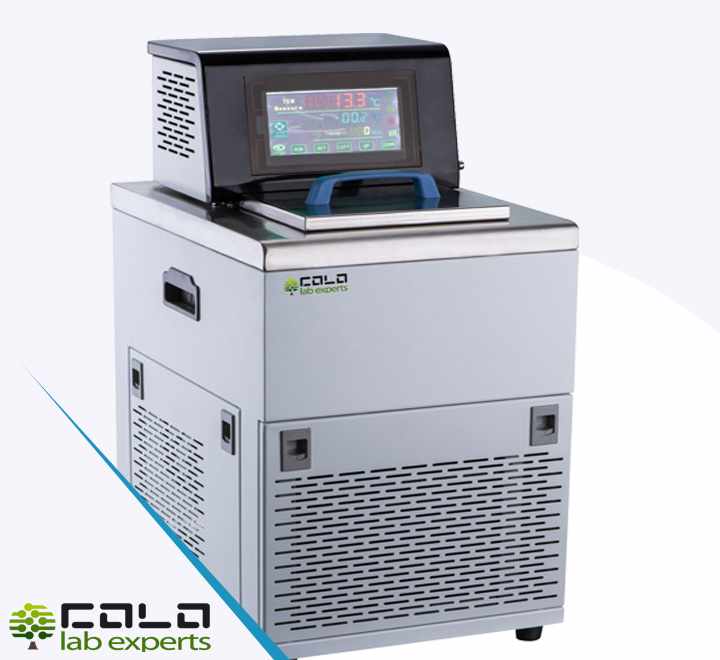
Circulates temperature-controlled liquid through the condenser and removes the heat released when solvent vapour condenses. The coolant and solvent follow separate paths.
| Parameter | Specification |
|---|---|
| Model | CIBAC45 |
| Temperature range | -10 to +100 °C |
| Bath volume | 7.3 L |
| Temperature stability | ±0.05 °C |
| Display resolution | 0.1 °C |
| Chamber (L × W × H) | 260 × 200 × 140 mm |
| Listed pump flow range | 0-20 L/min |
| Display / control | Touch LCD / PID |
The CIBAC45 circulates temperature-controlled liquid through the ROVA901 rotary evaporator condenser. Cooling liquid and solvent follow separate paths. Select cooling capacity at the required working temperature and heat load; the temperature range alone does not establish sufficient cooling performance.
Its listed pump flow range is not a permitted flow or pressure rating for the glass condenser. Tubing, connections and circulating conditions must be suitable for the complete cooling circuit.
VACUU-COT30 diaphragm vacuum pump — optional
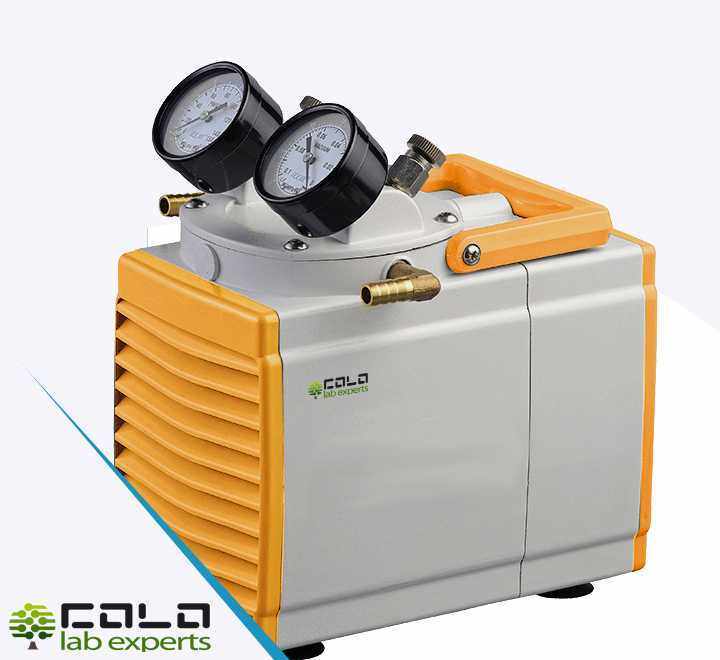
Reduces system pressure to allow evaporation at a lower temperature. The COT series uses PTFE/Teflon-treated gas-contact components and runs without lubricating oil in the pumping process.
| Parameter | Specification |
|---|---|
| Model | VACUU-COT30 |
| Pump principle | Diaphragm, oil-free |
| Nominal pumping speed | 30 L/min |
| Number of heads | 1 |
| Head / gas-contact treatment | PTFE / Teflon series |
| Motor protection | Overheating protection |
The VACUU-COT30 supplies vacuum to the ROVA901 rotary evaporator system. Nominal pumping speed is 30 L/min with one head. Select the pump for the required operating pressure, vapour load and chemical compatibility. Nominal flow alone does not define the pressure reached during evaporation.
A vacuum controller is a separate optional function for regulation. The pump creates reduced pressure, while the controller manages the pressure level selected for the procedure.
Chiller and cold trap: different functions
A recirculating chiller cools the main condenser through a liquid circuit. A cold trap is placed in the vacuum line to capture residual solvent vapour and can help protect the pump. CIBAC45 is a circulating bath, not a cold trap. Whether the system needs an additional trap depends on the solvent, vapour load and pump protection requirements.
Catalogue and technical documentation
Evaporation Overview
Compare the ROVA901 with other products for concentration and evaporation.
Evaporation Catalogue
Access available product documents and the EN technical specification PDF.
Use the EN technical specification PDF for the ROVA901 rotary evaporator when reviewing the detailed parameters or preparing a quotation request. The Evaporation Overview introduces the product group, and the Evaporation Catalogue provides access to available product documents. The technical specification and this page use the same approved model data.
Explore sample preparation on the international COLO.Science website
Applications and operational value
In extract preparation, the ROVA901 rotary evaporator can be used to reduce solvent volume before further processing. In analytical workflows, solvent removal can form part of sample preparation before the next method step. In synthesis laboratories, evaporation separates volatile solvent from a reaction product under conditions chosen for that mixture.
Solvent recovery collects condensate in the receiving flask, but recovery performance depends on the complete setup and operating procedure. For teaching, the system makes the relationship between heating, rotation, vacuum and condensation visible. For repeated laboratory work, recording the solvent, batch size and selected conditions provides a useful basis for comparing procedures.
Selection guide
- Define the sample: solvent or solvent mixture, initial volume, intended final volume, temperature sensitivity and foaming tendency.
- Define the process: preferred operating temperature and required processing time, without assuming a fixed evaporation rate.
- Specify glassware: evaporation and receiving flasks, condenser configuration and connections.
- Match cooling: coolant, chiller capacity at the working temperature, hose connections, flow and pressure.
- Match vacuum: achievable working pressure, pumping performance, chemical compatibility, regulation and possible vapour protection.
- List the supplied equipment: evaporator, glassware, seals, tubing, chiller, pump and optional controller.
When requesting a ROVA901 rotary evaporator quotation, include these application details so COLO can define the evaporator and supporting equipment together. This avoids treating the chiller, pump or flask capacity as an automatic consequence of the evaporator model designation.
Configuration notice
This information supports orientation and equipment selection. The binding specification, supplied glassware, accessories and acceptance criteria are defined by the official COLO.Science quotation or order confirmation. The specific order establishes the complete configuration. Specifications may change without notice.
INTERNATIONAL SALES AND PRODUCT SUPPORT
COLO Lab Experts
Polje ob Sotli 4, SI-3255, Slovenia
+386 70 713 437 · sales@colo.si · colo.si
International B2B supply and application support. Prices are quoted net, excluding VAT.
COLO.SCIENCE | ROVA901 SUPPORT
Need help selecting the right ROVA901 configuration?
Send the solvent, sample volume, required throughput and intended operating temperature. COLO can help define the evaporation unit, glassware, condenser cooling, vacuum source and optional regulation.