

Vibrio · Cultivation
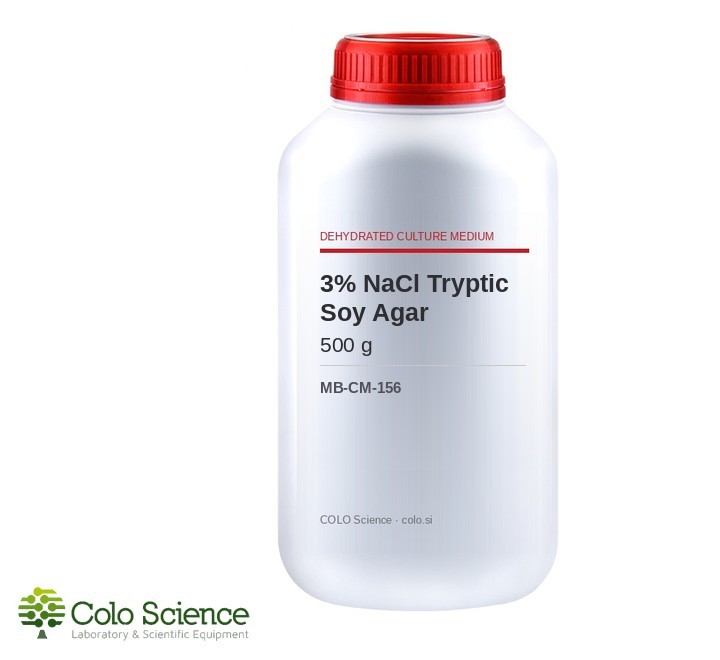
3% NaCl Tryptic Soy Agar – salt agar for halophilic vibrios
3% NaCl Tryptic Soy Agar is a tryptic soy agar with 3 % sodium chloride for the cultivation and purification of halophilic vibrios such as Vibrio parahaemolyticus before confirmation tests.
- 3 % sodium chloride
- For V. parahaemolyticus
- Purification before confirmation
How 3% NaCl Tryptic Soy Agar works
Tryptone and soy peptone supply nutrients, and the high salt content meets the needs of halophilic vibrios while limiting the growth of non-halophilic bacteria.
Technical data
| Preparation | 65 g/L; heat with stirring to boiling, autoclave 121 °C 15 min |
| Final pH | 7.3 ± 0.2 |
| Storage | Cool, dry place away from bright light; keep the container tightly closed |
| Shelf life | 3 years |
Applications and practical notes
Pathogenic vibrios are tested in seafood, fish and coastal water, for example according to ISO 21872-1. Typical applications include:
- Fish, shellfish and seafood
- Coastal and brackish water
- Aquaculture
- Clinical and public-health laboratories
Working with 3% NaCl Tryptic Soy Agar: Use a single typical colony from TCBS or chromogenic Vibrio agar and incubate the plate at about 36 °C before biochemical tests.
Good practice with dehydrated media: keep the bottle tightly closed in a cool, dry place, weigh the powder quickly to avoid moisture uptake, and use fresh distilled or deionised water. Check the pH of each new batch after preparation and before use, and label prepared media with the date. Performance of each lot can be verified with reference strains according to ISO 11133, the standard for the preparation, production, storage and performance testing of culture media.
About the Vibrio method: ISO 21872-1 describes the detection of potentially enteropathogenic Vibrio parahaemolyticus, V. cholerae and V. vulnificus in seafood and other foods. Samples are enriched twice in Alkaline Saline Peptone Water, plated on TCBS Agar and a second selective medium, and typical colonies are purified on saline agar and confirmed biochemically or by PCR. The FDA BAM Chapter 9 follows a similar scheme. COLO.Science offers media, supplements, rapid tests, identification kits and QC strains for every step.
Complete sets from one supplier: COLO.Science supplies culture media, supplements, rapid tests, identification kits and QC strains as complete sets for the method you follow. Send us your sample types and standards, and we will prepare an offer with the matching products and documentation.
3% NaCl Tryptic Soy Agar is supplied by COLO.Science in the pack sizes listed under Ordering information. For larger quantities, regular deliveries or method-specific sets that include 3% NaCl Tryptic Soy Agar, please send us a request. With every delivery of 3% NaCl Tryptic Soy Agar you receive the lot number and expiry date, and on request we send the available documentation for 3% NaCl Tryptic Soy Agar.
Where 3% NaCl Tryptic Soy Agar fits in Vibrio testing
- Enrichment – Alkaline Saline Peptone Water (ASPW), 37 °C and 41.5 °C
- Isolation – TCBS Agar plus a second medium: chromogenic Vibrio agar, mCPC or CC agar
- Purification – non-selective saline agar such as T1N1 Agar
- Confirmation – oxidase, biochemical identification, PCR or LAMP
Ordering information
| Product | COLO code | Pack |
|---|---|---|
| 3% NaCl Tryptic Soy Agar | PRO8175 | 500 g |
Product notice: preparation, storage conditions and shelf life are given on the label. Technical data on this page are for orientation; the label and the lot documentation apply. B2B prices are quoted net, excluding VAT.
Sales and technical support
COLO LabExperts
Polje ob Sotli 4, SI-3255, Slovenia
Quotations and technical support for culture media and microbiology products across our international sales territory. B2B prices are net, excluding VAT.
COLO.SCIENCE | MICROBIOLOGY SUPPORT
Need the complete set for your method?
Send the sample type, target organism and the standard you follow. COLO.Science will put together the media, supplements, QC strains and confirmation tests for the whole procedure.