


COLO.Science · EXPEC distribution for the EU · Elemental analysis
EXPEC 6500D ICP-OES spectrometer — dual view, vertical torch, 165–900 nm, full spectrum in one exposure
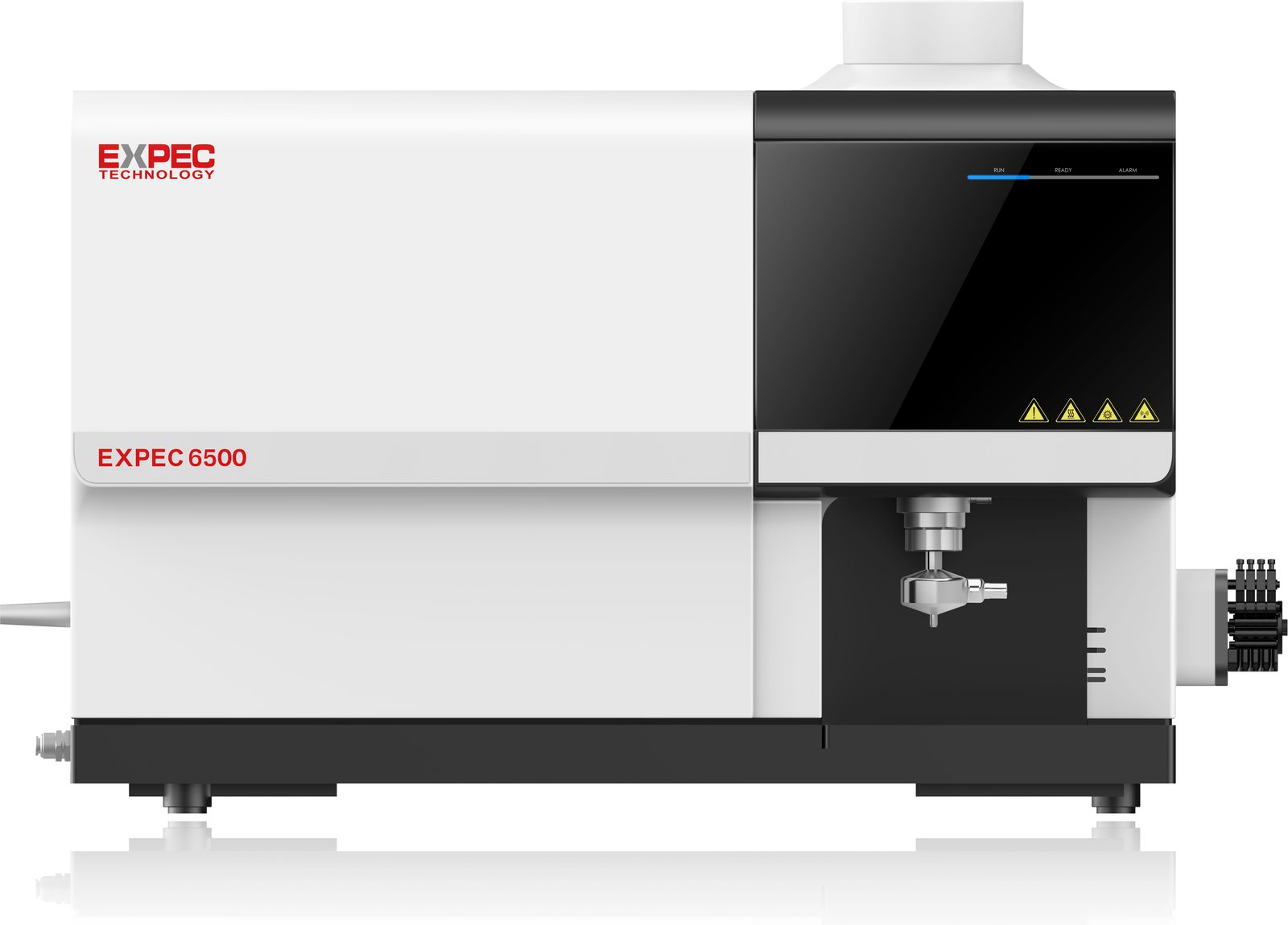
The EXPEC 6500D is a full-spectrum, simultaneous ICP-OES spectrometer for laboratories that must report trace, minor and major elements in the same run – from µg/L in drinking water to percent levels in alloys, ores and fertilisers. A vertical torch with axial and radial observation, a thermostatted echelle optic and a one-inch 1024 × 1024 detector capture the whole spectrum in one exposure: up to 72 elements in about 10 s, with 8-hour stability RSD ≤ 1 %. COLO.Science is the EXPEC distribution partner for the European Union and delivers the instrument with installation, training and local service. Product code PRO6868.
Traces and majors in one run
Most laboratories buy an ICP-OES spectrometer to replace several single-element methods. The practical test is what happens when one sample holds 20 µg/L of lead next to 2 g/L of sodium: the 6500D reads both in the same measurement. Axial view gives the lowest detection limits, radial view keeps the matrix under control, and intelligent attenuation extends the range by up to 100× without re-dilution. The full spectrum of every sample is stored, so a new element or an interference check can be evaluated later from data you already have.
Key characteristics
- Dual view (axial + radial) on a vertical torch – sensitivity and matrix tolerance in one instrument.
- 165–900 nm continuous coverage, fixed echelle optics thermostatted at 36 ± 0.1 °C.
- 1024 × 1024 ECCD detector, 24 µm pixels, full spectrum in a single exposure.
- 500–1600 W self-excited solid-state RF, stable on aqueous, high-salt and organic samples.
- 72 elements in about 10 s, approx. 200 spectral lines per minute, about 2 mL sample per analysis.
- Precision ≤ 0.5 % RSD, 8-hour stability ≤ 1 % RSD, linear range ≥ 105.
- iStandby 500 W with ≤ 5 L/min argon – more than 50 % argon saving between batches.
- Wavelength calibration without solutions: C, N, Ar lines plus real-time neon reference (FSC).
Suitable for
- Environmental and water laboratories working to EN ISO 11885-type methods.
- Metallurgy: ferroalloys (FeSi, FeSiMg, CaSi), steels, non-ferrous metals and slags.
- Geology and mining: ores, concentrates, coal and ash, rare-earth elements.
- Petrochemistry: wear metals and additives in oils and fuels with the organic introduction kit.
- Food, feed, fertiliser, chemical, battery and pharmaceutical laboratories (21 CFR Part 11 design).
Watch the EXPEC 6500 in operation
Two minutes that show why this ICP-OES spectrometer is built the way it is: the vertical torch and the dual-view light path, the thermostatted echelle optics, the detector and the sample introduction system at work.
EXPEC 6500 ICP-OES · product video, 1:14 · open the video in a new window
Why a vertical torch with dual view
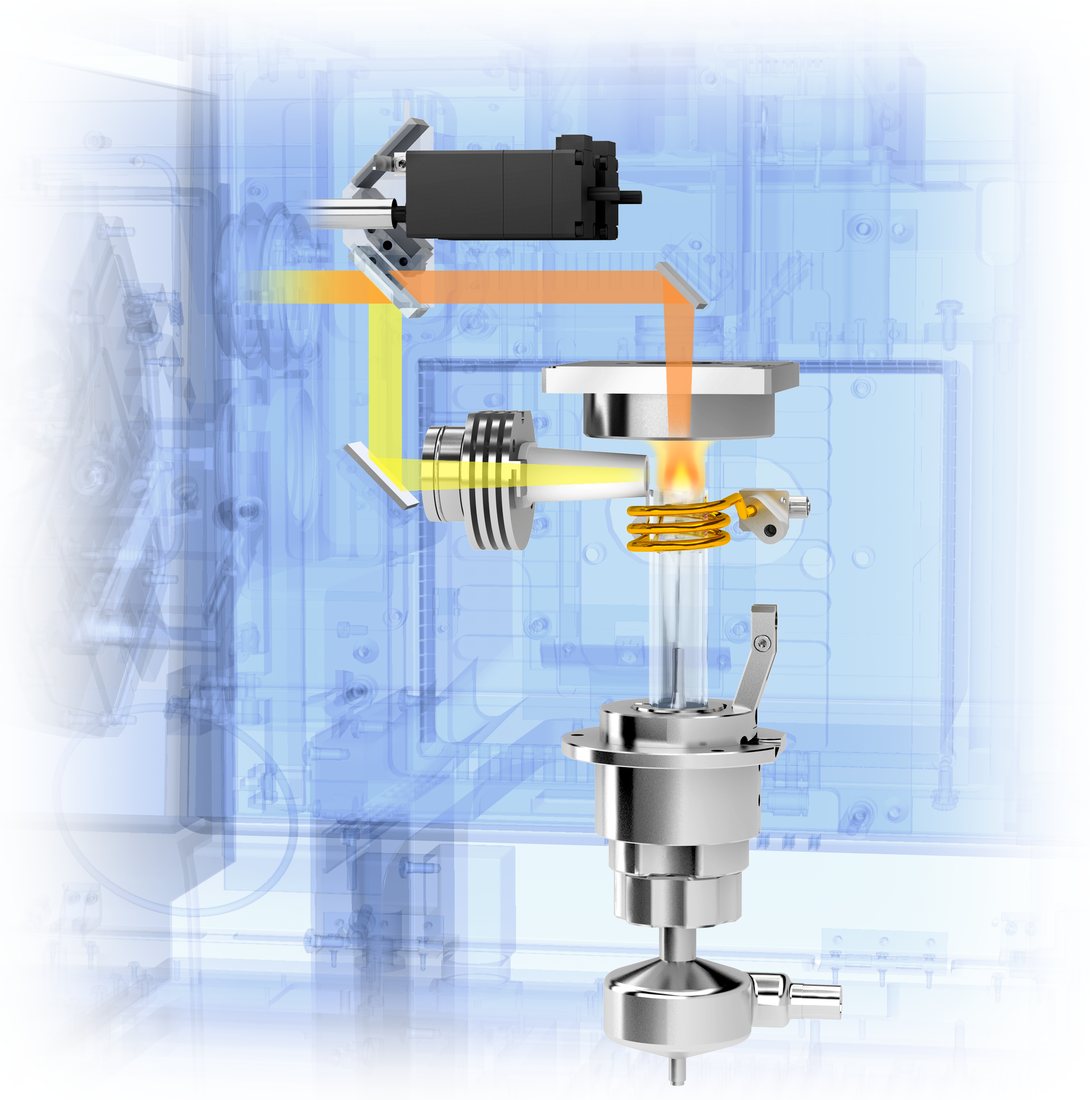
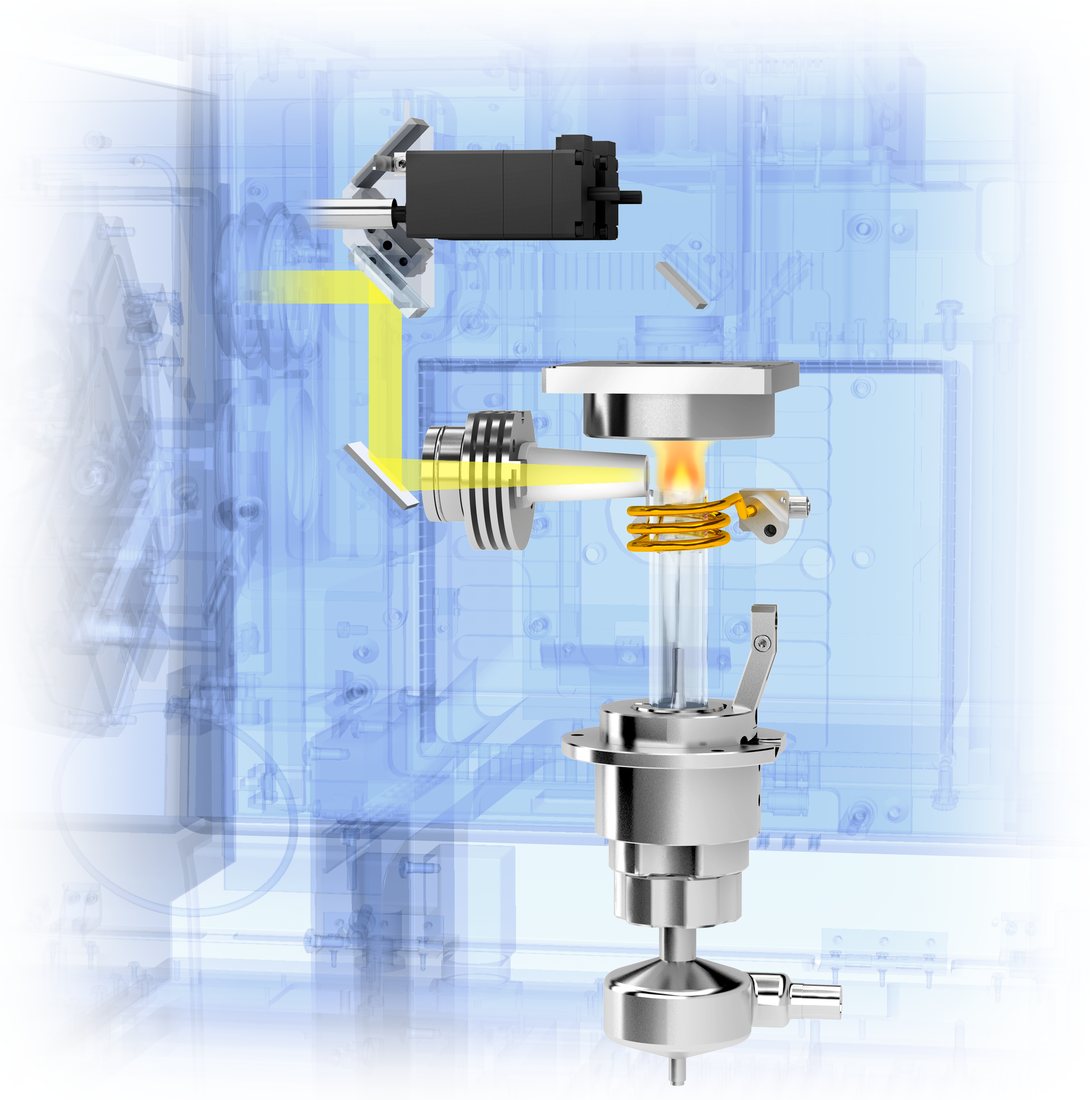
A horizontal-torch ICP-OES spectrometer sees the plasma end-on and gives the lowest detection limits, but salt and carbon collect on the torch and the interface. A radial-only instrument is robust but gives up an order of magnitude in sensitivity. The 6500D keeps the torch vertical – salts drain instead of building up – and collects light both along the axis and from the side. The cool tail flame is removed by a metal cooled cone, so the axial view needs no shear gas and no compressor.
For the laboratory this means one ICP-OES spectrometer for clean waters and for digests with several percent dissolved solids, without switching instruments or re-diluting samples. In radial view the observation height is adjusted per element to the zone where it emits most strongly, which improves both sensitivity and freedom from interference.
Model, product code and EU distribution
The EXPEC brand, technical data and software are kept in full. COLO.Science supplies the 6500D as a complete, configured system and provides installation, qualification, training, application support and service in the EU.
Configuration: dual view (axial + radial), vertical torch, standard quartz introduction system
6500R (radial view, for heavy matrices): available on request
Brand: EXPEC · EU distribution: COLO.Science
ICP-OES spectrometer technical specifications
| Observation | Axial, radial, dual and simultaneous dual view; vertical torch |
| Wavelength range | 165–900 nm, continuous |
| Optics | Fixed echelle, 87 L/mm, blaze 63.5°, quartz prism, 380 mm focal length |
| Resolution (FWHM) | ≤ 7 pm at 200 nm |
| Stray light | ≤ 2.0 mg/L (10 000 mg/L Ca at As 188.980 nm) |
| Optical chamber | Thermostatted 36 ± 0.1 °C, argon purge below 189 nm, no vacuum pump |
| Detector | ECCD 1024 × 1024 pixels, 25.4 × 25.4 mm, pixel-level TEC cooling, anti-blooming |
| RF generator | Self-excited solid state, 27.12 MHz, 500–1600 W, coupling > 80 % |
| Power / RF stability | ≤ 0.1 % / ≤ 0.01 % |
| Standby | iStandby 500 W, argon ≤ 5 L/min, ready in < 5 min |
| Gas control | Mass-flow controllers, up to 5 channels, 0.01 L/min |
| Peristaltic pump | 12 rollers, 4 channels, 0–125 rpm |
| Sample introduction | Quartz concentric nebulizer, cyclonic spray chamber, demountable torch |
| Speed | Approx. 200 lines/min; up to 72 elements in ~10 s |
| Precision / stability | ≤ 0.5 % RSD (n = 10) / ≤ 1 % RSD over 8 h |
| Linear dynamic range | ≥ 105 (Mn 257.610 nm, r ≥ 0.999) |
| Software | Full-spectrum storage, IEC, internal standard, standard addition; 21 CFR Part 11 design, audit trail |
| Power supply | 220 V AC ± 10 %, 50 Hz, separate 40 A circuit, < 4.5 kW |
| Dimensions / weight | 930 × 700 × 560 mm / approx. 100 kg |
| Product code | PRO6868 |
Values for the standard configuration from the manufacturer specification. The complete list of parameters is in the technical specification (PDF).
Technology inside the ICP-OES spectrometer
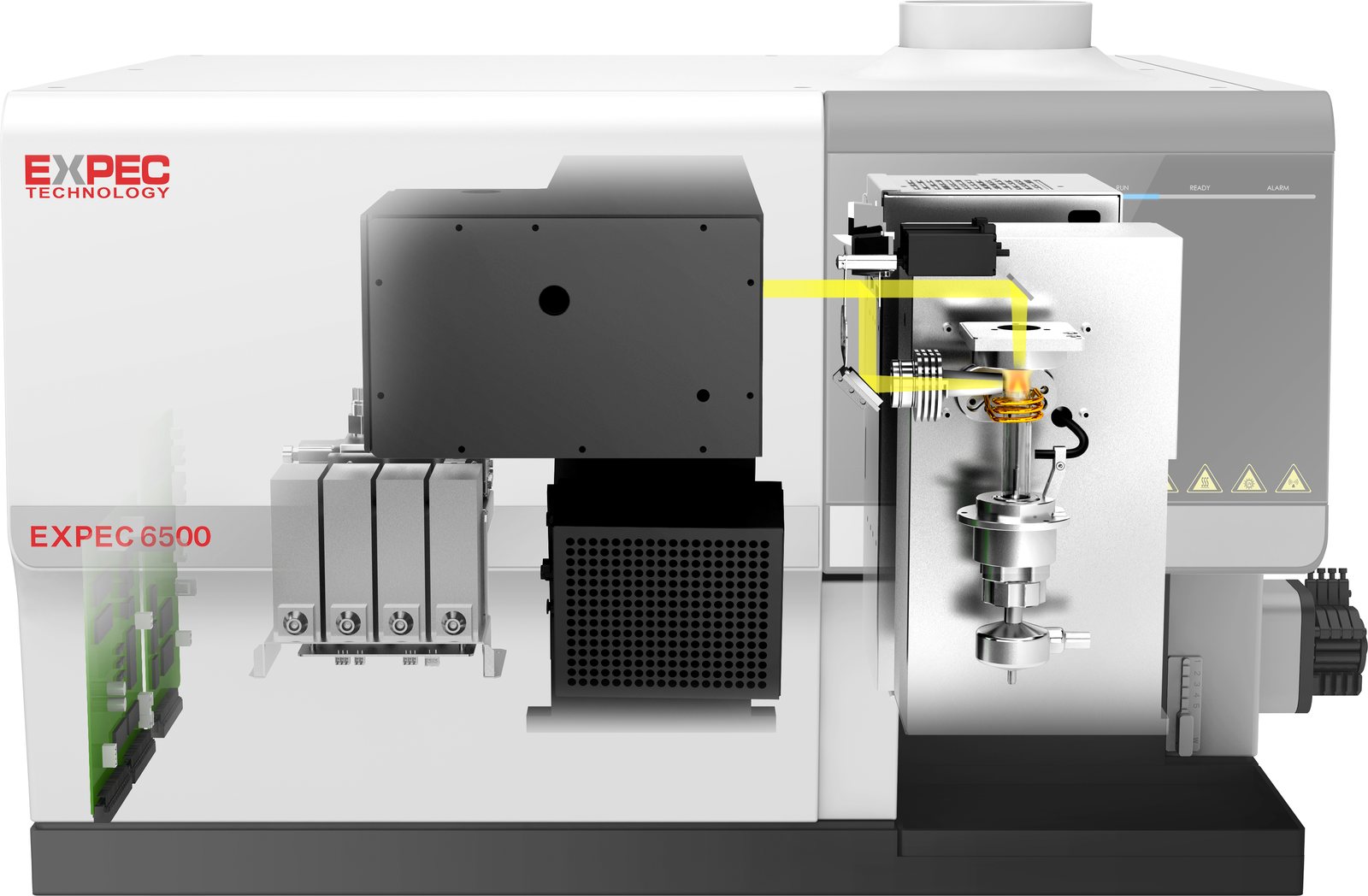
Self-excited solid-state RF generator
500–1600 W, adjustable in 1 W steps, with fast impedance matching – the plasma stays on when organic solvents or even air enter the torch. No moving parts, water-cooled, power stability ≤ 0.1 %. In iStandby the plasma idles at 500 W with ≤ 5 L/min argon and is analysis-ready in under five minutes.
Vertical torch and dual view
Demountable, self-aligning quartz torch: for a new application only the centre tube is changed (0.75 / 1.5 / 2.0 / 3.0 mm). Axial and radial attenuation handle concentrations up to 100× apart in one method.
Echelle optics with real-time correction
The fixed echelle system has no moving parts. At every ignition C, N and Ar lines calibrate the wavelength scale; the patented FSC system then follows a neon reference line in real time, which is why the 8-hour RSD stays at or below 1 % without recalibration.
ECCD detector
One square inch, a million pixels, read in a single exposure. Each pixel has its own overflow drain, so a strong line does not bleed into its neighbours, and intelligent integration sets the exposure per line – weak and strong lines both at their best signal-to-noise ratio.
Software and compliance
Qualitative, semi-quantitative and quantitative analysis on any line of a library with more than 50 000 lines, real-time background correction, interfering-element correction (IEC), internal standard and standard addition. Three user levels, electronic signature and audit trail for 21 CFR Part 11 environments; remote diagnostics over the network.
Detection limits, axial and radial
Instrument detection limits measured on the 6500 ICP-OES spectrometer in both viewing modes, in µg/L. The technical specification lists all 65 measured elements.
| Element | Line, nm | Axial | Radial |
|---|---|---|---|
| Mg | 279.553 | 0.02 | 0.1 |
| Ca | 396.847 | 0.04 | 0.4 |
| Ba | 455.403 | 0.04 | 0.25 |
| Mn | 257.610 | 0.06 | 0.5 |
| Zn | 213.856 | 0.34 | 2 |
| Cd | 214.438 | 0.44 | 2 |
| Cr | 267.716 | 0.47 | 2.5 |
| Fe | 238.204 | 0.62 | 3 |
| Al | 167.079 | 0.65 | 5 |
| Ni | 221.647 | 0.79 | 5 |
| Cu | 324.754 | 0.8 | 2.5 |
| Na | 589.592 | 0.83 | 16 |
| Pb | 220.353 | 5.5 | 40 |
| As | 189.042 | 9.42 | 67 |
Instrument detection limits with the standard quartz introduction system. Method detection limits in real samples depend on digestion, dilution and matrix.
6500D or 6500R – choosing the configuration
The 6500D and 6500R share the platform, optics, detector and software. They differ in the observation system: the 6500D collects light axially and radially, the 6500R radially only. The choice follows your samples.
| Your requirement | 6500D | 6500R |
|---|---|---|
| Traces below 10 µg/L (drinking water, food) | ✔ recommended | – |
| Environmental methods (EN ISO 11885 type) | ✔ recommended | ✔ |
| Alloys, steels, ferroalloys, slags | ✔ | ✔ recommended |
| Ores, geology, fusion digests | ✔ | ✔ recommended |
| Oils and organic solvents | ✔ | ✔ recommended |
| Mixed laboratory, many sample types | ✔ recommended | – |
Applications and method evidence
Application results from the EXPEC ICP-OES platform:
- Coal (6500, axial): 16 elements after ashing and HF digestion – RSD 0.04–7.37 %, recovery 95.4–107.6 %.
- Ferrosilicon (radial): Cr, Cu, Mn, Ni, P and Ti with matrix-matched calibration, confirmed on certified reference materials.
- Soil and sediment: aqua regia, hot-plate and microwave digestion; As and Hg by hydride generation with 91.5–98.3 % recovery.
- Iron, manganese and lead ores: major and minor elements in radial view, verified on CRMs.
Results come from EXPEC application notes on the 6500 and on the earlier 6000 series, which uses the same measurement principle. Before the quotation COLO.Science can arrange a test measurement of your samples on the ICP-OES spectrometer.
Standard delivery and options
Standard delivery
- EXPEC 6500D ICP-OES spectrometer main unit with dual-view vertical torch, RF generator, optics, ECCD detector and mass-flow gas control.
- Quartz concentric nebulizer, quartz cyclonic spray chamber, vertical quartz torch, connecting tube and 2.0 mm centre tube.
- Installation kit (argon regulator and hoses, exhaust hose, pump tubing) and EXPEC ICP-OES software in English.
- CW-200 recirculating chiller (2.1 kW, ± 0.1 °C) – required for operation.
Options
- SA-240 autosampler – up to 240 positions for unattended overnight runs.
- TC-100 organic introduction – spray chamber cooled to −15 °C, O2 addition for oils and solvents.
- HG-5000 hydride generator – As, Se, Sb, Bi, Sn and Hg with about 10× lower detection limits.
- HF-resistant introduction system – for silicate, geological and ferroalloy digests.
- High-salt kit and argon on-line dilution – samples with more than 10 % dissolved solids without manual dilution.
- Rapid sampling system – shorter uptake and rinse times for high sample loads.
Delivery, training and service
One partner from the first sample test to routine operation – COLO.Science is the EXPEC distribution partner for the EU.
Delivery
- Test measurement on your samples before the quotation
- Site check before shipment
- Delivered to your laboratory in the EU
- Installation by our engineer
- IQ/OQ and acceptance test with a signed protocol
Training
- Operator training on site, in your language
- Method set-up with your own samples
- Daily and weekly maintenance
- Method support for your standards and PQ
- Follow-up session after the first weeks
Service
- 12-month warranty
- Remote diagnostics
- Local service engineers
- Annual preventive maintenance and calibration check
- Spare parts and consumables from stock
Warranty: 12 months. Indicative delivery time: approx. 30 days from order, depending on the time of ordering; the binding date is confirmed with the pro-forma invoice.
Site requirements for the ICP-OES spectrometer
Prepare the room once – we check it with you before delivery.
- Laboratory ≥ 10 m², 10–30 °C (variation < 2 °C in 3 h), 20–80 % RH.
- Stable bench ≥ 2000 × 800 mm, load ≥ 200 kg, 500 mm service access behind.
- Exhaust duct Ø 110 mm, 8–12 m/s, adjustable damper.
- Separate 220 V / 40 A circuit, cable ≥ 6 mm²; UPS or stabiliser 10 kVA recommended.
- Argon ≥ 99.999 %, 0.6–0.8 MPa; deionised water 18.2 MΩ·cm.
Technical specification, video and catalogue
- Technical specification EXPEC 6500D (PDF) — eleven pages with all parameters, detection limits, options and site requirements
- Technical specification (web version) — the same document for viewing in the browser
- EXPEC 6500 product video — 1:14 min, MP4
- EXPEC Overview — all EXPEC systems offered by COLO.Science
- EXPEC Catalogue — EXPEC models compared by technique and key parameters
- Elemental Analysis Overview — ICP-OES, AAS, flame photometry and sample digestion
Selection guide
- Mostly waters, food and environment, lowest limits needed → 6500D with SA-240 autosampler.
- Metals, ores, slags, fusion digests → 6500R or 6500D with high-salt kit and HF-resistant introduction.
- Oils, fuels and solvents → add the TC-100 organic introduction system.
- As, Se, Hg at low µg/L → add the HG-5000 hydride generator.
- High sample load → SA-240 autosampler plus rapid sampling system.
- Not sure? Send us samples – we propose the configuration with measured results.
Configuration notice
The binding configuration and specification for a delivery is the COLO.Science quotation with its technical annex. Values on this page describe the standard configuration of the ICP-OES spectrometer and may change with product development.
EXPEC distribution for the EU · sales and application support
COLO Lab ExpertsPolje ob Sotli 4, SI-3255 Buče, Slovenia
Phone: +386 70 713 437 · Email: sales@colo.si · Web: colo.si
Quotations, test measurements, installation, training and service.