


ELISA range
Microplate washers and reader
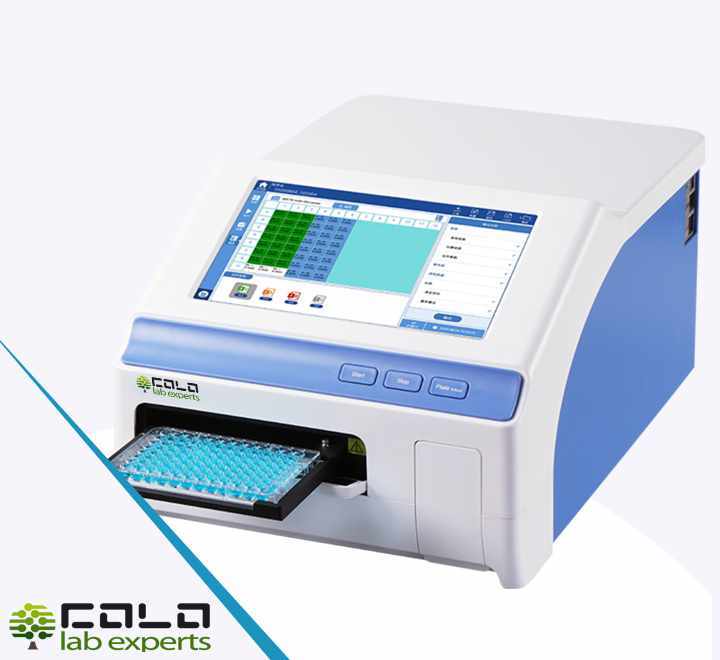
COLO.Science · BioScience · ELISA microplate washer
FLEXWASH ELISA microplate washer series — three models, ≤ 1 µL residual volume per well
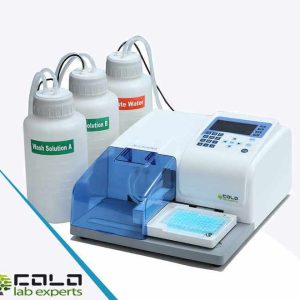
The FLEXWASH ELISA microplate washer series washes whole 96-well plates or single strips between the incubation steps of an ELISA. Both an 8-channel and a 12-channel manifold are supplied, residual volume stays at ≤ 1 µL per well, and soak, shake and bottom-wash steps are built into every program. Three models share this washing principle: FLEXWASH 3 (SKU PRO7228) and FLEXWASH 5 (PRO7229) are operated from an LCD panel, and FLEXWASH 10 (PRO6198) adds a touch screen, finer settings and three different wash liquids connected at the same time.
Which FLEXWASH model?
ELISA microplate washer overview
Washing decides how clean the background of an ELISA is. Every wash removes unbound antigen, antibody and conjugate; what stays behind in the well is carried into the next step and shows up as optical density that does not belong to the sample. A FLEXWASH ELISA microplate washer dispenses and aspirates all wells of a strip at once, at the same height and with the same timing, so that every well is washed the same way — something a multichannel pipette cannot repeat over a full working day.
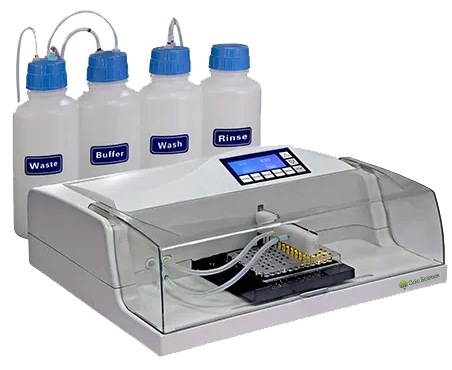
Key characteristics
- Residual volume ≤ 1 µL per well — low background and consistent optical density.
- 8-channel and 12-channel manifolds, both included.
- Whole plate or 1–12 strips, with strips skipped where wells are empty.
- 1–99 wash cycles, soak 0–24 h, shake and aspiration 0.1–9.9 s.
- One-point, two-point and complete bottom wash.
- Flat, U-bottom and V-bottom plates.
- Separate rinse, buffer and waste bottles; overflow alarm in the waste bottle.
Suitable for
- Clinical, hospital and veterinary laboratories running serology, infectious-disease and hormone ELISA kits.
- Food and feed laboratories testing allergens, mycotoxins and residues with ELISA kits.
- Research institutes and university laboratories working with immunoassays in 96-well plates.
- Teaching laboratories, where strip washing keeps small series economical.
- Laboratories that run several kits a day with different wash buffers — the FLEXWASH 10.
Why an automatic ELISA microplate washer
A wash step looks simple, yet it is where most variation in ELISA results comes from. Liquid left in the wells dilutes the next reagent, uneven aspiration leaves some wells wetter than others, and a needle set too low scratches the coated surface. The FLEXWASH ELISA microplate washer controls these points: the manifold height and position are adjustable, aspiration time is set from 0.1 to 9.9 s, and two-point aspiration and bottom wash remove the last droplets from the edge and the bottom of each well.
The bottle system is part of the same idea. Wash buffer is pushed to the manifold by pressure, the aspirated liquid passes a buffer bottle before it reaches the waste bottle, so the pump never sees liquid, and a separate rinse bottle with distilled water flushes the lines at the end of the day. Salt from the wash buffer then has no chance to dry inside the needles — the most common reason why a washer starts to dispense unevenly.
FLEXWASH ELISA microplate washer models compared
All three ELISA microplate washers wash the same plates with the same manifolds and reach the same residual volume. They differ in how they are operated and in how many wash liquids can stay connected.
| FLEXWASH 3 | FLEXWASH 5 | FLEXWASH 10 | |
|---|---|---|---|
| SKU | PRO7228 | PRO7229 | PRO6198 |
| Operation | LCD, 8-key membrane keypad | LCD, 8-key touch-button keypad | Touch screen |
| Wash liquid channels | 1 | 1 | 3 (A, B, C) |
| Bottles | 4 | 4 | 6 |
| Stored wash programs | up to 48 | up to 48 | up to 100 |
| Dispense volume setting | 10–3000 µL / well | 10–3000 µL / well | 10–9999 µL, step 1 µL |
| Shake time | 0–600 s | 0–600 s | 0–24 h |
| Line wash · pause | Rinse key · — | Rinse key · — | 1–10 min · yes |
| Power | 220 V, 50 Hz | 220 V, 50 Hz | AC 220 V ±10 %, 50 Hz, 65 VA |
| Dimensions · weight | 448 × 382 × 163 mm · 8 kg | 448 × 382 × 163 mm · 8 kg | 446 × 368 × 164 mm · 9 kg |
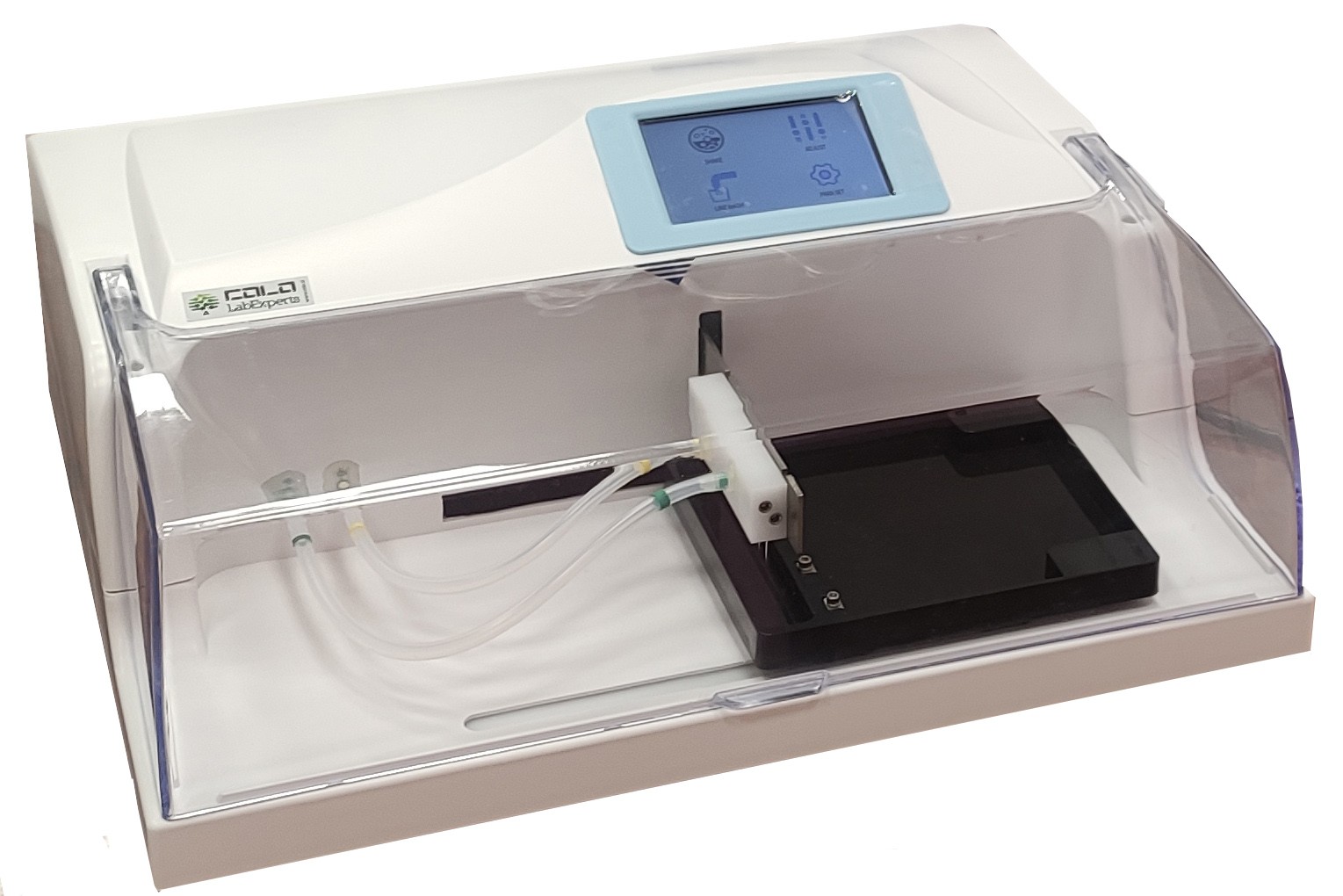
FLEXWASH 3 and FLEXWASH 5 share one mechanical platform and differ in the keypad: a membrane keypad on FLEXWASH 3, touch buttons on FLEXWASH 5. Both store up to 48 wash programs and suit laboratories with a steady routine of one or two kits.
FLEXWASH 10 is the touch-screen model: up to 100 programs, pause and resume during washing, line wash of 1–10 min and dispense volume set in 1 µL steps. Its three wash inlets let the program itself select wash liquid A, B or C.
Technical specifications of the FLEXWASH ELISA microplate washers
Washing
| Models / SKU | FLEXWASH 3 PRO7228 · FLEXWASH 5 PRO7229 · FLEXWASH 10 PRO6198 |
| Manifolds | 8-channel and 12-channel, both supplied |
| Plate format | 96-well plate (8 × 12) and strips |
| Plate bottom | Flat, U-bottom, V-bottom |
| Wash strips | 1–12, skip strip allowed |
| Wash cycles | 1–99 per program |
| Residual volume | ≤ 1 µL per well |
| Soak time | 0–24 h, step 1 s |
| Aspiration time | 0.1–9.9 s |
Operation and installation
| Operation | LCD keypad (FLEXWASH 3, 5) · touch screen (FLEXWASH 10) |
| Wash liquid channels | 1 · 3 on FLEXWASH 10 |
| Waste overflow | Liquid sensor with alarm |
| Operating environment | 5–40 °C, ≤ 80 % relative humidity |
| Shipping carton | 50 × 53 × 59 cm, 13 kg gross |
Four bottles or six — the FLEXWASH bottle system
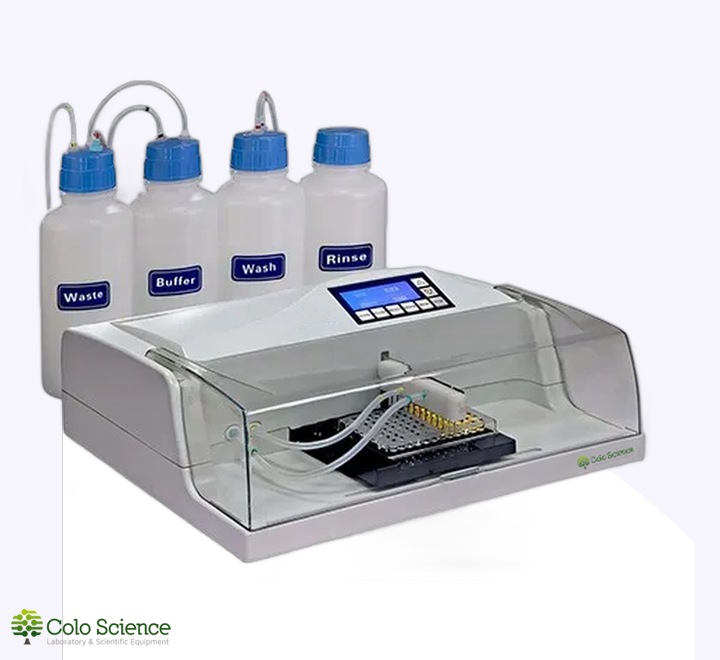
Single-channel models work with four bottles: wash (the wash buffer), rinse (distilled water for line wash), buffer (a vacuum trap that keeps aspirated liquid away from the pump) and waste (with the liquid sensor of the overflow alarm). The FLEXWASH 10 adds wash bottles B and C — six bottles in total.
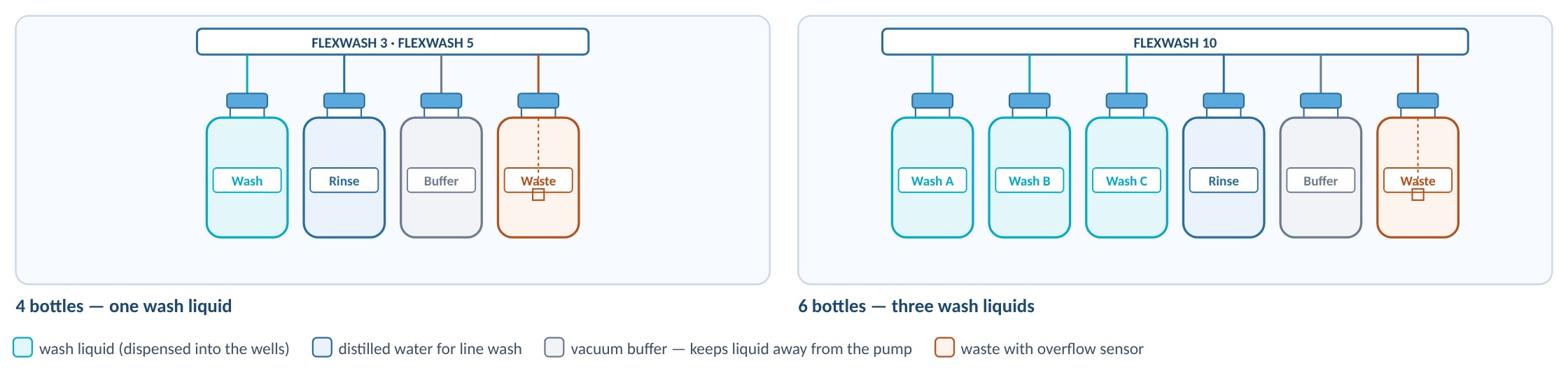
When six bottles pay off
- Several kits a day. ELISA kits often specify their own wash buffer or dilution. With three buffers connected, a change of kit does not mean emptying, rinsing and refilling a bottle.
- One program per kit. The wash channel is stored in the program: the operator chooses the program, the instrument chooses the buffer. Fewer mix-ups between kits.
- Less carry-over. Each buffer has its own bottle and line, so one kit’s buffer is not diluted by another.
- One buffer for all work? Then a single-channel model is the economical choice.
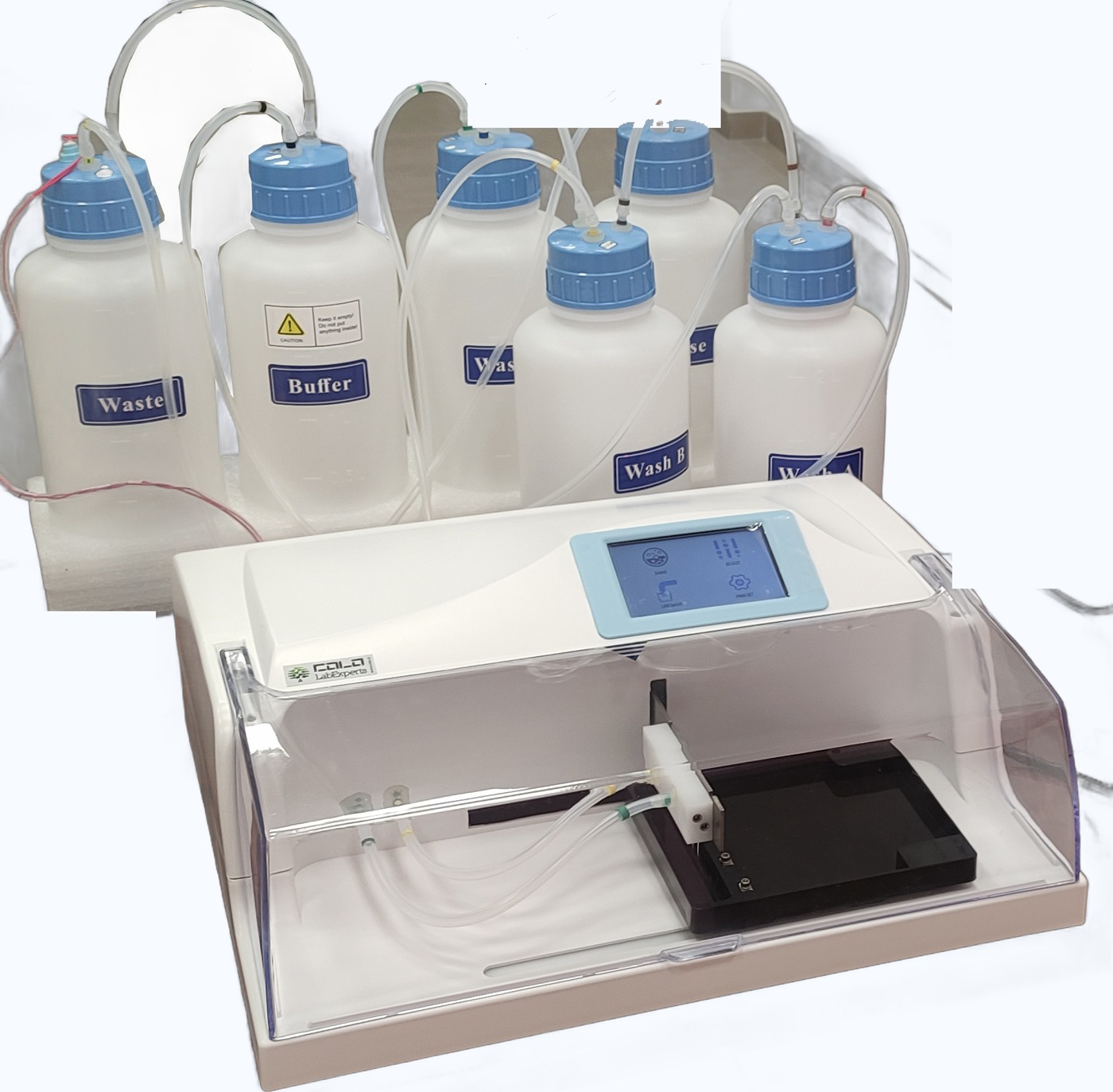
Multiple wash inlets are an established feature of laboratory plate washers, because they let one process use several buffers. Flushing the lines with distilled water after use is the standard recommendation against clogging — on every FLEXWASH model this is what the rinse bottle is for.
ELISA microplate washer programs and functions
Wash program
Each program defines the number of strips, the number of wash cycles (1–99), the dispense volume, soak or shake time and the aspiration time. Strips without samples can be skipped. FLEXWASH 3 and FLEXWASH 5 store up to 48 programs, FLEXWASH 10 up to 100, and on the FLEXWASH 10 the program also stores the wash channel.
Aspiration and bottom wash
One-point, two-point and complete bottom wash remove liquid from the centre, from the edge and from the bottom of the well. On the touch-screen FLEXWASH 10 bottom wash is set from 0.1 to 9.9 s and the wash liquid pressure can be fine-adjusted.
Rinse and line wash
After the last plate the lines are flushed with distilled water from the rinse bottle — with the rinse key on FLEXWASH 3 and FLEXWASH 5, and with an adjustable line wash of 1–10 min on FLEXWASH 10.
Construction, power and safe operation of the ELISA microplate washer
The plate carrier and the manifold sit under a transparent cover. Silicone tubing and bottle caps are colour-coded to the inlets on the back of the instrument, so that the bottles are connected the same way after every cleaning. A filter at the end of the wash-bottle suction line keeps particles out of the needles.
FLEXWASH 3 and FLEXWASH 5 run on 220 V, 50 Hz and weigh 8 kg (448 × 382 × 163 mm). FLEXWASH 10 runs on AC 220 V ±10 %, 50 Hz, 65 VA and weigh 9 kg (446 × 368 × 164 mm). All models work at 5–40 °C and up to 80 % relative humidity.
Standard delivery of the ELISA microplate washer
- FLEXWASH ELISA microplate washer, ordered model.
- 8-channel and 12-channel manifolds.
- Bottles: 4 (FLEXWASH 3, 5) or 6 (FLEXWASH 10), with colour-coded caps.
- Silicone tubing set.
- Power cord.
- User manual.
Delivery, installation and operator training by COLO.Science are quoted on request. Prices are net B2B prices.
Knowledge base
COLO.Science knowledge base — methods, application notes and practical advice on laboratory instruments.
Applications
In a typical ELISA the plate is washed three to five times after each incubation: after coating and blocking, after the sample, after the detection antibody and after the conjugate. A FLEXWASH ELISA microplate washer repeats these steps with the same volume and timing for every strip, from the first plate of the day to the last.
Together with an ELISA microplate reader such as the FLEX reader, the ELISA microplate washer completes the ELISA workstation for diagnostic, food-safety and research laboratories.
How to choose the right ELISA microplate washer
- One wash buffer, simple routine: FLEXWASH 3 or FLEXWASH 5 — the same washing, keypad or touch buttons.
- Many protocols and two or three different wash buffers in daily use: FLEXWASH 10 — touch screen, up to 100 programs, six bottles, buffer selected by program.
- Plates: all models take flat, U- and V-bottom 96-well plates and strips with both manifolds.
- Reader: add an ELISA microplate reader for the complete workstation.
Configuration notice
The model, mains voltage, number of wash liquids and the delivery scope of the ELISA microplate washer are confirmed in the COLO.Science quotation. Specifications may change without notice.