


COLO.Science · Spectroscopy & Color · Liquid colour measurement
CS4010 Liquid Spectrophotometer — colour and transmittance of liquids
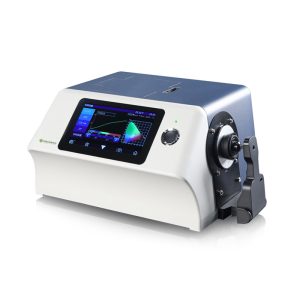
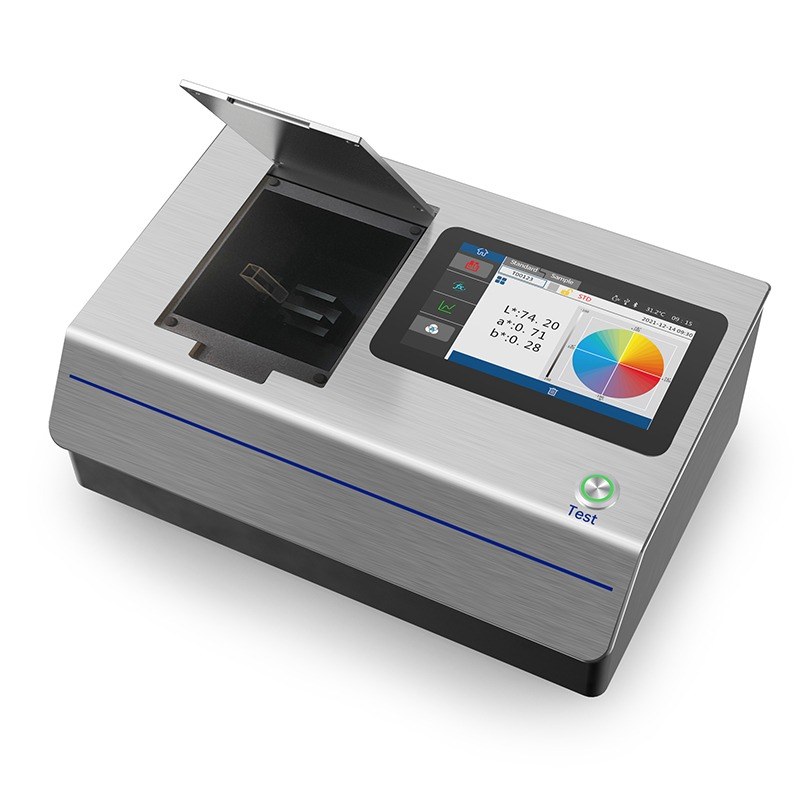
The CS4010 liquid spectrophotometer (COLO product code PRO7936) measures the colour and spectral transmittance of clear and coloured liquids in a cuvette and reports them as CIE colour values, colour difference to a standard and the liquid colour scales used in specifications — Pt-Co (APHA / Hazen), Gardner, Saybolt, ASTM D1500, pharmacopoeia colour, EBC and ICUMSA. It is the instrument for routine colour control of liquids with standard cuvettes.
Which instrument?
Overview
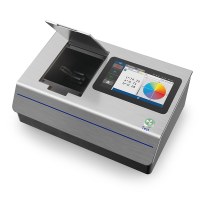
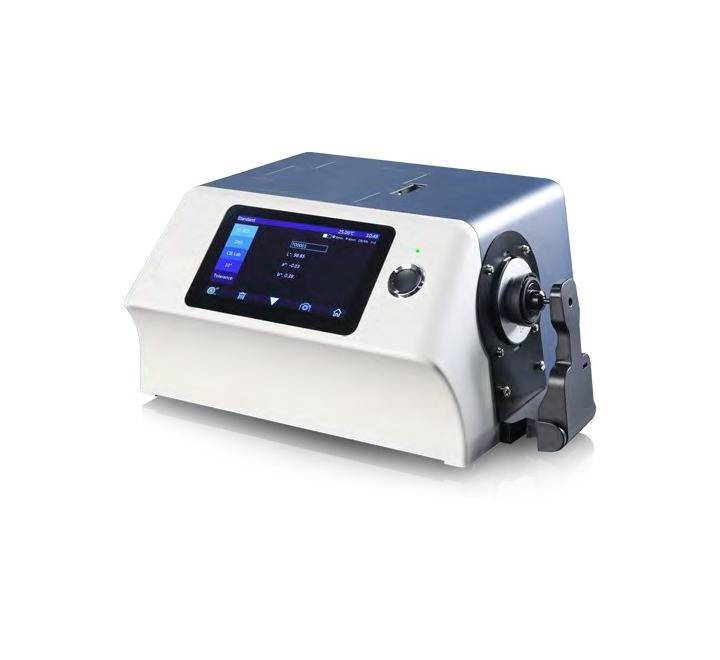
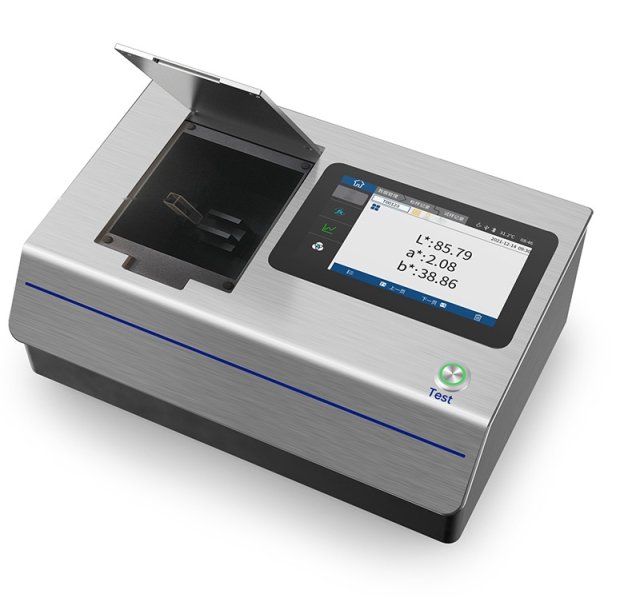
Fill the cuvette, place it in the compartment and press Test: in about 0.8 s the instrument shows the transmission spectrum, the colour values, the colour difference to the stored standard, the selected colour scale and a pass/fail result. Intelligent zero calibration keeps the results stable through the working day.
Key characteristics
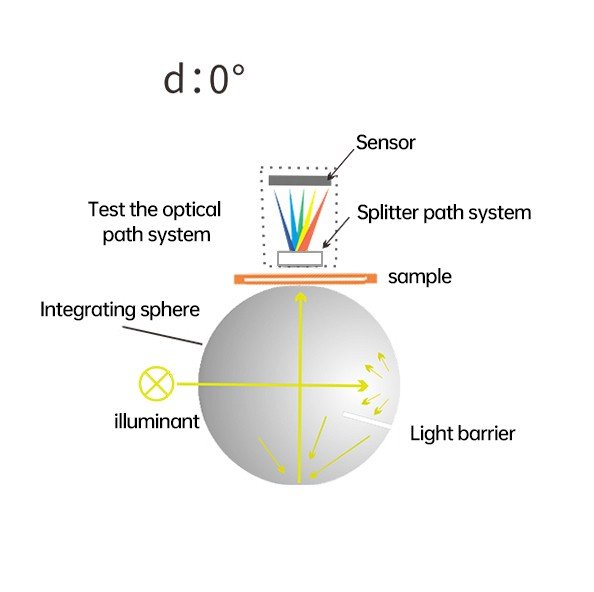
- Transmission d/0 with Ø40 mm integrating sphere, Ø10 mm aperture
- Flat grating and dual 40-element silicon photodiode array, 360–780 nm in 10 nm steps, 0–200 % transmittance
- Liquid colour scales: Pt-Co / APHA / Hazen, Gardner, Saybolt, ASTM D1500, pharmacopoeia colour, EBC, ICUMSA
- Repeatability ΔE*ab 0.015, inter-instrument agreement ΔE*ab 0.25
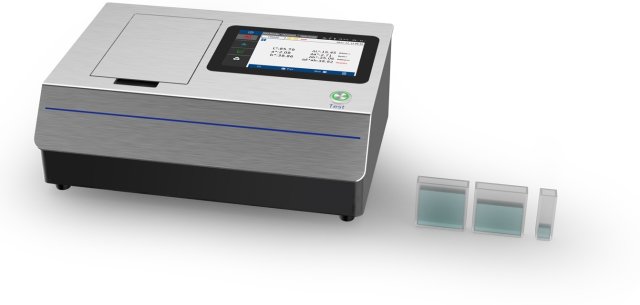
- 10 mm and 50 mm cuvettes with holder in standard delivery; micro-volume holder as option
- 7″ capacitive touch screen, 1 000 standards and 10 000 samples, audit trail, USB, serial printer port
Suitable for
- Solvents, resins, plasticisers and other chemicals — Pt-Co / APHA / Hazen and Gardner colour in incoming and release control
- Oils, fuels and petroleum products — Saybolt and ASTM D1500 colour
- Pharmaceutical solutions — colour against Ph. Eur., USP and ChP colour references
- Food and beverages — beer (EBC), sugar solutions (ICUMSA), juices, syrups, edible oils
- Cosmetic liquids, dyes and clear films or plates in transmission
What is liquid colour measurement for?
The colour of a liquid is one of its specification values. A solvent, a resin, an oil or a pharmaceutical solution leaves production or enters the plant with a colour limit — for example a maximum Pt-Co (APHA / Hazen) value, a Gardner or Saybolt number, an ASTM D1500 colour or a pharmacopoeia colour reference. A change of colour is often the first visible sign of oxidation, thermal damage, contamination, an incomplete purification step or a raw-material change.
Traditionally the sample is compared by eye with reference solutions or coloured glass discs. The result depends on the operator, the light in the room and the tube used, and it cannot be stored as a number with a measured spectrum. A liquid colour spectrophotometer measures the transmission spectrum of the sample and calculates all these scales from it — the same sample gives the same value on every shift and at every site, and the record is kept for audits and certificates.
- Release and incoming control — the colour value on the certificate of analysis measured, not estimated.
- Process monitoring — colour drift of a batch shows a deviation before other tests do.
- One instrument, many scales — Pt-Co, Gardner, Saybolt, ASTM D1500, pharmacopoeia, EBC, ICUMSA and CIE Lab from one measurement.
- Colour difference to a standard — ΔE and pass/fail against the approved batch, under the illuminant and observer your customer specifies.
Liquid colour spectrophotometer or UV/Vis spectrophotometer?
Both instruments send light through a cuvette, but they answer different questions. A UV/Vis spectrophotometer is an analytical instrument: it measures absorbance at selected wavelengths and, through a calibration, the concentration of a substance. A liquid colour spectrophotometer measures the visible transmission spectrum and expresses it as colour — the way the eye sees it under a defined light, and in the colour scales of industry and pharmacopoeia.
| Liquid colour spectrophotometer (CS4010) | UV/Vis spectrophotometer | |
|---|---|---|
| Question it answers | What colour is the liquid, is it within the colour specification? | How much of a substance is in the sample? |
| Main result | CIE Lab, ΔE to a standard, Pt-Co, Gardner, Saybolt, ASTM D1500, EBC, ICUMSA, pass/fail | Absorbance, transmittance, concentration, spectrum scan, kinetics |
| Wavelength range | Visible, 360–780 nm — the range relevant for colour | Typically 190–1100 nm, including UV |
| Optics | d/0 transmission with integrating sphere, as defined by CIE for colour measurement | Narrow parallel beam at a selected wavelength, single or double beam |
| Colour calculation | Built in: 2° / 10° observer, standard illuminants, colour-difference formulas | Not intended; needs separate software and method |
| Typical user | QC of solvents, oils, chemicals, pharmaceuticals, beverages | Analytical and research laboratories, water and environmental analysis |
If your method prescribes absorbance at a wavelength or a concentration, choose a UV/Vis spectrophotometer; if it prescribes a colour value, a colour scale or a colour difference, the liquid colour spectrophotometer is the right instrument. Many QC laboratories use both.
On the instrument
Technical specifications
Optics and performance
| Measuring geometry | Transmission d/0 (diffuse illumination, 0° viewing) |
| Standards | CIE No. 15, ASTM E308, ASTM D1003 / D1044, DIN 5033-7, GB/T 3978, GB 2893, GB/T 18833 |
| Integrating sphere | Ø40 mm |
| Light source | Combined full-spectrum LED; more than 3 million measurements in 5 years |
| Optics | Flat grating, silicon photodiode array (dual row of 40 elements) |
| Wavelength range | 360–780 nm, 10 nm interval, 5 nm half bandwidth |
| Transmittance range | 0–200 % |
| Measuring aperture | Ø10 mm |
| Repeatability | ΔE*ab 0.015; spectral transmittance SD within 0.05 % (400–700 nm: 0.04 %) |
| Inter-instrument agreement | ΔE*ab 0.25 (average of 5 transmission colour plates) |
| Measuring time | approx. 0.8 s (fast mode) |
Colour data and general
| Liquid colour scales and indices | Pt-Co / APHA / Hazen, Gardner, iron-cobalt, Saybolt, ASTM D1500, pharmacopoeia colour (Ph. Eur., USP, ChP), EBC, ICUMSA, Klett, iodine, turbidity, RYBN, transmittance, absorbance; WI, YI, TI, metamerism index |
| Colour spaces | CIE Lab, XYZ, Yxy, LCh, CIE Luv, Munsell, sRGB, Hunter Lab, βxy, DIN Lab99, CMYK (partly via PC software) |
| Colour difference | ΔE*ab, ΔE*uv, ΔE*94, ΔE*cmc (2:1 and 1:1), ΔE*00, DIN ΔE99, ΔE Hunter, ΔE*CH |
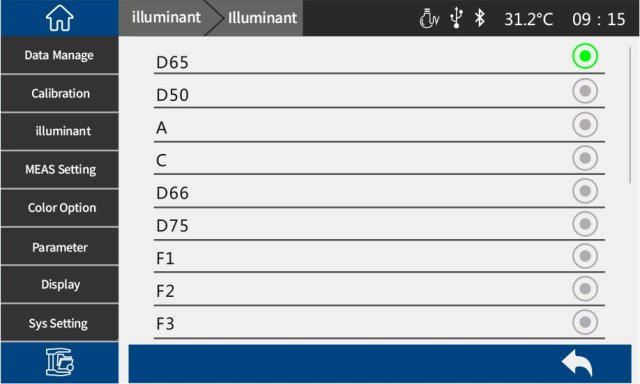
| Observer · illuminants | 2° and 10° · 41 illuminants incl. D65, A, C, D50, F-series and LED (via PC software) |
| Calibration | Intelligent zero calibration; transmission black board |
| Display | 7″ TFT colour, capacitive touch screen |
| Interface · storage | USB, serial printer port · 1 000 standards, 10 000 samples; audit trail |
| Power | 24 V DC / 3 A power adapter |
| Dimensions · weight | 370 × 255 × 140 mm · approx. 4.9 kg |
| Operating environment | 0–40 °C; storage −20–50 °C |
Measuring and data
Results are stored with the standard and can be printed on the micro-printer or transferred to a PC. The PC quality-management software builds reports and keeps the audit trail; data are transferred by USB, serial printer port.
For pale liquids (low Pt-Co or Saybolt values) a longer cuvette increases sensitivity; dark liquids such as Gardner-range resins or oils are measured in the 10 mm cuvette.
CS4010 or CS4020 — comparison
Both models share the same benchtop body, d/0 transmission optics with a Ø40 mm sphere, full-spectrum LED, 360–780 nm, 0–200 % transmittance, the same colour scales and indices and the 7″ touch screen. They differ in precision, sample volume and data transfer:
| CS4010 | CS4020 | |
| Repeatability ΔE*ab | 0.015 | 0.01 |
| Inter-instrument agreement ΔE*ab | 0.25 | 0.2 |
| Micro-volume holder (from 1 ml) | option | standard |
| Cuvettes in delivery | 10 mm, 50 mm + 50 mm holder | 10 mm, 50 mm |
| Interface | USB, serial printer port | USB, serial printer port, Bluetooth |
| Optics, range, colour scales, screen | same | same |
- CS4010 — routine colour control of liquids in 10 mm and 50 mm cuvettes: solvents, oils, fuels, beverages; the economical choice when sample volume is not limited.
- CS4020 — tighter repeatability and inter-instrument agreement for specifications with narrow tolerances, small or expensive samples from 1 ml (pharmaceuticals, fine chemicals, R&D) and wireless data transfer.
Standard delivery
- CS4010 liquid spectrophotometer with 7″ touch screen
- 10 mm cuvette, 50 mm cuvette, 50 mm cuvette holder
- Transmission test holder assembly
- Transmission black board
- Power adapter, data cable; PC quality-management software available for download
- User guide
Options: micro-printer, micro-volume holder Ø4 mm, 30 mm and 100 mm cuvettes. The delivered configuration for a specific order is the one confirmed in the COLO.Science quotation.
Knowledge base
New to colour measurement? Light sources, CIE Lab, ΔE, measuring geometries and transmission measurement of liquids are explained in the Colour Measurement Guide and on COLO.Science, our knowledge base.
Selection guide
- Colour of liquids only: the CS40 liquid colour spectrophotometers — see the comparison above.
- Liquids and also solids, powders or pastes: the CS60 benchtop series with reflectance and transmittance.
- Concentration, absorbance at a wavelength, UV range: a UV/Vis spectrophotometer.
- Not sure which colour scale your customer means? Send us the specification — we confirm the method with the quotation.
Configuration notice
This page is provided for orientation and product selection. The colour scales, cuvettes, accessories and the data you report are confirmed with the official COLO.Science quotation.
Sales and support for international customers
COLO Lab ExpertsPolje ob Sotli 4, SI-3255 Buče, Slovenia
Phone: +386 70 713 437 · Email: sales@colo.si · Web: colo.si
We supply laboratories across Europe directly and through partners. B2B prices are quoted net, excluding VAT.