


COLO.Science · Spectroscopy & Color · Multi-angle colour measurement
CM3005 Multi-Angle Spectrophotometer — 5 angles for metallic and effect finishes
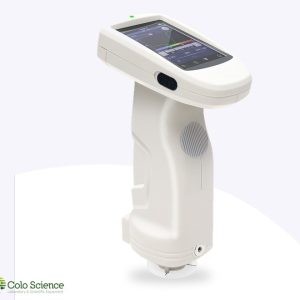
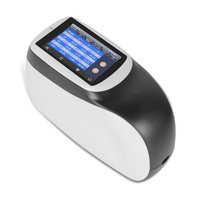
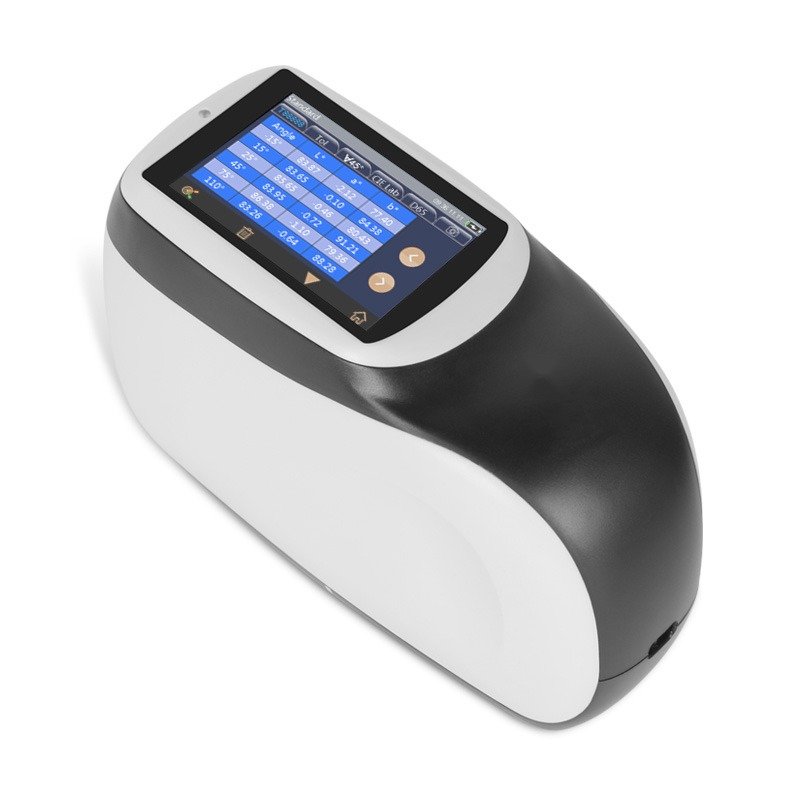
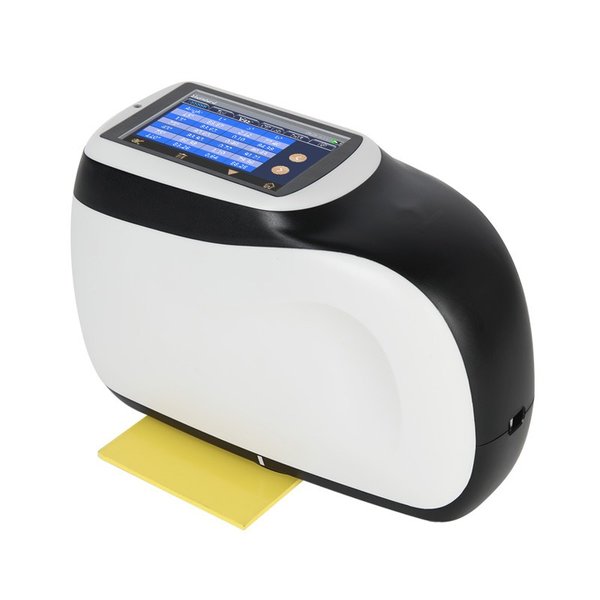
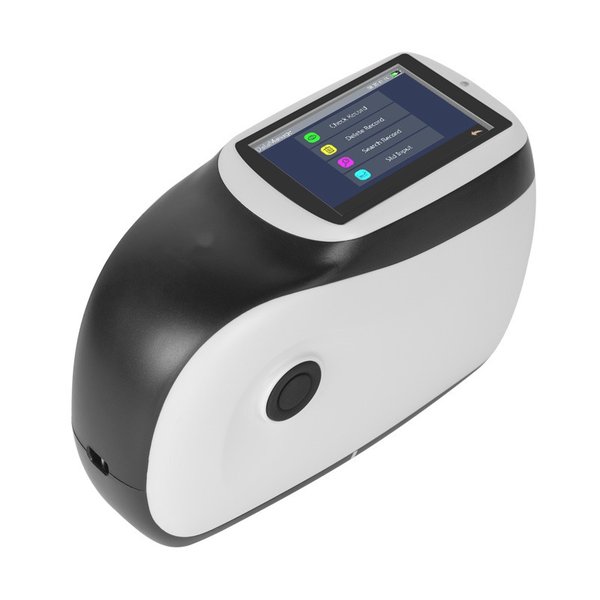
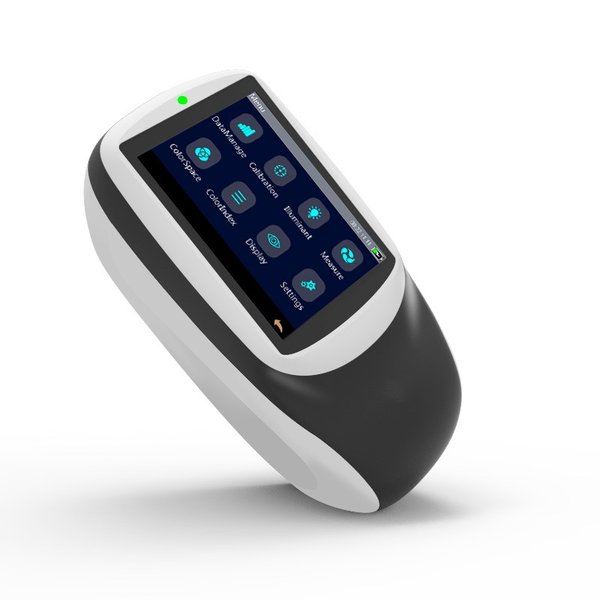
The CM3005 multi-angle spectrophotometer (COLO product code PRO7922) measures the colour of metallic, pearlescent and other special-effect finishes at 5 angles in one measurement, with 1 receiver (45°). It is a handheld, battery-powered instrument for the car body, the paint shop, the production line and the laboratory.
Which model?
 Near-specular, face and flopCM30033 angles · 45° receiverFive ASTM/DIN anglesCM30055 angles · 45° receiverSix angles + effect valuesCM30066 angles · 45° receiver · SG/DC/CVSecond 15° receiverCM30088 angles · 45° + 15° receivers · SG/DC/CVTwelve angles, two receiversCM301212 angles · 45° + 15° receivers · SG/DC/CV
Overview
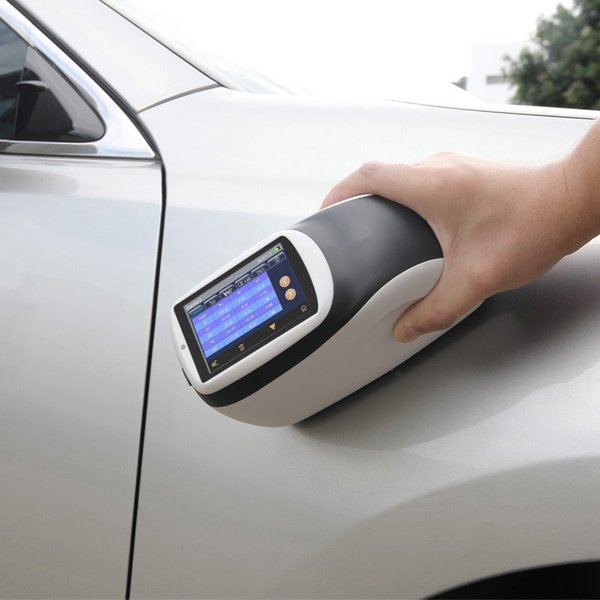
Place the instrument on the panel and press the button: all 5 angles are measured in about 5 s and shown in one table on the touch screen, with the colour difference to the standard at every angle and a pass/fail result.
Key characteristics
- 5 measuring angles in one measurement, 1 receiver (45°)
- Concave grating and 256-pixel dual-array CMOS sensor, 400–700 nm in 10 nm steps, 0–600 % reflectance
- Full-spectrum LED with blue enhancement
- Repeatability ΔE*ab 0.03, inter-instrument agreement 0.2 ΔE*00
- Flop index and colour difference at every angle
- Colour camera preview, 3.5″ touch screen, USB and Bluetooth 5.0, battery operation
Suitable for
- Automotive OEM coatings: body colours, bumpers, mirror caps and other add-on parts matched to the body
- Refinish and body repair: the repair colour checked against the original paint at every angle
- Paint and effect-pigment producers: aluminium, mica and interference pigments in development and incoming inspection
- Coated plastics and consumer goods with metallic or pearlescent finish
Why multi-angle
A metallic or pearlescent coating does not have one colour: near the gloss angle it is light and saturated, at the face angle it shows its main colour, and at a flat angle (the flop) it turns darker or changes hue. Two panels can match at 45° and still look different on the car. A multi-angle instrument measures every angle the standard prescribes, so a mismatch is found before the parts are assembled. The CM3005 measures the five angles used in the ASTM and DIN methods for metallic finishes.
On the instrument
Technical specifications
Optics and performance
| Measuring geometry | 5 angles, 1 receiver (45°) |
| Measuring angles | 45° receiver: 45as15°, 45as25°, 45as45°, 45as75°, 45as110° |
| Standards | ASTM D2244, E308, E1164, E2194, E2539; DIN 5033, 5036, 6174, 6175-1, 6175-2; ISO 7724, ISO 11664-4; SAE J1545 |
| Light source | Full-spectrum LED with blue enhancement; 5 years, 3 million measurements |
| Optics | Concave grating, 256-pixel dual-array CMOS image sensor |
| Wavelength range | 400–700 nm, 10 nm interval |
| Reflectance range | 0–600 % |
| Measuring aperture | Illumination Ø23 mm, spot 9 × 12 mm |
| Repeatability | ΔE*ab 0.03; spectral reflectance SD within 0.08 % |
| Reproducibility | ΔE* < 0.10 grey BCRA tile; < 0.25 colour BCRA tiles |
| Inter-instrument agreement | 0.2 ΔE*00 (BCRA Series II tiles) |
Colour data and general
| Colour spaces | CIE Lab, XYZ, Yxy, LCh, βxy, DIN Lab99 |
| Colour difference | ΔE*ab, ΔE*94, ΔE*cmc (2:1 and 1:1), ΔE*00, DIN ΔE99, ΔE DIN 6175 |
| Other indices | Flop index |
| Observer | 2° and 10° |
| Illuminants | D65, A, C, D50, D55, D75, F1–F12 (incl. CWF, DLF, TPL5, TL84, TL83/U30) |
| Measuring time | approx. 1 s per angle, approx. 5 s for all angles |
| Measurement modes | Single, average 1–99, continuous 1–99; button or software trigger |
| Positioning · display | Colour camera preview · 3.5″ TFT capacitive touch screen |
| Interface · storage | USB, Bluetooth 5.0 · 1 000 standards, 4 000 samples |
| Calibration | White calibration board, black light trap; 4 h, 8 h, 24 h or at start-up |
| Power | Li-ion 3.7 V, 5 000 mAh; 6 000 measurements in 8 h |
| Dimensions · weight | 195 × 83 × 128 mm · approx. 1 kg |
| Operating environment | 10–50 °C, ≤ 85 % RH, non-condensing |
Measuring and data
All 5 angles are measured with one press of the button; the camera preview shows where the instrument sits on the part. The instrument keeps 1 000 standards and 4 000 samples and transfers data by USB or Bluetooth 5.0; the PC software is available for download.
Which model in the series?
All models share the same handheld body, concave-grating optics with a 256-pixel CMOS array, 400–700 nm, 0–600 % reflectance, camera preview and a 3.5″ touch screen. They differ in the number of angles and receivers and in the effect values:
| CM3003 | CM3005 | CM3006 | CM3008 | CM3012 | |
| Measuring angles | 3 | 5 | 6 | 8 | 12 |
| Receivers | 45° | 45° | 45° | 45° + 15° | 45° + 15° |
| 45° receiver angles | 25° · 45° · 110° | 15° · 25° · 45° · 75° · 110° | −15° · 15° · 25° · 45° · 75° · 110° | as CM3006 | as CM3006 |
| 15° receiver angles | — | — | — | −15° · 15° | −45° · −30° · −15° · 15° · 45° · 80° |
| Effect values SG · DC · CV | — | — | ✓ | ✓ | ✓ |
| Repeatability ΔE*ab | 0.04 | 0.03 | 0.03 | 0.03 | 0.02 |
| Inter-instrument ΔE*00 | 0.2 | 0.2 | 0.2 | 0.18 | 0.18 |
| All angles | ≈ 3 s | ≈ 5 s | ≈ 6 s | ≈ 8 s | ≈ 12 s |
- CM3003 — routine check of metallic colours: near-specular, face and flop angle.
- CM3005 — the five angles of the ASTM and DIN methods for metallic finishes, for paint shops and suppliers of add-on parts.
- CM3006 — six angles plus sparkle grade, coarseness and colour variation, when the effect pigment itself must be controlled.
- CM3008 — adds a 15° receiver for pearlescent and interference pigments.
- CM3012 — twelve angles with two receivers for development laboratories and OEM colour approval.
Standard delivery
- CM3005 multi-angle spectrophotometer with 3.5″ touch screen and built-in battery
- White calibration board and black light trap
- Power adapter, USB cable; PC software available for download
- Carrying case for transport and storage
- Protective cap, wrist strap, user guide
The delivered configuration for a specific order is the one confirmed in the COLO.Science quotation.
Knowledge base
New to colour measurement? Light sources, metamerism, CIE Lab, ΔE and measuring geometries — including multi-angle measurement of effect finishes — are explained on COLO.Science, our knowledge base.
Selection guide
- Metallic, pearlescent and special-effect finishes: the CM30 multi-angle series — see the comparison above.
- Solid colours with a hand-held 45/0 instrument: the CS45 portable series.
- Solid colours with d/8 and SCI/SCE: the CS70 portable series.
- Reflectance and transmittance on the bench: the CS60 benchtop series.
Configuration notice
This page is provided for orientation and product selection. The finish, angles, aperture and the colour data you report are confirmed with the official COLO.Science quotation.
Sales and support for international customers
COLO Lab ExpertsPolje ob Sotli 4, SI-3255 Buče, Slovenia
Phone: +386 70 713 437 · Email: sales@colo.si · Web: colo.si
We supply laboratories across Europe directly and through partners. B2B prices are quoted net, excluding VAT.