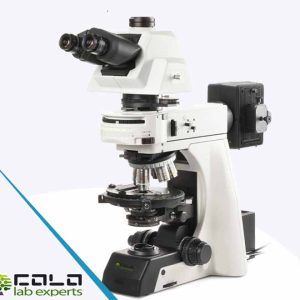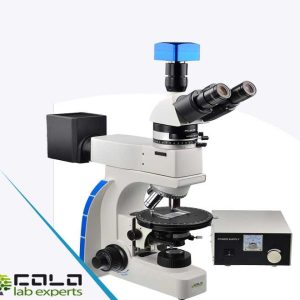



In routine laboratory work, polarization microscopy is often the fastest way to reveal anisotropic properties in a sample—crystals, minerals, stress patterns in glass and polymers, fibers, and other optically active materials.
Good polarization microscopy starts with a stable stand, correct optics and illumination, and a configuration that matches day-to-day laboratory workflow.
The Polarization Microscopes category in the COLO Lab Store brings together reliable microscopes designed for everyday use in education, geology/mineralogy, materials analysis, industrial QC, and general laboratory observation under polarized light.
Choose by head type (mono / binocular / trinocular), illumination (LED / Halogen), and polarization-specific add-ons (rotating stage, polarizer/analyzer, compensators, Bertrand lens).
MICROSCOPY NAVIGATION
- Polarization microscopes –
for crystal/mineral analysis, stress inspection, and characterization of anisotropic samples. - COLO.Science microscopy hub –
practical guidance for selecting optics, illumination, and configurations. - Typical configurations –
binocular for comfortable daily use, trinocular when documentation/camera work is required, and robust stands for teaching and shared labs.
FEATURED: ROUTINE POLARIZATION SETUPS
For routine polarized-light workflows, the best value usually comes from LED illumination, a stable stand, and a practical objective set (typically 4× / 10× / 40×, depending on application).
For polarization tasks, a rotating stage, polarizer/analyzer, and—when needed—compensators and a Bertrand lens are key for accurate daily analysis.
If your lab requires documentation, prioritize a trinocular head and smooth focusing/ergonomics for long sessions.
Polarization microscopes
Showing all 2 results