


COLO.Science · Spectroscopy & Color · Gloss measurement
CG60M Small Aperture Gloss Meter — 60° gloss on curved and small parts
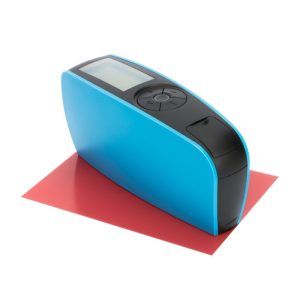
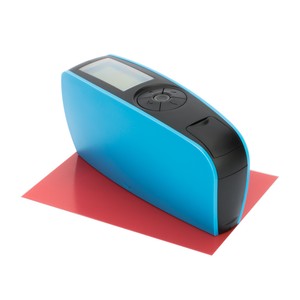
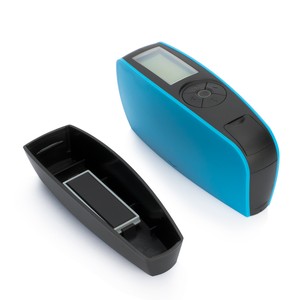
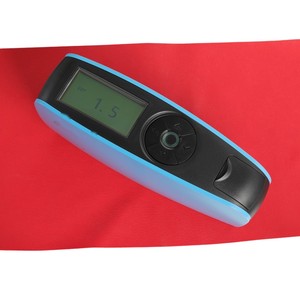
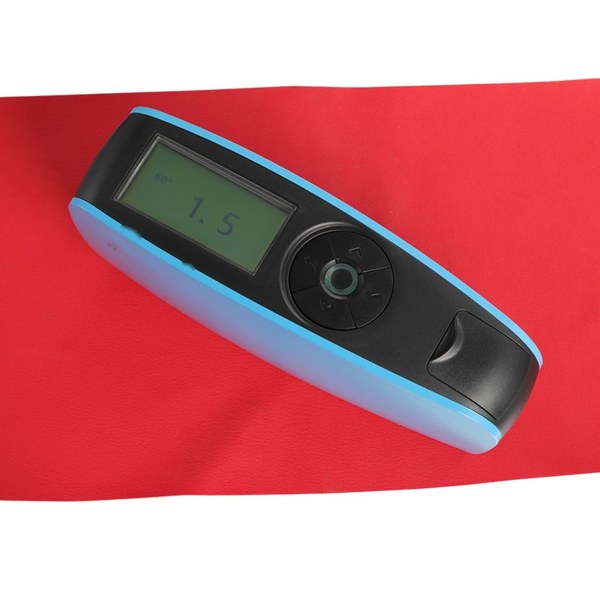
The CG60M small aperture gloss meter (COLO product code PRO7997) is a 60° gloss meter with a measuring spot of only 2 × 4 mm, made for surfaces where a standard gloss meter cannot sit flat: curved housings, handles, profiles, buttons, small moulded parts and even fruit.
Which gloss meter?
Overview
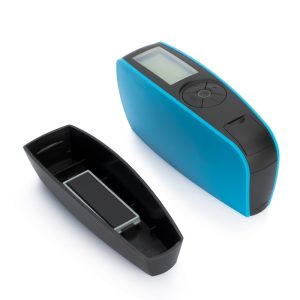
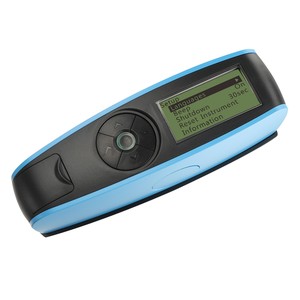
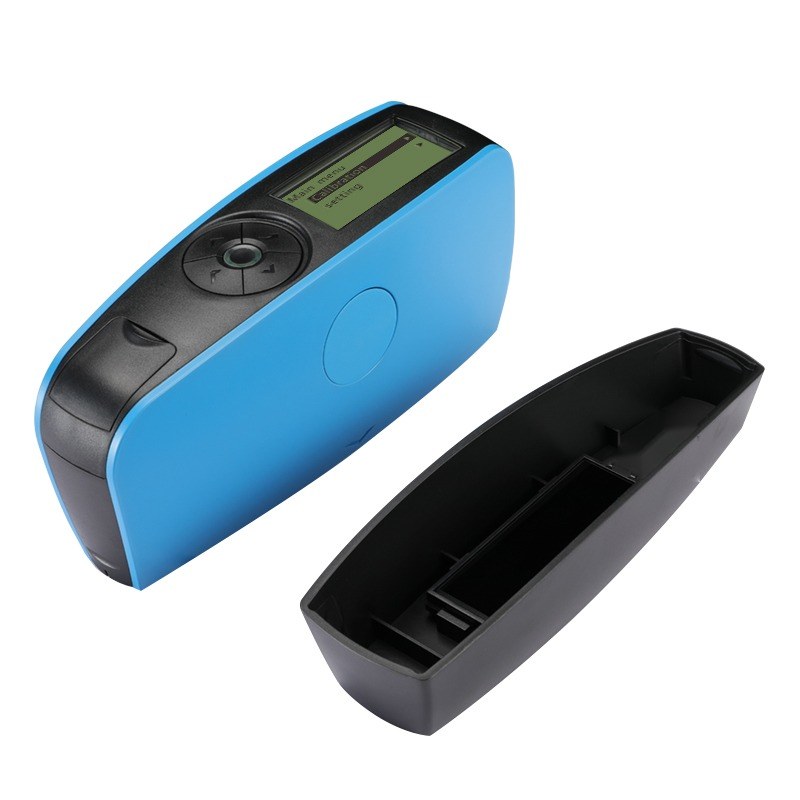
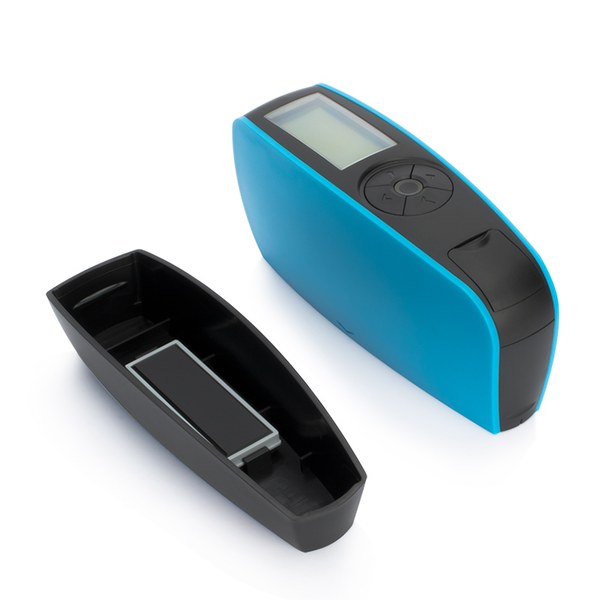
Working with the CG60M small aperture gloss meter is simple. Place the instrument flat on the sample and press the measuring key: the 60° value appears in 0.5 s. Calibration on the standard in the base takes a few seconds; statistics, continuous measurement over a panel and pass/fail limits make routine work quick.
Key characteristics
- Measuring angle: 60°
- Range 60°: 0–1000 GU
- Measuring spot 60°: 2 × 4 mm
- Repeatability 0–100 GU: ±0.2 GU · 100–1000 GU: ±0.2 %
- Working gloss meter to JJG 696
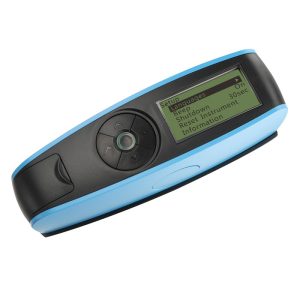
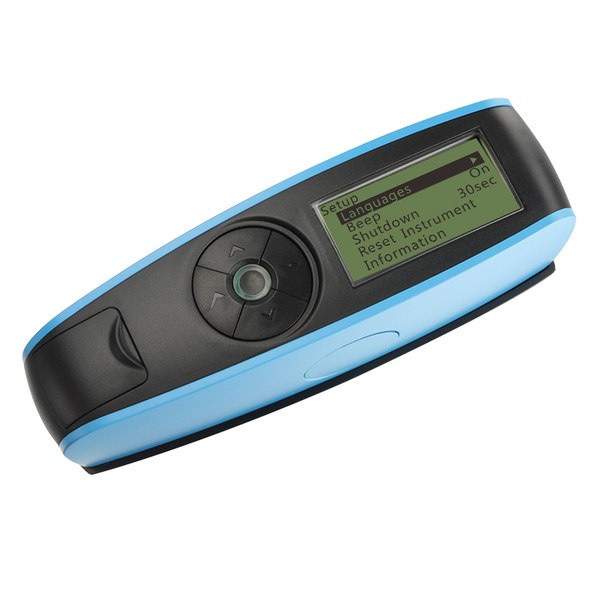
- 2.3″ monochrome display, keypad; 35 000 readings
- USB; Bluetooth with optional adapter; 1 × AA battery (more than 10 000 measurements) or USB power
Suitable for
- Curved housings, handles, knobs and profiles
- Buttons, inserts and small moulded parts
- Electronics and hardware — visible parts, plating, anodising
- Fruit and food — surface shine, e.g. apples with edible coatings
What is gloss and how is it measured?
Gloss is the light a surface reflects in the mirror direction. A polished surface looks glossy and shows a sharp reflected image; a matt surface scatters the light and looks dull. Gloss is given in gloss units (GU): a polished black glass standard is 100 GU, metals and mirrors read more.
A gloss meter sends a beam onto the sample at a fixed angle and measures the light reflected at the same angle on the other side. The angle matters: 60° for most surfaces, 20° for high gloss (above 70 GU at 60°), 85° for matt finishes (below 10 GU at 60°); 45° and 75° are used for ceramics, films and paper. Always report the angle with the value.
- High gloss — car paint, piano lacquer, polished stone: measure at 20°.
- Semi-gloss — most industrial coatings and plastic parts: 60°.
- Matt — wall paints, interior car parts, textured plastics: 85°.
- Ceramics, films, paper — 45° and 75°.
Gloss meter or colour spectrophotometer?
The CG60M small aperture gloss meter answers how glossy a surface is; a colour spectrophotometer answers what colour it is. Gloss changes how a colour is seen, and colour spectrophotometers show it as the difference between SCI and SCE readings. They do not give a gloss value in GU. When gloss is specified, it is measured with a gloss meter; colour and gloss are often checked together.
| Gloss meter (CG60M) | Colour spectrophotometer | |
|---|---|---|
| Main value | Gloss in GU at 60° | Colour (CIE Lab, ΔE), SCI/SCE |
| Geometry | Specular, 60° | d/8 or 45/0 |
| Standards | JJG 696 | CIE colour standards |
| Typical use | Gloss specification and QC | Colour specification and QC |
On the instrument
Technical specifications
Measurement
| Measuring angles | 60° |
| Standards | JJG 696 working gloss meter |
| Measuring range | 60°: 0–1000 GU |
| Measuring spot | 60°: 2 × 4 mm |
| Resolution | 0.1 GU |
| Repeatability | 0–100 GU: ±0.2 GU · 100–1000 GU: ±0.2 % |
| Measuring time | 0.5 s |
| Measuring modes | Basic, statistical, continuous and QC (pass/fail) mode |
Data and general
| Calibration | Calibration plate in the base, recognised automatically; manual calibration possible |
| Display | 2.3″ monochrome display, keypad |
| Data storage | 35 000 readings |
| Interface | USB; Bluetooth with optional adapter |
| Power | 1 × AA battery (more than 10 000 measurements) or USB power |
| Dimensions · weight | 160 × 52 × 84 mm (L × W × H), approx. 300 g |
| Instrument languages | English, Chinese (simplified and traditional) |
| Operating environment | 0–40 °C, below 85 % RH non-condensing; storage −20–50 °C |
Which model? — comparison
All five measure 0–1000 GU or more with ±0.2 GU repeatability (0–100 GU), store readings, offer statistics and pass/fail, and connect to the PC. They differ in angles and measuring spot:
| CGT268 | CG268 | CG60 | CG60M | CG47 | |
|---|---|---|---|---|---|
| Angles | 20° / 60° / 85° | 20° / 60° / 85° | 60° | 60° | 45° / 75° |
| Max. range | 2000 GU | 2000 GU | 1000 GU | 1000 GU | 800 GU |
| Small spot 2 × 4 mm | — | — | — | ✓ | — |
| Touch screen | ✓ | — | — | — | — |
| Power | Li-ion | AA / USB | AA / USB | AA / USB | AA / USB |
| Memory | 5 000 per mode | 35 000 | 35 000 | 35 000 | 35 000 |
- CGT268 — laboratory and incoming inspection over the full gloss range, with touch screen and rechargeable battery.
- CG268 — the same three angles in a compact instrument for production and field use.
- CG60 — routine 60° control where the specification names one angle.
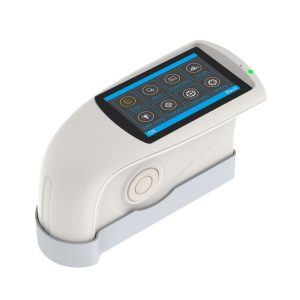
- CG60M — curved, narrow and small parts, 2 × 4 mm spot.
- CG47 — 45° and 75° for ceramics, films, paper and print.
Standard delivery
- CG60M with calibration plate in the protective base
- USB cable; PC quality software
- User guide
Options: mini printer, bluetooth adapter. The delivered configuration for a specific order is the one confirmed in the COLO.Science quotation.
Knowledge base
Gloss units, angles and standards are explained in the Gloss Measurement Guide, colour values in the Colour Measurement Guide, and practical examples on COLO.Science, our knowledge base.
Selection guide
- Choosing the angle: see the Gloss Measurement Guide.
- Colour of the same samples: the CS60 benchtop spectrophotometers (SCI and SCE).
- Haze of transparent films and sheets: the haze meters in the Haze Measurement Guide.
- Not sure which angle your customer means? Send us the specification — we confirm it with the quotation.
Configuration notice
This page is provided for orientation and product selection. The model, accessories and the values you report are confirmed with the official COLO.Science quotation.
Sales and support for international customers
COLO Lab ExpertsPolje ob Sotli 4, SI-3255 Buče, Slovenia
Phone: +386 70 713 437 · Email: sales@colo.si · Web: colo.si
We supply laboratories across Europe directly and through partners. B2B prices are quoted net, excluding VAT.