


COLO.Science · Shakers & Mixers · Thermo shakers
MTP200 thermo shaker for microplates — RT+5 °C to 80 °C, two plates, 200–1600 rpm
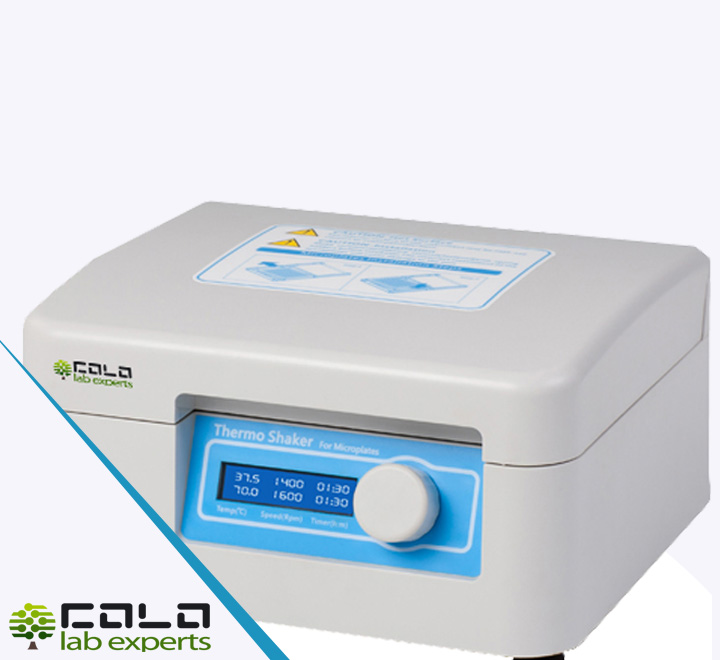
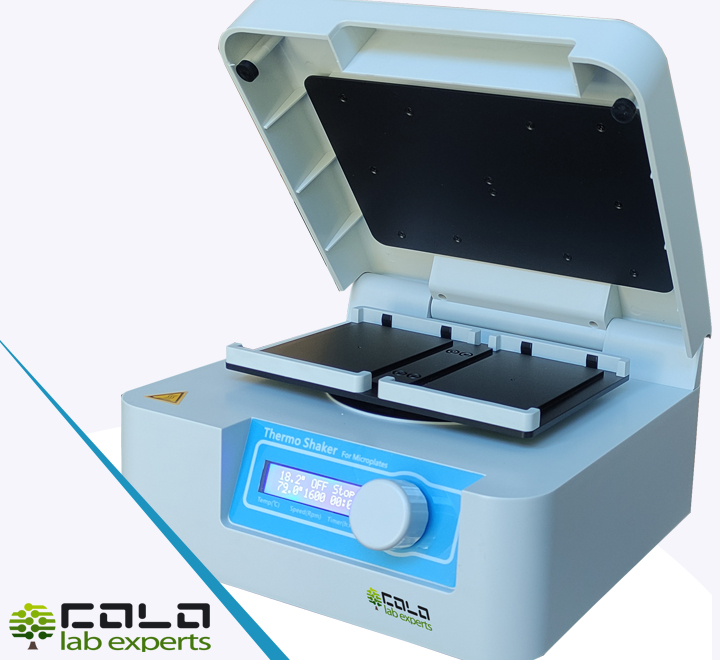
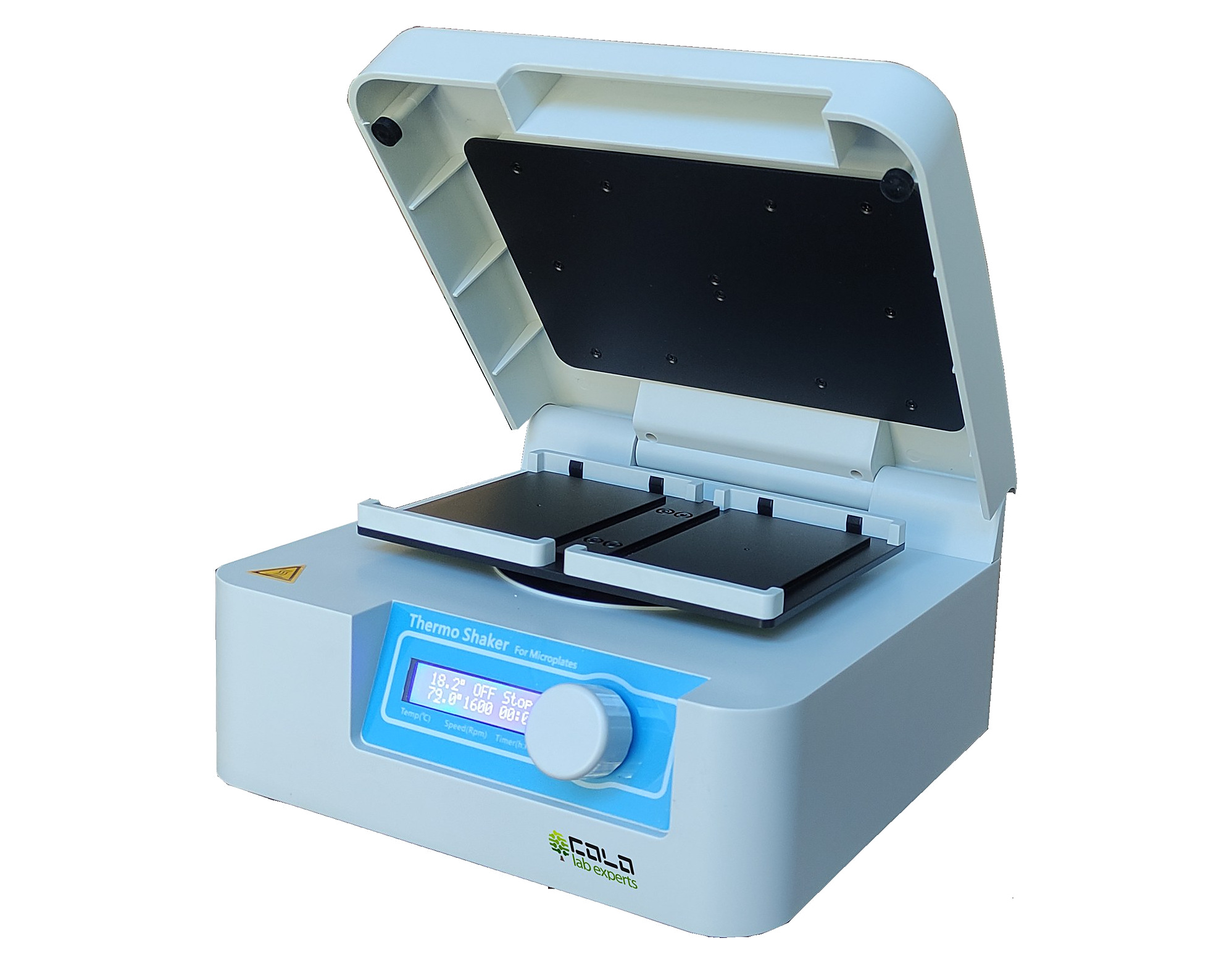
The MTP200 is a thermo shaker for microplates that heats and shakes two plates at the same bench position. A heating film under PID control holds the plate area from 5 °C above the room up to 80 °C, to ≤ ±0.5 °C, while a brushless DC drive shakes from 200 to 1600 rpm on a 3 mm orbit. It takes ELISA microplates with 96 or 384 wells and 96-well tissue culture plates. Product code PRO4503.
Two plates heated and shaken at one bench position
Plate work is rarely one plate at a time. A sample plate and a standards plate, or two replicates of the same assay, belong under the same temperature and the same movement — otherwise the two are no longer comparable. The MTP200 is a thermo shaker for microplates that takes both positions at once and shakes them together, from 200 to 1600 rpm, anywhere from 5 °C above the room to 80 °C.
Key characteristics
- Two plate positions — both shake together, in one run.
- RT+5 °C to 80 °C, held by a heating film under PID control.
- ≤ ±0.5 °C accuracy and uniformity, 0.1 °C on the display.
- 200–1600 rpm on a 3 mm orbit.
- Heats to 80 °C in ten minutes or less from room temperature.
- Timer from 1 minute to 99 hours 59 minutes — long incubations run without being restarted.
- Brushless DC drive — no brushes to wear and no service interval.
- 96-well and 384-well ELISA plates and 96-well tissue culture plates.
Suitable for
- ELISA incubation steps that ask for shaking at a set temperature.
- Cell and tissue culture plates that need gentle movement while warm.
- Enzyme reactions and binding assays run in 96-well or 384-well format.
- Bead-based clean-ups and resuspension in plates rather than in tubes.
- Laboratories running a sample plate and a control plate under identical conditions.
What two plate positions actually change
A single-plate instrument makes you run the standards plate after the sample plate, or find a second instrument. Neither is neutral: the second run happens at a different time, sometimes at a different room temperature, and the comparison carries that difference. A thermo shaker for microplates with two positions removes the question — both plates sit on the same platform, under the same heating film, moving on the same orbit.
The temperature range is the second half of it. RT+5 °C to 80 °C covers the usual plate protocols — 37 °C incubation, 45 °C hybridisation steps, heat inactivation up to 80 °C — but it has no cooling, so anything that has to sit below room temperature needs a different instrument. That limit is worth stating plainly before a purchase, not after it.
Model, product code and identification
This thermo shaker for microplates is supplied as a complete unit with both plate positions built in — there are no separate blocks to order. Quote and order with the COLO product code, and state the mains voltage, because the version is fixed in the instrument and cannot be changed later.
Thermo shaker for microplates, RT+5 °C to 80 °C, 200–1600 rpm, 3 mm orbit, two plate positions.
Technical specifications
| Product code | PRO4503 |
| Product type | Thermo shaker for microplates |
| Temperature control range | RT+5 °C to 80 °C |
| Temperature accuracy | ≤ ±0.5 °C |
| Temperature uniformity | ≤ ±0.5 °C |
| Display resolution | 0.1 °C |
| Heating time | ≤ 10 min, from room temperature to 80 °C |
| Heating method | Heating film |
| Shaking speed | 200–1600 rpm |
| Mixing orbit | 3 mm |
| Timer | 1 min – 99 h 59 min |
| Sample capacity | 2 microplates or culture plates |
| Plate formats | 96-well and 384-well ELISA microplates, 96-well tissue culture plates |
| Motor | Brushless DC |
| Control | PID, LCD display with setting knob |
| Power | 150 W |
| Supply voltage | AC220 V or AC110 V, 50/60 Hz — selected at order |
| Dimensions (W × D × H) | 280 × 270 × 140 mm |
| Net weight | 7.0 kg |
Operating functions
Heating and temperature control
Heat comes from a heating film under the plate area rather than from a heated cabinet, so it reaches the plate through contact with the platform. PID regulation holds the setting to ≤ ±0.5 °C, with the same figure for uniformity across the area, and the display reads to 0.1 °C. From room temperature the instrument reaches 80 °C in ten minutes or less. The bottom of the range is defined against the room: in a laboratory at 22 °C the lowest setting is 27 °C, so a warm room raises the bottom of the range on any thermo shaker for microplates of this type.
Shaking and timing
Speed is adjustable from 200 to 1600 rpm on a 3 mm orbit — a short orbit at high speed, which is what keeps liquid inside the wells of a 384-well plate instead of climbing the walls. The timer runs from one minute to 99 hours 59 minutes, so an overnight or weekend incubation is set once and left. Speed, time and temperature are all read from the LCD and set with the knob below it.
Plate loading
Both positions are on one platform, each held by a clamp at the end of the plate. A plate drops in and the clamp holds it against the platform, so nothing slides at 1600 rpm. The lid closes over both positions and keeps the heated area covered during the run.
Build, motor and safe operation
The drive in this thermo shaker for microplates is a brushless DC motor: no brushes to wear out, no service interval, no carbon dust near open plates, and quiet enough for the instrument to stay on a working bench rather than in a side room. At 1600 rpm on a 3 mm orbit that matters — a brushed motor at those speeds is both louder and a consumable.
Power is 150 W. The supply voltage is AC220 V or AC110 V at 50/60 Hz and is selected at order — unlike a wide-input instrument, this one is built for one of the two, so the mains voltage has to be stated when ordering. The instrument measures 280 × 270 × 140 mm and weighs 7.0 kg.
Standard delivery
- MTP200 main unit, both plate positions included.
- Mains cable for the voltage version ordered.
- Operating manual.
- Declaration of conformity and warranty documentation.
Microplates and culture plates are consumables and are not part of the delivery of this thermo shaker for microplates. The delivered configuration for a specific order is the one confirmed in the COLO.Science quotation.
Catalogue, technical specification and international links
- MTP200 thermo shaker for microplates — technical specification (PDF) — five pages, A4 landscape, with the parameter table and drawings of the plate formats and the working area.
- Shakers & Mixers overview — thermo shakers, orbital shakers, incubators, rockers, vortex mixers and roller mixers.
- Shakers & Mixers catalogue — model comparison by speed, orbit, temperature range and capacity.
- Shakers and mixers on COLO.Science — our international site.
Applications and operational value
In immunoassay work a thermo shaker for microplates is used for the incubation steps: antigen coating, sample and conjugate incubation, and the washes in between, each of which asks for the plate to be held at temperature and moving. Shaking during incubation shortens the step and evens out what happens between the wells at the edge of the plate and the wells in the middle.
In cell and tissue culture the same instrument is used more gently: 96-well culture plates held at 37 °C with slow movement, for resuspension or for keeping a suspension from settling during a step. In molecular biology it covers bead clean-ups, enzyme reactions and binding assays run in plate format rather than in tubes, where the plate is the unit of work and the tube rack is not.
The 99-hour timer is what makes the long end of that list practical. A protocol that incubates overnight, or over a weekend, is set once on this thermo shaker for microplates and does not need anyone to restart it — and the two positions mean the control plate goes through exactly the same run, not a second one.
Selection guide
- How many plates per run? Two positions are the capacity of this thermo shaker for microplates. For four or six plates in one run, the larger models in the same range are the answer.
- Does anything need to go below room temperature? There is no cooling. The lowest setting is 5 °C above the room, so a cold hold or a 4 °C step needs a different instrument.
- Plate format. 96-well and 384-well ELISA microplates and 96-well tissue culture plates. Deep-well and skirted plates are taller than a standard plate and should be checked against the working area before ordering.
- Mains voltage. AC220 V or AC110 V is chosen at order and fixed in the instrument — it is not a switch on the back.
- Top temperature. 80 °C covers incubation and most heat inactivation steps. A protocol that needs 95 °C or 100 °C is outside this range.
What the specification does not state
Everything stated above for this thermo shaker for microplates comes from the manufacturer’s parameter table. Four things it does not give, and which we therefore do not quote:
- Shaking amplitude beyond the 3 mm orbit.
- Noise level at working speed.
- Maximum plate height and the skirt types accepted.
- Protection class and fuse rating.
If any of these decides the purchase, ask and we will obtain it from the manufacturer in writing rather than estimate it here.
Configuration notice
This page is provided for orientation and product selection. It does not replace the binding specification, the delivered configuration, the validation protocol or the acceptance criteria confirmed in the official COLO.Science quotation, proforma invoice or order confirmation. The temperature range of this thermo shaker for microplates is stated relative to room temperature, and the mains voltage version is fixed at order. B2B prices are quoted net, excluding VAT.
Sales and support for international customers
COLO Lab ExpertsPolje ob Sotli 4, SI-3255 Buče, Slovenia
Phone: +386 70 713 437 · Email: sales@colo.si · Web: colo.si
We supply laboratories across Europe directly and through partners. B2B prices are quoted net, excluding VAT.