

Membrane filters and membrane filtration
Sterile gridded membrane filters in MCE, CN and PES, 47 and 50 mm, with everything around them: stainless steel filtration manifolds, a touchless membrane dispenser and the tools for incubation and colony counting. This overview shows what you need at each step and which membrane fits your method.
Membrane filtration step by step
The membrane filtration technique for microbiological testing of water, beverages, food and pharmaceutical samples – five steps and the equipment for each.
Sterilise
Flame-sterilise forceps and funnels with a Bunsen burner, or use an infrared sterilizer for loops and needles.
Place the membrane
Take the sterile membrane with flat-tipped membrane forceps or dispense it touch-free with the MEMDIS150 dispenser.
Filter the sample
Run the membrane filtration on a stainless steel MANIVAC manifold with 1 to 6 places and a vacuum pump.
Incubate
After membrane filtration, transfer the membrane to a 55 mm Petri dish with agar or a nutrient pad and incubate.
Count colonies
Count colonies on the grid by eye or with a colony counter and report CFU per volume.
Membrane filters – choose the material
All membranes are sterile and supplied individually packed or in a continuous pack for dispensers.
MCE membrane filtersMixed cellulose esters (cellulose acetate and cellulose nitrate), biologically inert, with a smoother and more uniform surface than pure nitrocellulose – the most widely used membrane for microbiological membrane filtration. White with black grid or black with white grid. 47 and 50 mm; 0.22, 0.45, 0.8 and 1.0 µm.
CN membrane filtersCellulose nitrate, white with black grid, for colony counting and general microbiological analysis. 47 and 50 mm; 0.22, 0.45, 0.8 and 1.0 µm.
PES membrane filtersPolyethersulfone, white without grid (0.22 and 0.45 µm) or black with white grid (0.45 µm), 47 mm.
Pore size guide for membrane filtration
The right pore size decides what the membrane retains and how fast the sample runs through it.
| Pore size | Typical use | Available in |
|---|---|---|
| 0.45 µm | Standard membrane filtration for bacteria – total count, coliforms and E. coli in water, beverages and food | MCE white (47, 50 mm), MCE black (47 mm), CN (47, 50 mm), PES white and black (47 mm) |
| 0.22 µm | Retention of smaller bacteria, sterility testing and filtration of solutions | MCE white (47, 50 mm), MCE black (47 mm), CN (47, 50 mm), PES white (47 mm) |
| 0.8 µm | Yeasts and moulds, samples with more particles | MCE and CN, 47 and 50 mm |
| 1.0 µm | Yeasts and moulds, particulate analysis and microscopy | MCE and CN, 47 and 50 mm |
Membrane filtration packaging: individual or continuous pack
Individual pack – 100 membranes
Each membrane in its own sterile envelope. Open one membrane at a time and place it with sterile forceps – ideal for smaller series and different pore sizes on the same day.
Continuous pack – 150 membranes
Membranes on a continuous band for the MEMDIS150 automatic membrane dispenser: hands-free dispensing in under a second, less handling and lower contamination risk in routine laboratories.
Membrane filtration quality you can document
- Sterilised by gamma irradiation
- Shelf life 3 years
- E. coli recovery rate above 90%
- Saccharomyces recovery rate above 90%
- Grid ink that supports growth on the grid lines
- Quality certificate for every lot
Applications of membrane filtration
- Drinking, surface and waste water testing
- Beverages, beer, wine and dairy
- Food hygiene – total count, coliforms, E. coli
- Pseudomonas aeruginosa and Staphylococcus aureus
- Sterility testing in pharmaceutical laboratories
- Microscopy and particulate analysis
Membrane filtration concentrates the microorganisms from a large sample volume on one membrane, so even low counts become measurable – which is why it is the reference technique in many water and beverage standards.
Methods and practical notes on microbiological testing are published on COLO.Science.
Equipment for membrane filtration
Everything around the membrane filtration workflow – from sterilisation to colony counting.
 MANIVAC filtration manifoldSS316L, 1–6 places, 100–500 ml funnels for 47 and 50 mm membranes, autoclavable.
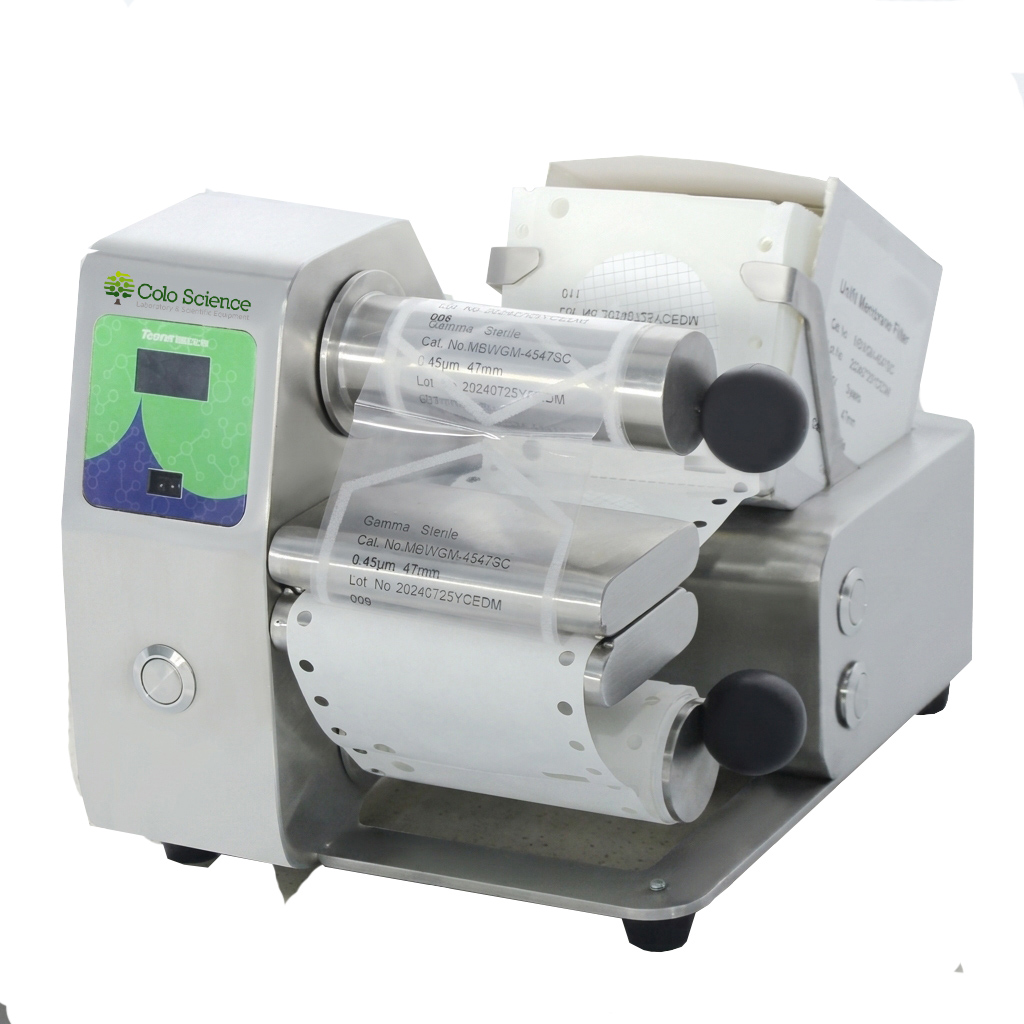 MEMDIS150 membrane dispenserTouchless dispensing of sterile membranes from the continuous pack.
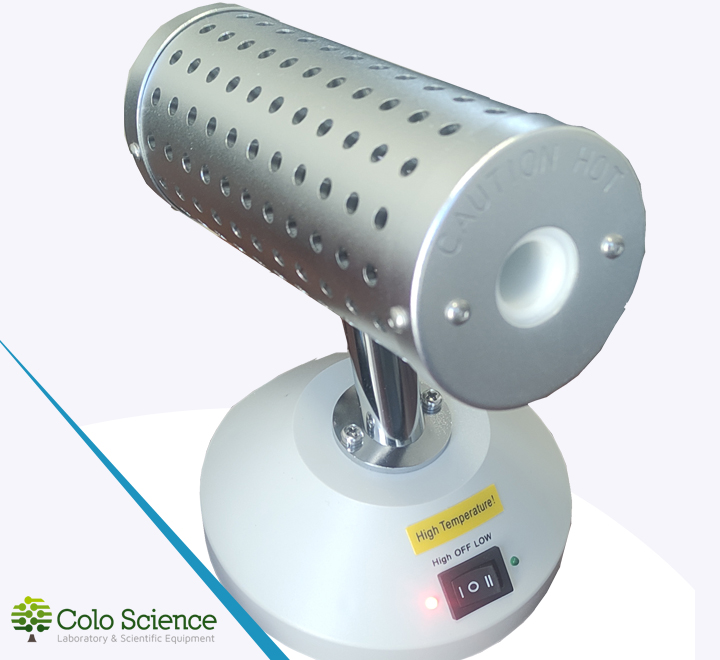 IRBACTI infrared sterilizerFlame-free sterilisation of loops and needles at the bench.