

Biochemical test · Hippurate hydrolysis
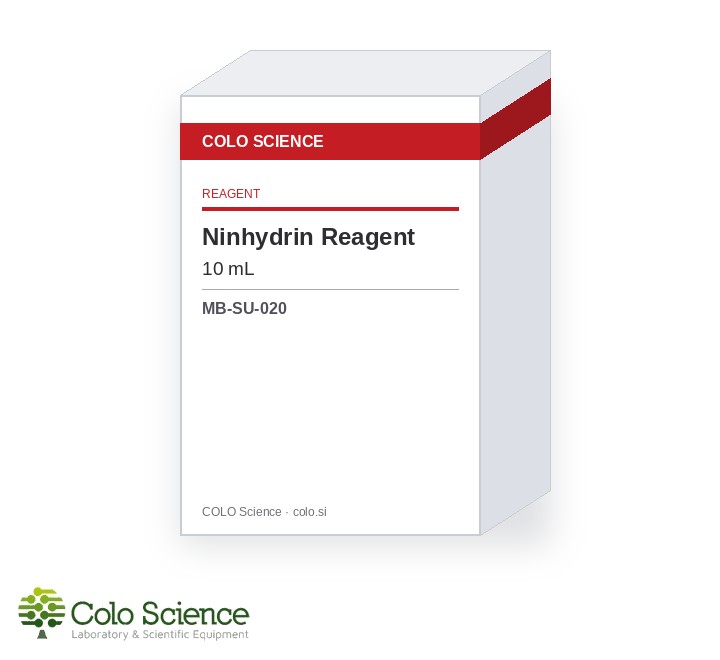
Ninhydrin Reagent – hippurate hydrolysis test
Ninhydrin Reagent detects glycine from the hydrolysis of sodium hippurate and is used to identify Campylobacter jejuni and group B streptococci.
- Hippurate hydrolysis test
- Purple = positive
- 10 mL
How Ninhydrin Reagent works
Hippuricase splits hippurate into benzoic acid and glycine; ninhydrin reacts with glycine and gives a deep purple colour.
Typical results
| Result | Read-out |
| Positive (e.g. C. jejuni) | Deep purple |
| Negative | Colourless or yellow |
Technical data
| Incubation | 36 ± 1 °C, 10 min after adding the reagent |
| Storage | 2–8 °C, protected from light |
| Shelf life | 3 years |
Applications and practical notes
Biochemical reagents and stains are used for the confirmation of typical colonies in food, water, clinical and pharmaceutical microbiology. Typical applications include:
- Confirmation of typical colonies
- Biochemical identification of isolates
- Media preparation
- Teaching and reference laboratories
Working with Ninhydrin Reagent: Add 5 drops to the hippurate test tube, incubate for 10 minutes and read immediately.
Good practice with media and supplements: keep the bottle tightly closed in a cool, dry place, weigh the powder quickly to avoid moisture uptake, and use fresh distilled or deionised water. Check the pH of each new batch after preparation and before use, and label prepared media with the date. Performance of each lot can be verified with reference strains according to ISO 11133, the standard for the preparation, production, storage and performance testing of culture media.
About biochemical tests and stains: reference methods for food, water and pharmaceutical microbiology confirm typical colonies with a small set of classic tests – Gram stain, catalase, oxidase, indole, methyl red, Voges-Proskauer and others – before or alongside identification kits. Reliable reagents with known shelf life and a positive and negative control strain for each test are part of good laboratory practice according to ISO 11133. COLO.Science supplies the reagents together with media, identification kits and QC strains.
Complete sets from one supplier: COLO.Science supplies culture media, supplements, rapid tests, identification kits and QC strains as complete sets for the method you follow. Send us your sample types and standards, and we will prepare an offer with the matching products and documentation.
Ninhydrin Reagent is supplied by COLO.Science in the pack sizes listed under Ordering information. For larger quantities, regular deliveries or method-specific sets that include Ninhydrin Reagent, please send us a request. With every delivery of Ninhydrin Reagent you receive the lot number and expiry date, and on request we send the available documentation for Ninhydrin Reagent.
Where Ninhydrin Reagent fits in microbiological testing
- Staining and microscopy – Gram stain and spore stain
- Rapid colony tests – catalase, oxidase and Lugol’s iodine
- Biochemical confirmation – indole, methyl red, Voges-Proskauer, nitrate, phenylalanine and tryptophan deaminase, ninhydrin, Nessler and Benedict reagents
- Media additives – glycerol, sterile liquid paraffin and TTC solution
Ordering information
| Product | COLO code | Pack |
|---|---|---|
| Ninhydrin Reagent | PRO7662 | 10 mL |
Product notice: preparation, storage conditions and shelf life are given on the label. Technical data on this page are for orientation; the label and the lot documentation apply. B2B prices are quoted net, excluding VAT.
Sales and technical support
COLO LabExperts
Polje ob Sotli 4, SI-3255, Slovenia
Quotations and technical support for culture media and microbiology products across our international sales territory. B2B prices are net, excluding VAT.
COLO.SCIENCE | MICROBIOLOGY SUPPORT
Need the complete set for your method?
Send the sample type, target organism and the standard you follow. COLO.Science will put together the media, supplements, QC strains and confirmation tests for the whole procedure.