

STEC · Real-time PCR for stx1 and stx2
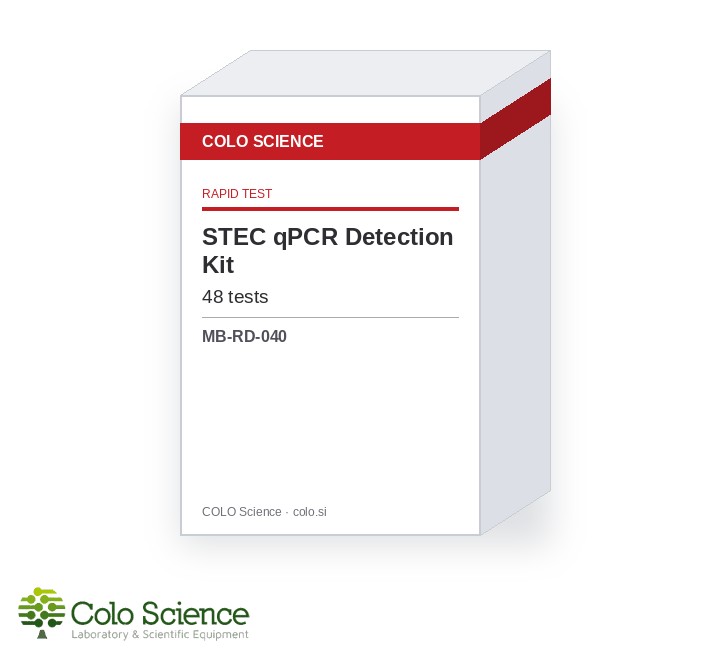
STEC qPCR Detection Kit – Shiga toxin genes by real-time PCR
The STEC qPCR Detection Kit detects Shiga toxin-producing E. coli by real-time PCR for the stx1 and stx2 genes, with an internal bacterial target. The combination of signals shows the STEC type.
- stx1 and stx2 by real-time PCR
- Detection limit about 100 CFU per test
- Ready-to-use reagents and controls
How STEC qPCR Detection Kit works
Colonies or enrichment broth are lysed at 99 °C and the DNA is amplified with probes for stx1, stx2 and a bacterial control gene. The Ct values for each channel give the result and the toxin profile.
Typical results
| Result | Read-out |
| Positive | Ct ≤ 35 |
| Retest | Ct 35–37 |
| Negative | Ct ≥ 37 |
Technical data
| Preparation | Ready-to-use reagents; sample lysis 99 °C 10 min |
| Incubation | PCR 95 °C 30 s + 40 cycles (95 °C 5 s / 60 °C 30 s) |
| Storage | -20 °C, protected from light; avoid repeated freeze-thaw |
| Shelf life | 12 months |
Applications and practical notes
E. coli O157 and other Shiga toxin-producing E. coli (STEC) are tested in meat, raw milk products, sprouts and vegetables, for example according to ISO 16654 and FDA BAM Chapter 4. Typical applications include:
- Raw and minced meat, especially beef
- Raw milk and raw-milk cheese
- Sprouts, leafy greens and other fresh produce
- Outbreak investigations and environmental samples
Working with STEC qPCR Detection Kit: Use the kit to screen colonies from STEC agar or enrichment broths and confirm positive results according to your method.
Good practice with rapid tests: store the kit as stated on the label, let the components reach room temperature before use and use each item only once. Record the lot number and the result, and confirm positive results according to the reference method when this is required.
About coliform and E. coli methods: coliforms and E. coli are counted either by the multiple-tube (MPN) method, with a presumptive broth followed by confirmation broths, or by colony counts on selective agars. FDA BAM Chapter 4 describes both approaches for food and water, and ISO 16649-2 gives the colony-count method for β-glucuronidase-positive E. coli on TBX Agar. E. coli O157 and other STEC need dedicated media, serology and PCR. COLO.Science offers media, supplements, rapid tests, identification kits and QC strains for every step.
Complete sets from one supplier: COLO.Science supplies culture media, supplements, rapid tests, identification kits and QC strains as complete sets for the method you follow. Send us your sample types and standards, and we will prepare an offer with the matching products and documentation.
STEC qPCR Detection Kit is supplied by COLO.Science in the pack sizes listed under Ordering information. For larger quantities, regular deliveries or method-specific sets that include STEC qPCR Detection Kit, please send us a request. With every delivery of STEC qPCR Detection Kit you receive the lot number and expiry date, and on request we send the available documentation for STEC qPCR Detection Kit.
Where STEC qPCR Detection Kit fits in STEC testing
- Presumptive test – Lauryl Sulfate Tryptose Broth (MPN) or VRBL / chromogenic agar (colony count)
- Confirmation – BGLB Broth for coliforms; EC or EC-MUG Broth at 44.5 °C for E. coli
- Isolation – EMB, MacConkey, TBX or chromogenic E. coli agar
- Identification – IMViC kit; for O157 and STEC: SMAC or chromogenic O157 agar, latex and PCR
Ordering information
| Product | COLO code | Pack |
|---|---|---|
| STEC qPCR Detection Kit | PRO7404 | 48 tests |
Product notice: preparation, storage conditions and shelf life are given on the label. Technical data on this page are for orientation; the label and the lot documentation apply. B2B prices are quoted net, excluding VAT.
Sales and technical support
COLO LabExperts
Polje ob Sotli 4, SI-3255, Slovenia
Quotations and technical support for culture media and microbiology products across our international sales territory. B2B prices are net, excluding VAT.
COLO.SCIENCE | MICROBIOLOGY SUPPORT
Need the complete set for your method?
Send the sample type, target organism and the standard you follow. COLO.Science will put together the media, supplements, QC strains and confirmation tests for the whole procedure.