


COLO.Science · Spectroscopy & Color · Benchtop spectrophotometers
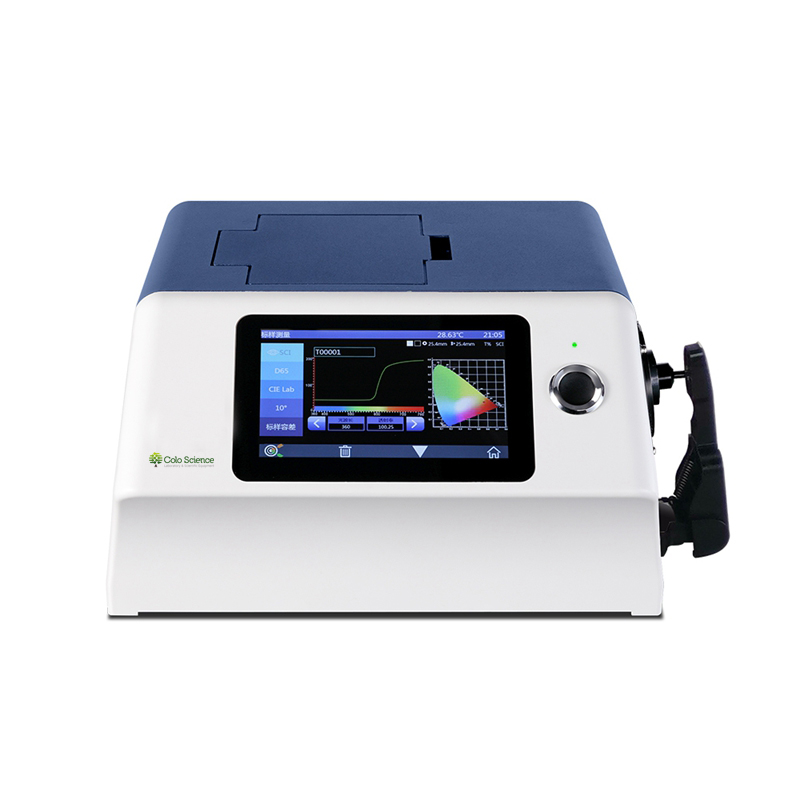
CS6020 Benchtop Spectrophotometer — xenon colour measurement in reflectance and transmittance
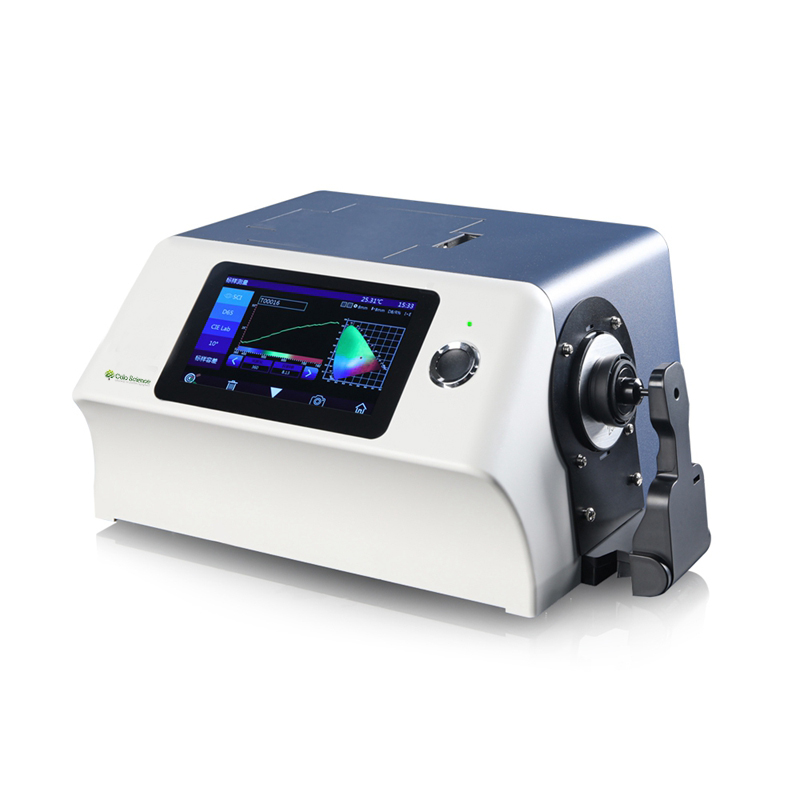
The CS6020 benchtop spectrophotometer (COLO product code PRO7906) brings a pulsed xenon lamp, d/8 reflectance and d/0 transmittance geometry and simultaneous SCI/SCE into the price range of LED instruments. It measures CIE Lab and ΔE of plastic plaques, films, coatings and liquids for colour quality control and as an additional instrument next to an existing laboratory spectrophotometer.
Benchtop or portable spectrophotometer?
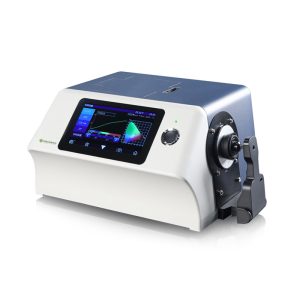 Highest agreement · full UV controlCS6080Pulsed xenon · UV cut-off 400/420/460 nm · ΔE*ab ≤ 0.12 inter-instrument · Bluetooth · transmittance component included
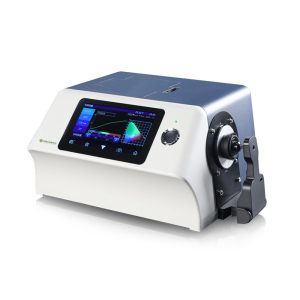 Xenon · basic modelCS6020Pulsed xenon · UV cut-off 400 nm · ΔE*ab ≤ 0.15 inter-instrument · transmittance component optional
 Portable · at the lineSC810Hand-held d/8 · LED · 400–700 nm · Ø 8 mm · ΔE*ab 0.04 · battery · liquids and powders with test component
Overview
The CS6020 keeps the measuring principle of the CS6080 — same sphere, same geometries, xenon light — and drops what many laboratories do not need every day: the extra 420/460 nm UV filters, the 18/15 mm apertures and Bluetooth. Transmittance and haze are measured with the optional transmittance test component.
Key characteristics
- Reflectance d/8 and transmittance d/0, SCI and SCE
- Pulsed xenon lamp 360–780 nm, 400 nm UV cut-off
- Repeatability ΔE*ab ≤ 0.015 (reflectance) and ≤ 0.018 (transmittance)
- Inter-instrument agreement ΔE*ab ≤ 0.15
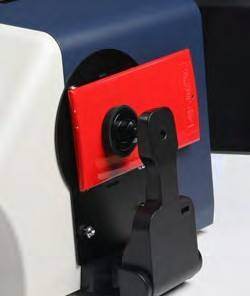
- Reflectance apertures Ø30/25.4, 10/8 and 6/4 mm, recognised automatically
- Haze per ASTM D1003 with the transmittance component
Suitable for
- Opaque and translucent plastic plaques, masterbatch and compounds
- Paints, coatings, inks and pigments; textiles and paper
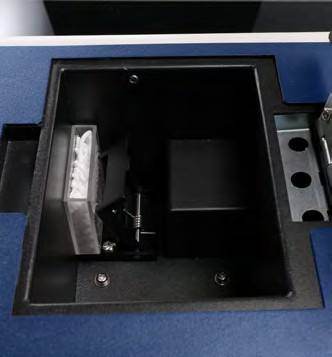
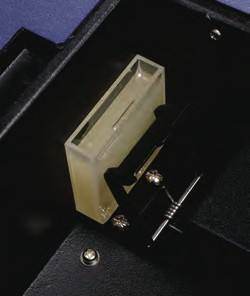
- Films, sheets and glass in transmittance; liquids in cuvettes
- Colour quality control with CIE Lab (D65/10°) and ΔE pass/fail
Why this instrument
When an existing instrument stays the reference and a second instrument is needed for daily checks, the deciding question is whether the second one sees colour the same way. The CS6020 uses the same type of light source and geometry as classic xenon benchtop instruments, so CIE Lab values under D65 can be compared directly — at a price that makes a second measuring point in production realistic.
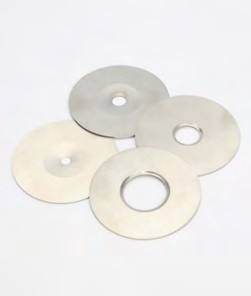
Reflectance, transmittance and sample handling
Technical specifications
Optics and performance
| Geometry | Reflectance d/8, transmittance d/0, SCI + SCE, UV included / excluded |
| Standards | CIE No.15, ISO 7724/1, ASTM E1164, DIN 5033 Teil 7 |
| Light source | Pulsed xenon lamp; 400 nm cut-off |
| Integrating sphere | Ø 154 mm |
| Spectral system | Concave grating, 256-element double-array CMOS sensor |
| Wavelength range · pitch | 360–780 nm · 10 nm |
| Half bandwidth | 10 nm |
| Reflectance range | 0–200 % |
| Apertures, reflectance | Ø30/25.4, Ø10/8, Ø6/4 mm |
| Apertures, transmittance | Ø30/25.4 mm |
| Repeatability | Reflectance ΔE*ab ≤ 0.015 · transmittance ΔE*ab ≤ 0.018 (Ø25.4 mm, SCI) |
| Inter-instrument agreement | ΔE*ab ≤ 0.15 (Ø25.4 mm, SCI) |
| Interfaces · storage | USB, printer port · 2 000 standards, 20 000 samples |
Colour data and general
| Colour spaces | CIE Lab, XYZ, Yxy, LCh, CIE LUV, Hunter Lab, Munsell, s-RGB, DIN, βxy |
| Colour difference | ΔE*ab, ΔE*uv, ΔE*94, ΔE*cmc (2:1 and 1:1), ΔE*00, ΔE Hunter, DIN ΔE99 |
| Indices | WI, YI, metamerism index, APHA/Hazen/Pt-Co, Gardner, Saybolt, 555 index, colour fastness and staining, colour strength, opacity, haze (ASTM D1003) |
| Observer · illuminants | 2° and 10° · D65, A, C, D50, D55, D75, F1–F12, CWF, DLF, TL83, TL84, TPL5, U30 |
| Measuring time | approx. 2.4 s (SCI + SCE approx. 5 s) |
| Display | 7″ TFT capacitive touch screen |
| Power supply | DC 24 V, 3 A adapter |
| Lamp life | 5 years, more than 3 million measurements |
| Dimensions (W × D × H) | 370 × 300 × 200 mm |
| Net weight | approx. 9.6 kg |
| Operating environment | 0–40 °C, 0–85 % RH, non-condensing |
Software and data
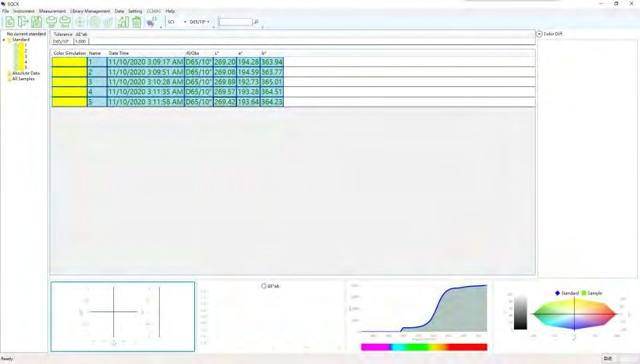
The PC software stores standards with their tolerances, shows the spectrum, the colour plot and the colour difference, and exports results for reports and archiving. Quality-control and sample modes are also available directly on the 7″ touch screen.
Reflectance and transmittance results are kept in the same database, so one standard can be checked in both modes.
Standard delivery
- Instrument with white calibration tile and black calibration board
- Reflectance apertures Ø25.4, 8 and 4 mm, sample holder and fixing frame
- Transmission black board
- PC software, USB cable, DC 24 V power adapter, user guide
Optional: transmittance test component (required for transmittance and haze), Ø4 mm transmittance component, micro-printer, inversion component, custom apertures. The delivered configuration for a specific order is the one confirmed in the COLO.Science quotation.
Knowledge base
New to colour measurement? Light sources, metamerism, CIE Lab, ΔE and measuring geometries are explained on COLO.Science, our knowledge base.
Selection guide
- Close agreement with other laboratories, fluorescent samples: CS6080 — three UV cut-off filters and ΔE*ab ≤ 0.12 between instruments.
- Second instrument for daily checks, budget first: CS6020 — same xenon principle and geometries at a lower price.
- Transmittance or haze: both models; with the CS6020 order the transmittance test component.
- Large or curved parts at the production line: a portable spectrophotometer is the better tool — ask us for the right model.
Configuration notice
This page is provided for orientation and product selection. Sample type, apertures, transmittance accessories and the colour data you report are confirmed with the official COLO.Science quotation.
Sales and support for international customers
COLO Lab ExpertsPolje ob Sotli 4, SI-3255 Buče, Slovenia
Phone: +386 70 713 437 · Email: sales@colo.si · Web: colo.si
We supply laboratories across Europe directly and through partners. B2B prices are quoted net, excluding VAT.