

Laboratory centrifuges catalog by COLO.Science is a practical selection hub for laboratories that need reliable sample separation in clinical diagnostics, microbiology, molecular biology, veterinary work, food testing, environmental analysis and routine laboratory preparation.
This page helps users compare centrifuge types before selecting an individual model. A laboratory centrifuge should not be selected only by maximum speed or general product appearance. The correct choice depends on sample type, tube format, rotor capacity, required RCF, daily workload, available bench space and whether the sample must remain under controlled temperature conditions during separation.
COLO.Science organizes centrifuges by practical use: mini centrifuges for quick spin-down, clinical centrifuges for blood tubes and routine diagnostics, refrigerated centrifuges for temperature-sensitive samples, vacuum centrifuges for special preparation workflows, and benchtop centrifuges for general sample separation.
How to use this laboratory centrifuges catalog
Rotor selection defines real laboratory use
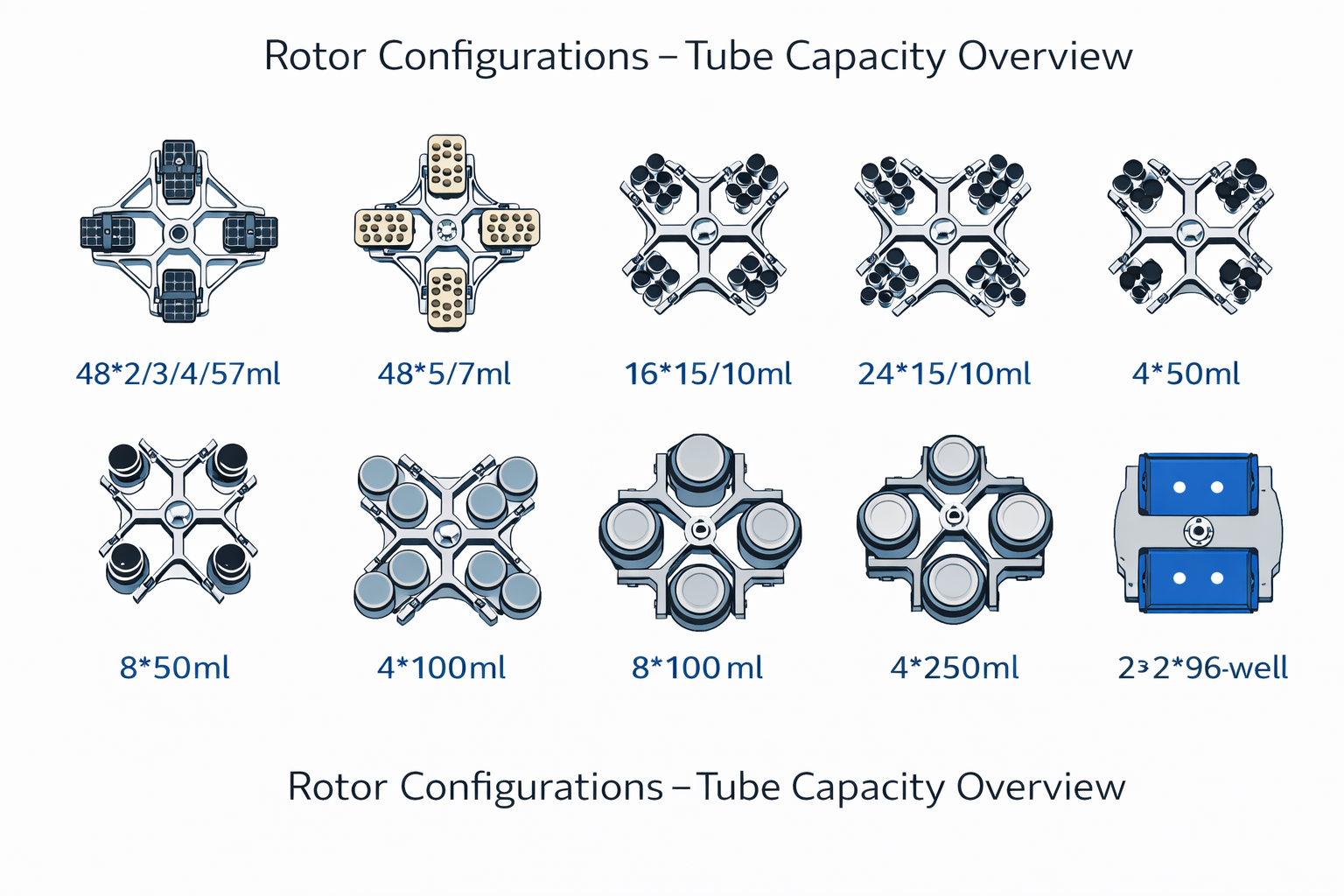
A centrifuge catalog is most useful when it shows not only the instrument type, but also the practical rotor possibilities. Rotor selection determines whether the laboratory can work with small microtubes, larger tubes, blood collection tubes or different sample volumes in routine workflows.
A flexible rotor program makes one centrifuge family more useful across multiple applications. For this reason, rotor capacity, tube volume and tube format should be checked before comparing only RPM or maximum RCF.
Main centrifuge groups
The COLO.Science centrifuge range can be understood through practical laboratory groups. This structure helps users move from application to suitable model instead of browsing a mixed product list without technical guidance.
Mini centrifuges
Mini centrifuges are used for quick spin-down, microtubes and small-volume preparation steps. They are compact, easy to place near the workstation and suitable for fast routine handling.
Clinical centrifuges
Clinical centrifuges are intended for blood tubes, serum and plasma preparation, veterinary laboratories and routine diagnostic workflows where stable and repeatable separation is required.
Refrigerated centrifuges
Refrigerated centrifuges are selected when samples must be processed under controlled temperature conditions. They are important for temperature-sensitive materials and selected research methods.
Vacuum centrifuges
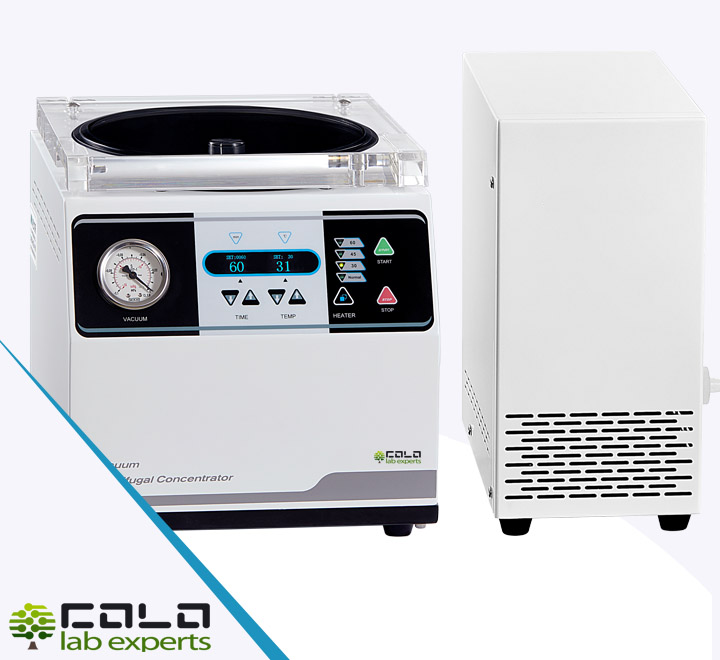
Vacuum centrifuges expand the range of special centrifuge applications and are useful where sample concentration, drying or advanced preparation steps are required.
Special centrifuge applications
Vacuum centrifuges for advanced preparation
A centrifuge catalog should also show special instruments when they are relevant to laboratory preparation. A vacuum centrifuge enriches the centrifuge range because it supports specialized workflows that go beyond standard separation of tubes and blood samples.
This makes the product group more complete for laboratories that need not only routine centrifugation, but also advanced preparation possibilities for selected samples and methods.
Key parameters for centrifuge comparison
The most important parameters in centrifuge selection are maximum RPM, maximum RCF, rotor capacity, compatible tube formats and rotor geometry. RPM describes rotational speed, while RCF describes the centrifugal force applied to the sample. In many laboratory methods, RCF is the more useful comparison value because two centrifuges with the same RPM can generate different centrifugal force depending on rotor radius.
Rotor configuration should be checked carefully before selecting a model. A rotor for microtubes is not the same as a rotor for blood collection tubes or larger conical tubes. Laboratories should consider tube volume, number of positions, rotor lid design, balancing requirements and whether a fixed-angle or swing-out rotor is preferred.
For routine clinical workflows, simple operation and predictable separation may be more important than very high maximum speed. For research workflows, higher RCF, cooling options and rotor flexibility may become more important. For a small laboratory or point-of-use station, compact size and easy operation may be the decisive factors.
Precise centrifugation settings
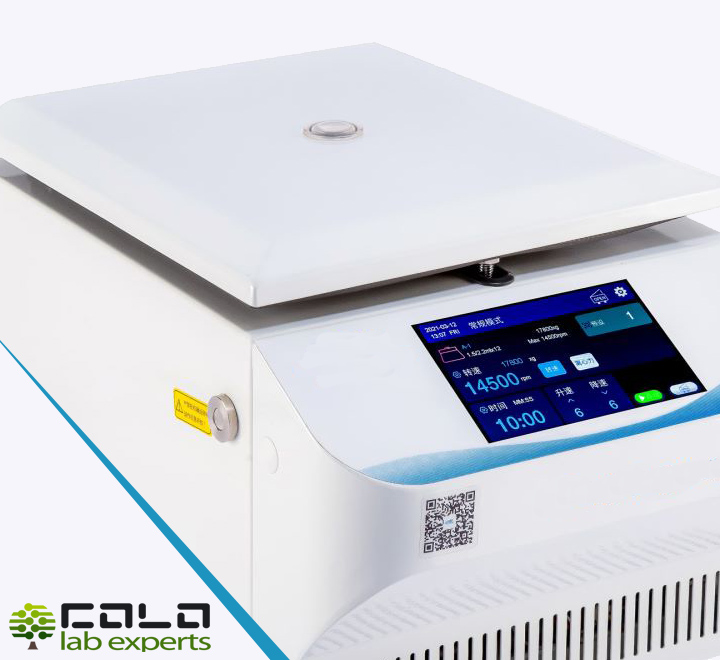
Control menu for repeatable methods
A rich control menu allows precise adjustment of centrifugation requirements. Depending on the model, the user may need to set speed, time, acceleration, braking, temperature or program memory. These settings are important when a method must be repeated consistently.
For laboratories with several users, clear menu control and repeatable program settings reduce the risk of wrong operation and make the centrifuge easier to integrate into routine laboratory work.
Typical laboratory applications
Laboratory centrifuges are used across many sample preparation workflows. In clinical laboratories, they support blood sample separation, serum preparation and plasma preparation. In microbiology and molecular biology, centrifuges are used for small-volume tubes, pellet formation, clarification and preparation before downstream analysis.
Veterinary laboratories use centrifuges for routine diagnostic sample handling. Food testing and environmental laboratories may use centrifuges for clarification, phase separation and preparation of samples before analysis. In all these cases, the suitable model depends on the sample matrix, method requirements, tube format and number of samples processed per run.
For broader laboratory background, application articles and technical context, users can also visit the COLO.Science knowledge portal. The product catalog on colo.si remains focused on model selection, technical comparison and request-for-quote preparation.
Recommended catalog information for each model
When the laboratory centrifuges catalog is expanded with individual model cards, each entry should include model name, SKU, centrifuge type, maximum RPM, maximum RCF, rotor capacity, tube format, refrigeration status and links to the product page and full technical specification. This format is easier to scan than a long technical paragraph and allows users to compare similar models quickly.
For purchasing and project preparation, the most useful information is not only the model name, but also the practical configuration: which tubes fit, how many samples can be processed per run, whether the rotor is included, which accessories are optional and whether the model is suitable for the intended laboratory method.
Useful information for quotation
For a precise quotation, please specify sample type, tube volume, required RPM or RCF, number of samples per run, preferred rotor type and whether refrigeration is required. This helps match the centrifuge to the real laboratory workflow instead of selecting only by maximum speed.
Laboratory centrifuges catalog FAQ
How do I choose the right laboratory centrifuge?
Start with the sample type, tube volume, number of samples per run and required RCF. After that, check rotor compatibility, speed range, available bench space and whether the sample needs refrigeration during centrifugation.
What is more important, RPM or RCF?
RPM shows rotational speed, but RCF describes the centrifugal force applied to the sample. For method comparison and reproducible laboratory work, RCF is often more useful because it also depends on rotor radius.
When is a refrigerated centrifuge needed?
A refrigerated centrifuge is recommended when samples are temperature-sensitive or when the laboratory method requires controlled temperature during separation. For routine non-sensitive samples, a standard clinical or benchtop centrifuge may be sufficient.
What information should be sent with a centrifuge RFQ?
The most useful RFQ information includes sample type, tube format, tube volume, number of samples per run, required RPM or RCF, preferred rotor type and whether refrigeration is required.
Continue from the centrifuge catalog
Use these links to continue from this catalog hub to the main centrifuge product group, the broader centrifuge overview page or the complete COLO Lab Store catalog.
Centrifuges overview
Open the broader overview page for centrifuge selection and applications.
Request a centrifuge quote
Send us your centrifuge requirements and we will help you select the suitable model, rotor configuration and tube capacity for your laboratory workflow.