



Lactic streptococci · Cultivation
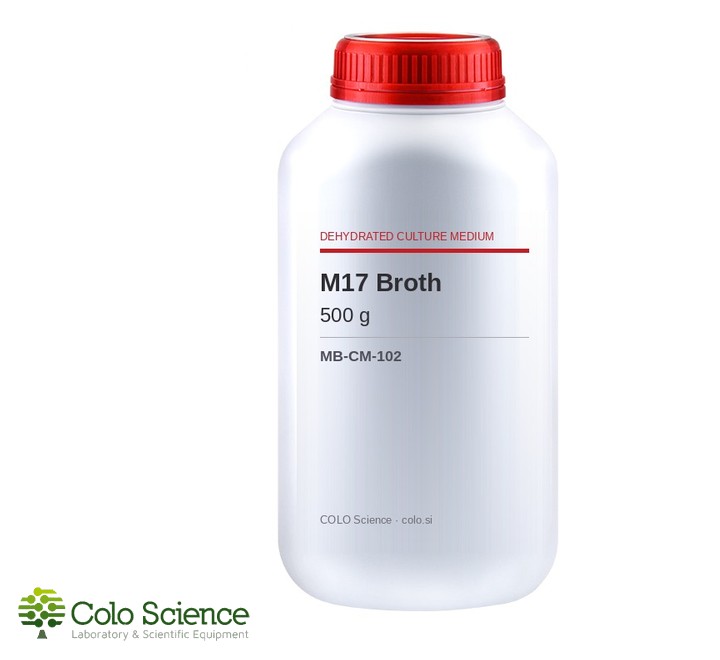
M17 Broth – cultivation of lactic streptococci
M17 Broth is the liquid M17 medium for the cultivation and enrichment of lactic streptococci and lactococci, for example for maintaining starter culture strains.
- Liquid M17 medium
- For S. thermophilus and lactococci
- Starter culture maintenance
How M17 Broth works
The glycerophosphate buffer prevents a fast drop of pH, so lactic streptococci reach high cell numbers. Lactose can be added for lactococci when required by the procedure.
Typical results
| Organism | Result |
| Streptococcus thermophilus, Lactobacillus plantarum | Growth, turbid broth |
| Lactobacillus helveticus | No growth, clear broth |
Technical data
| Preparation | 42.25 g/L; boil to dissolve, dispense, autoclave 121 °C 15 min |
| Final pH | 6.8 ± 0.2 |
| Incubation | 36 ± 1 °C, 24–48 h |
| Storage | Dry, dark place; keep the container tightly closed |
| Shelf life | 3 years |
Applications and practical notes
Lactic acid bacteria are starter cultures in dairy, meat and fermented products, probiotic organisms and spoilage organisms in beverages; they are counted for example according to ISO 15214. Typical applications include:
- Yoghurt, cheese and fermented milk
- Starter cultures and probiotics
- Fermented meat and vegetables
- Beer, wine and soft drinks
Working with M17 Broth: Dispense the broth before autoclaving and incubate cultures at 36 °C for 24–48 hours.
Good practice with dehydrated media: keep the bottle tightly closed in a cool, dry place, weigh the powder quickly to avoid moisture uptake, and use fresh distilled or deionised water. Check the pH of each new batch after preparation and before use, and label prepared media with the date. Performance of each lot can be verified with reference strains according to ISO 11133, the standard for the preparation, production, storage and performance testing of culture media.
About lactic acid bacteria methods: mesophilic lactic acid bacteria in food are counted on MRS agar at 30 °C according to ISO 15214. In dairy products and starter cultures, lactobacilli are counted on MRS media, lactic streptococci such as Streptococcus thermophilus on M17 media, and bifidobacteria on MRS with lithium mupirocin under anaerobic conditions. In breweries, beer-spoiling lactic acid bacteria are detected on Raka-Ray Agar. COLO.Science offers media, supplements and count plates for these methods.
Complete sets from one supplier: COLO.Science supplies culture media, supplements, rapid tests, identification kits and QC strains as complete sets for the method you follow. Send us your sample types and standards, and we will prepare an offer with the matching products and documentation.
M17 Broth is supplied by COLO.Science in the pack sizes listed under Ordering information. For larger quantities, regular deliveries or method-specific sets that include M17 Broth, please send us a request. With every delivery of M17 Broth you receive the lot number and expiry date, and on request we send the available documentation for M17 Broth.
Where M17 Broth fits in lactic acid bacteria testing
- Lactobacilli and mesophilic LAB – MRS Agar and MRS Broth
- Bifidobacteria – MRS base with the modified MRS supplement (lithium mupirocin and cysteine), anaerobic
- Lactic streptococci and lactococci – M17 Agar and M17 Broth
- Beer spoilage – Raka-Ray Agar with supplement; count plates for fast results
See all lactic acid bacteria products in the Microbiology Catalogue →
Ordering information
| Product | COLO code | Pack |
|---|---|---|
| M17 Broth | PRO7529 | 500 g |
Product notice: preparation, storage conditions and shelf life are given on the label. Technical data on this page are for orientation; the label and the lot documentation apply. B2B prices are quoted net, excluding VAT.
Sales and technical support
COLO LabExperts
Polje ob Sotli 4, SI-3255, Slovenia
Quotations and technical support for culture media and microbiology products across our international sales territory. B2B prices are net, excluding VAT.
COLO.SCIENCE | MICROBIOLOGY SUPPORT
Need the complete set for your method?
Send the sample type, target organism and the standard you follow. COLO.Science will put together the media, supplements, QC strains and confirmation tests for the whole procedure.