

Yeasts and moulds · Selective count agar
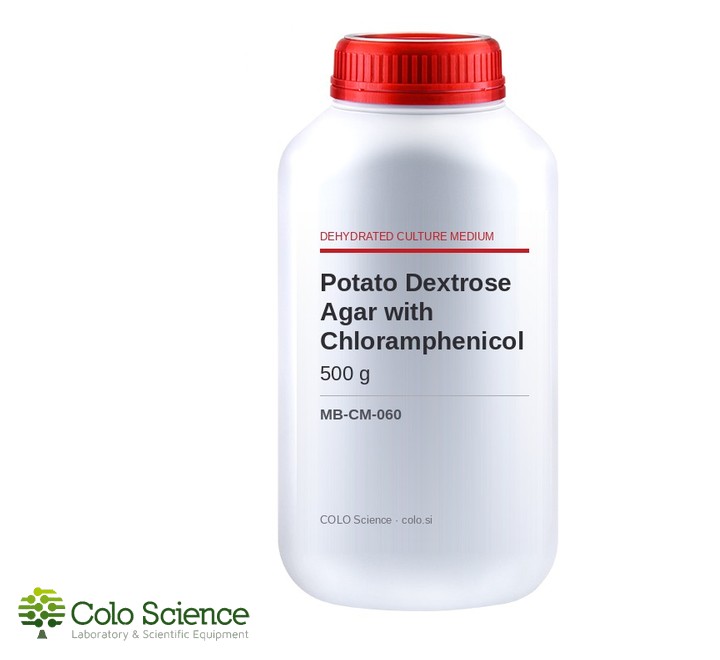
Potato Dextrose Agar with Chloramphenicol – ready selective formulation
Potato Dextrose Agar with Chloramphenicol is a ready-to-use selective formulation for counting yeasts and moulds in food. Chloramphenicol is already in the powder, so no separate antibiotic supplement is needed.
- Chloramphenicol already included (0.1 g/L)
- Count of yeasts and moulds in food
- No acidification needed
How Potato Dextrose Agar with Chloramphenicol works
Potato infusion and dextrose support the growth and sporulation of fungi. Chloramphenicol suppresses bacteria at the normal pH of the medium, so tartaric acid is not needed. Colonies are counted after 3 to 5 days at 25–28 °C.
Typical colony appearance
| Organism | Colonies |
| Saccharomyces cerevisiae | Cream colonies |
| Aspergillus brasiliensis | White mycelium with black spores |
| E. coli, S. aureus | Inhibited |
Technical data
| Preparation | 40.1 g/L; boil to dissolve, autoclave 121 °C 15 min (contains 0.1 g/L chloramphenicol) |
| Incubation | 25–28 °C, 72 h |
| Storage | Dry, dark place; keep the container tightly closed |
| Shelf life | 3 years unopened |
Applications and practical notes
Yeast and mould counts are part of the routine quality control of food, feed, beverages and raw materials, for example according to ISO 21527-1 and FDA BAM Chapter 18. Typical applications include:
- Yeast and mould counts in food and feed
- Dairy products, bakery products, fruit and vegetables
- Spices, cereals, flour and dried foods
- Raw-material and finished-product quality control
Working with Potato Dextrose Agar with Chloramphenicol: Do not overheat the medium after autoclaving and pour plates at about 45–50 °C to protect the antibiotic.
Good practice with dehydrated media: keep the bottle tightly closed in a cool, dry place, weigh the powder quickly to avoid moisture uptake, and use fresh distilled or deionised water. Check the pH of each new batch after preparation and before use, and label prepared media with the date. Performance of each lot can be verified with reference strains according to ISO 11133, the standard for the preparation, production, storage and performance testing of culture media.
About yeast and mould methods: in the food chain, yeasts and moulds are counted by spread plating on DRBC Agar for products with a water activity above 0.95 according to ISO 21527-1, and on DG18 Agar for drier products according to ISO 21527-2. The FDA BAM Chapter 18 describes similar plate count methods. In pharmaceutical microbiology, the total yeast and mould count (TYMC) and the test for Candida albicans use Sabouraud media according to EP 2.6.12 / 2.6.13 and USP <61> / <62>. COLO.Science offers counting media, identification media, supplements and reference strains for every step.
Complete sets from one supplier: COLO.Science supplies culture media, supplements, rapid tests, identification kits and QC strains as complete sets for the method you follow. Send us your sample types and standards, and we will prepare an offer with the matching products and documentation.
Potato Dextrose Agar with Chloramphenicol is supplied by COLO.Science in the pack sizes listed under Ordering information. For larger quantities, regular deliveries or method-specific sets that include Potato Dextrose Agar with Chloramphenicol, please send us a request. With every delivery of Potato Dextrose Agar with Chloramphenicol you receive the lot number and expiry date, and on request we send the available documentation for Potato Dextrose Agar with Chloramphenicol.
Where Potato Dextrose Agar with Chloramphenicol fits in yeast and mould testing
- Food and feed counts – DRBC Agar for aw > 0.95 (ISO 21527-1) and DG18 Agar for aw ≤ 0.95 (ISO 21527-2); alternatives: Rose Bengal Chloramphenicol, PDA with chloramphenicol, YGC for dairy products
- Pharmaceutical products – Sabouraud Dextrose Agar and Broth for TYMC and the Candida albicans test (EP 2.6.12 / 2.6.13, USP <61> / <62>)
- Cultivation and identification – PDA, Malt Extract and Czapek-Dox Agar for moulds; Corn Meal, chromogenic Candida and BIGGY Agar, Yeast Nitrogen Base for yeasts
- Fermentation and QC – WL Nutrient, Wort Agar and YPD for brewing and culture yeasts; C. albicans and A. brasiliensis reference strains for media testing
See the complete yeast and mould set in the Microbiology Catalogue →
Ordering information
| Product | COLO code | Pack |
|---|---|---|
| Potato Dextrose Agar with Chloramphenicol | PRO7487 | 500 g |
Product notice: preparation, storage conditions and shelf life are given on the label. Technical data on this page are for orientation; the label and the lot documentation apply. B2B prices are quoted net, excluding VAT.
Sales and technical support
COLO LabExperts
Polje ob Sotli 4, SI-3255, Slovenia
Quotations and technical support for culture media and microbiology products across our international sales territory. B2B prices are net, excluding VAT.
COLO.SCIENCE | MICROBIOLOGY SUPPORT
Need the complete set for your method?
Send the sample type, target organism and the standard you follow. COLO.Science will put together the media, supplements, QC strains and confirmation tests for the whole procedure.