COLO Science · Technology insight
NCPComposite Rotor TechnologyLightweight · corrosion-resistant · engineered as a systemBeyond rpm.Engineering the rotor system.
NCP composite rotors show why modern centrifuge selection is no longer a simple comparison of speed and capacity. Material, rotating inertia, RCF, tube geometry, chemical compatibility and workflow must be evaluated as one system.
Advanced laboratory technology begins with asking better engineering questions.
COLO Science connects product specifications with the physics and workflow behind them. We help laboratories move from “Which centrifuge is fastest?” to “Which complete rotor configuration delivers the right force, capacity, handling and control for this method?”
The COLO technology lens
We evaluate the complete rotating system—not one headline number.
NCP is a manufacturer-specific nanocomposite polymer rotor technology. Its relevance is best understood through the engineering relationships that shape real laboratory performance.
Specific strength
Composite reinforcement can provide structural performance at lower mass than a conventional metal body.
Rotor inertia
Lower rotating mass can reduce the work required during acceleration and braking, depending on the complete system.
Corrosion behaviour
The composite body avoids conventional aluminium corrosion, while its exact chemical and cleaning limits still apply.
Workflow fit
Lower weight can make frequent rotor exchange, cleaning and storage easier—especially with larger formats.
A visible engineering difference
One rotor format. Two material strategies.
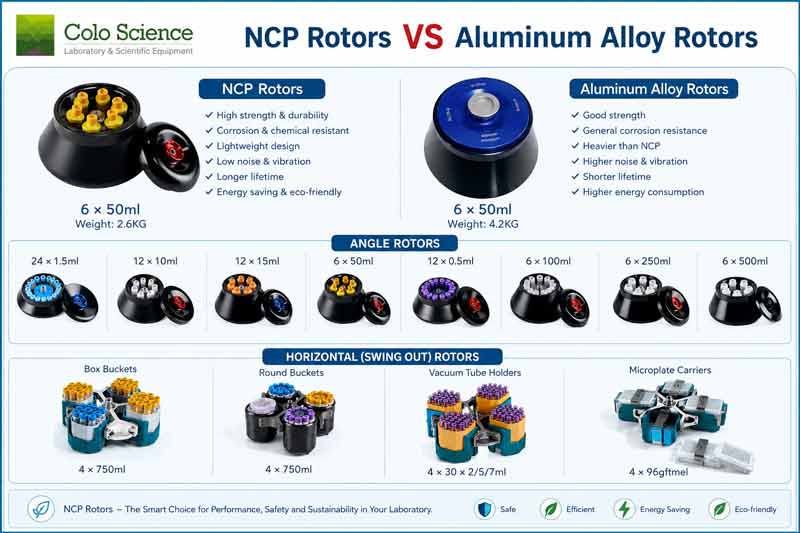
From material to laboratory value
The advantage is a chain of engineering relationships.
Composite architecture
Reinforcement, matrix and rotor geometry are designed together.
Lower mass
Less rotor weight must be handled and set in motion.
Lower inertia
The drive may operate with less rotating mass for the selected profile.
Practical workflow
Rotor exchange, cleaning and configuration changes can become easier.
System value
Performance is judged with RCF, capacity, safety and lifecycle—not mass alone.
Transparent comparison
NCP composite and aluminium rotors each require disciplined selection.
| Selection factor | NCP composite rotor | Aluminium-alloy rotor |
|---|---|---|
| Weight | Typically lower for a comparable configuration; easier to exchange and handle. | Generally heavier, with familiar conventional construction. |
| Material behaviour | High strength-to-weight potential depends on reinforcement, matrix, geometry and validation. | Established isotropic metal properties and long use history. |
| Corrosion | Not subject to conventional aluminium corrosion; chemical compatibility still must be confirmed. | Protective surfaces require care; pitting and corrosion are inspection concerns. |
| Dynamic response | Lower inertia may support efficient acceleration and braking in the complete system. | Higher rotor mass can require more drive effort for the same profile. |
| Inspection focus | Impact damage, cracks, surface change and insert condition according to manufacturer guidance. | Corrosion, pitting, scratches, deformation and coating damage. |
| Final decision | Always based on approved centrifuge compatibility, working RCF, tube or plate format, load, chemical limits, cleaning method and service rules. | |
COLO Science selection method
Technology translated into a usable laboratory configuration.
1. Start with the method
Define sample volume, tube geometry, target RCF, temperature and required throughput.
2. Build the rotor chain
Confirm centrifuge → rotor → bucket → adapter → consumable compatibility.
3. Evaluate operating reality
Include handling frequency, cleaning chemistry, balancing, cycle tracking and inspection.
4. Document the configuration
Align quotation, model codes, accessories and operating limits so the delivered system is unambiguous.
Technical position: composite does not mean maintenance-free. Only the rotor manufacturer defines permitted cleaning agents, temperature limits, sterilisation methods, inspection intervals, maximum cycles and retirement criteria.
COLO Science · informed technology selection
Do not choose a centrifuge. Engineer the right separation system.
We can help compare rotor material, capacity, tube format, working RCF, refrigeration, handling, cleaning requirements and documentation for your laboratory workflow.